

 Search
Review of Noir Deductive Mystery Game Black Box Edition
Players: 2-9
Playing Time: 15-60 minutes.
Summary of the Components
Noir is a card game that also contains a small set of cardboard tokens.
 |
Quality: The cards are all thick, sturdy, linen-textured cardstock, while the tokens are similarly thick and linen-textured. 5/5.
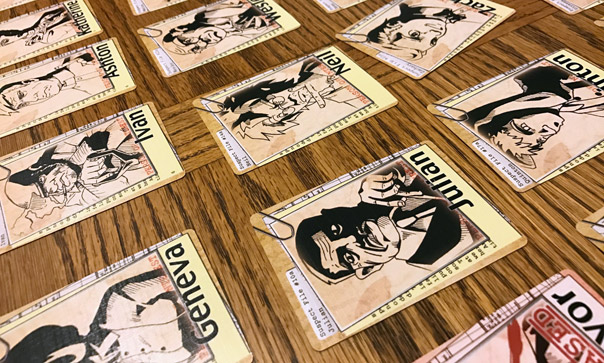
Beauty: Unfortunately, the artwork on the cards is all plain black and white artwork that feels somewhat amateurish. The tokens also have very plain iconography, and in fact it's a little hard to figure out which tokens are intended for which purposes. 2/5.
Usability: The main usability element of the game focuses on pattern matching, as you correlate secret evidence cards to open suspect cards laid out in a grid. Unfortunately, this isn't particularly easy to do. More than once I spent a long time trying to match a muddy black-and-white piece of artwork in my hand with the same artwork on the table ... all while not revealing where I was looking.
However, the game also has one very nice piece of usability: each of the six games has slightly different actions, sometimes different for different players, and there's a full deck of cards that provides each player with their own list of actions available to them. 3/5.
Theming: Noir is primarily an abstract deduction game of moving cards around in a grid. It doesn't really come off as noir, though the individual games, focusing on killers, spies, thieves, and the mafia do all lightly touch upon that category. 3/5.
As a whole, Noir is an average production, with great components and unfortunately subpar artwork. I've given it a "3" out of "5" for Style.
Summary of the Gameplay
Noir is actually a set of games that all have the same basic premise and mechanics. In each, the game begins with a grid of suspects being laid out. Each player is then given a secret evidence card that reveals who they are on that grid.
During his turn, a player can take certain actions on the grid to affect cards that they're adjacent to, and he can also "shift" the grid by pushing a row or column so that the last card falls out of the grid (and is then put back in the first space). The object of shifting the grid is either to get your character closer to certain people or objects or to obscure your position. Many games also allow for more widespread canvassing, to reveal if a character is within a certain area.
The six games are:
Killer vs. Inspector (2 players). One player kills adjacent characters or disguises to change his identity; the other accuses adjacent characters or pulls cards to exonerate them. The inspector tries to accuse the killer; the killer tries to kill the inspector or 14 innocent victims.
Hitman vs. Sleuth (2 players). This time, the killer has a list of specific people he wants to kill.
Spy Tag (3-6 or 8 or 9 players). The players are all trying to capture each other. Enough captures, and a player wins. With six or more players, teams count up their "trophies" to see who wins.
Master Thief vs. Chief of Police (2 players). A thief tries to steal adjacent treasures while a police chief tries to catch him.
FBI vs. Mafia (6 or 8 players). In equal teams, the mafia tries to kill suspects, while the FBI tries to catch them. Different special roles for different players provide unique actions.
Heist (5-7 players). A team of thieves tries to crack four safes (each of which requires extreme coordination) while a chief of security tries to catch them. Special powers for the thieves gives different players unique actions (and also escalates the game, as they get better later on).
Relationships to Other Games
The hidden-on-a-grid games are a fun alternate take on hidden identities. Exposed (2016) is another recent game that uses the same core idea.
The Game Design
This review is based on Actual Play of the Spy Tag and Heist games, plus consideration of all the rules.
The core mechanics of Noir are clever and interesting if a little simplistic. The ability to slowly deduce where people are based what they've done is well thought out — though it's easy for the data to get overwhelming quite quickly. The ability to slowly move rows and columns is also interesting, both because it allows you to escape persecution and to get to the places where you need to be.
If I were going to rate the Substance of Noir solely on those core mechanics, I'd probably give it a "3": average but not outstanding.
However, where the game seems to really excel is in its team mechanics. This creates interesting new dynamics. First, you have the need to figure out where your own allies are. Because, if you can, then you can likely engage in much more effective gameplay. Second, you also need to coordinate your activities.
There are a few team-based games in the rules, of which we played "Heist", which allowed for superb gameplay among the collaborators, as we sometimes tried stratagems to work together that didn't work and sometime managed brilliant coups.
On the basis of this strong team-based game (and my assumption that some of the other team games have similar strengths), I've upped my rating of Noir to a "4" out of "5" for Substance.
Conclusion
Noir offers an interesting set of game mechanics that are used as the basis for six different (but similar) games. Some of them are a bit simple: fun but not amazing. However, there are also some team-based games, and these excel. So, if you're looking for a deductive game, and particularly one that allows for fun partnered play, take a look at Noir.

