

 Search
Review of Orléans
Playing Time: 2 hours
Players: 2-4
Summary of the Components
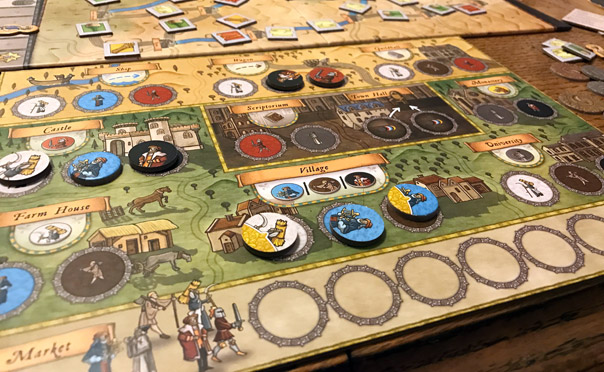
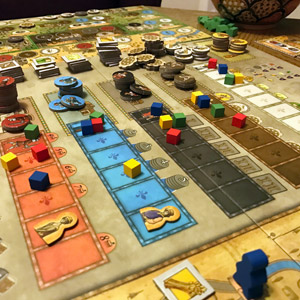
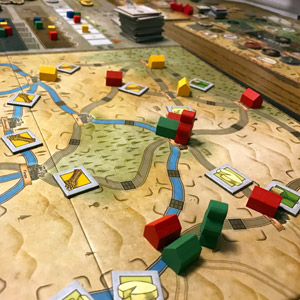
Orléans comes in a bookshelf box absolutely stuffed with components, including: a cardboard map and player boards; cardboard tokens, characters, and tiles; and some beautiful felt bags.
 | |
 |  |
Quality: The cardboard components are all top quality. I've actually seen the character tokens start to get worn in some sets, due to swirling them around in the bags, but I think that reflects the wear and tear of the gameplay, not a problem with the components. 4+/5.
Beauty: There's a ton of art by Klemenz Franz. Some of the work is pretty plain, such as the main board, but that's understandable because there needs to be lots of space for other components. Where Franz has more space to stretch out, such as the place tiles, his woodcut-style illustrations really shine. Overall, his work is beautiful to look at. 5/5.
Usability: The main board is quite complex, featuring six character tracks and a development track that all do different things and give you different rewards at different times. Each player board has spaces that enable various actions and additional place tiles provide even specialer actions. There is simple iconography on all these tracks, places, and other spaces that makes them easy to setup and to use. The game helpfully even places rules like the end-game scoring off in this corner of the board. The only iconography that's at all challenging is on the event tiles, but once you read through the six different events and what they mean, you should have no trouble deciphering them during play. 5/5.
Theming: The theme is clearly medieval, and that comes across well in the artwork, in the characters, and in the places. I couldn't tell you why it's Orléans specifically (other than the fact that it's on a map of France). Nonetheless, the theming generally feels evocative. 4/5.
Overall, Orléans is beautifully produced, beautifully illustrated, and easy to use. It also gives you great value for your money with tons of stuff. I've given it a full "5" out of "5" for Style.
Note: There is also a Deluxe edition of Orléans, which was available through Kickstarter. It upgraded many of the cardboard bits to either wood (resources, characters) or metal (coins). It's generally a nicer edition of the game (though the wooden resources are pretty superfluous) and can still be found in secondary markets if you really must have it, but the in-print game from TMG comes as described above.
Summary of the Gameplay
Orléans is a multi-faceted game where you can gain points by a number of means, but especially by collecting gold, collecting goods, building trading stations, collecting citizens, and advancing on the development track.
Setup: Each player gets a bag with four characters (colored discs) in it: white farmer, blue boatsman, brown craftsman, and black trader. Each player also gets their own player board, which depicts their personal actions, plus a small cache of gold coins. Finally, each player places a marker in Orléans, on the main map-board.
The game is played out over 18(!) rounds.
Surviving the Events: Each round of play begins with an event. About half are bad (pay taxes on your goods; pay food goods or money; lose a character). Most of the rest reward you for expansion (gain gold for your trading stations; gain gold for your development track). The events are revealed at the start of the round, then occur at the end, giving you the whole round to prepare for them.
Drawing Your Characters: Each player then draws character discs out of their velvet bag. This is the "bag building" aspect of play: you'll slowly add characters to your bag over the course of play, changing your ability to do different actions. However, you'll always be drawing just some of them out of your bag, meaning there's a large random element to what you're actually able to do on any turn.
Sending Your Characters to Work: You now use your characters to take the actions depicted on your personal board. Each action tends to require two or three characters, which means that you have to draw not just the right characters, but the right combination of characters. But, no worries, you can save your characters in your market, or you can assign them to action spaces without finishing them, so they'll never be entirely wasted; a bad turn can often set up a good one.
Once all of the players have assigned their characters, they take actions, one at a time.
Most of the actions give you more characters to put in your bag, but they also move you forward on various tracks, which give you various one-time advantages:
- Farmers (white) also give you a good.
- Boatmen (blue) also give you money.
- Craftsmen (brown) also give you gears, which can be placed on action spaces to automate them, making that task require one less character.
- Traders (black) also give place tiles, which are new, better actions that you can take.
- Scholars (gray) also advance you on the development track.
- Knights (red) also increase the number of characters you get to draw each turn.
Meanwhile, the gray scholars open up an action that advances you on the development track and another that lets you hire monks (yellow), which are wild cards that can be sent to any action space.
The Town Hall. The last action space on the player board is the town hall. This is what lets you get rid of characters from your bag, by sending them off to serve on stultifying councils. You also get a a few coin for taking this action.
The Buildings. The buildings that you can earn when taking traders give you a variety of private actions, including: taking goods, earning development, earning coins, drawing more tiles from your bag, substituting required characters, avoiding events, taking gears, and sending characters off to the council quicker. They help you to define a strategy for yourself.
About Citizens: Citizens are scattered about the board. They're awarded to players for being the first to get to certain places on the tracks and for completing the councils through the Town Hall. They're worth points at the end of the game.
What You Do: So what do you do during a game of Orléans? A little bit of everything. Early on you may worry more about what characters to take, but as the game advances you increasingly focus on the advantages their tracks give you.
Beyond that, you'll be paying attention to what gives you victory points. Some players focus on gathering goods or coins, which can score on their own, while others will advance their trading houses and development in lock-step. The place actions can help to define your strategy, because their little advantages can point you toward a particular strategy.
Ending the Game: At the end of the game, each player earns points for their goods and their coins. They then add up their citizens and trading stations and multiply that by their rank on the development track (meaning that you have to do well on both to take full advantage of this scoring!). The player with the most total points wins!
Relationships to Other Games
Orléans is a bag-building game, which is a recent category of games derived from the deckbuilding games that kicked off with Dominion (2008).
Though it's been called worker placement, it's decidedly not, since contention for actions is a core element of that gameplay, and there's no competition for your actions in Orléans.
The Game Design
The core mechanic of Orléans is fascinating, thanks to its combination of bag building, bag drawing, and actions that require multiple resources (characters) to activate. This allows players to approach the game from a strategic point-of-view (building the bag that you need) and a tactical point-of-view (doing what you can with the draws that you get). Yes, there's luck in it, but if that offends you, you can mitigate your luck using certain buildings or the yellow monks.
The variety of paths toward victory is equally fascinating. Do you want to automate actions? If so which? Do you prefer to give yourself better actions? Do you go for goods and coins or do you dive into the trading halls + development strategy. There perhaps isn't as much diversity of strategy as you'd think; everyone needs to do a little bit of everything. However, while doing that, each player is likely to excel in one particular niche of the game, giving it variety.
The game is relatively solitaire, but there are some points of contention: the characters will run out over the course of the game, and the last few of each type will be hard fought. Players will also compete for goods on the map. This helps you to ensure that you remain aware of the other players will still giving you plenty of time to pursue your individual fun.
As a whole what really shines forth in Orléans is its density. Each player will have a variety of choices every turn and can push their own advancement in the game by a variety of means. It's a game that rewards careful thought and careful play. Though it can run up to two hours, it feels like it remains fresh throughout.
When you add together the excellent gameplay of Orléans and its originality, you get one of the top releases of 2015. I've given it a full "5" out of "5" for Substance.
Conclusion
Orléans is a dense game of building up your position in the game and then using those advantages to better yourself even more. It's original and innovative while also being dense and thoughtful. It's one of the best eurogames out in recent years and won't be quite like anything else you've played.

