

 Search
Review of Guilds of London
Players: 2-4
Playing Time: 1-2 hours
Summary of the Components
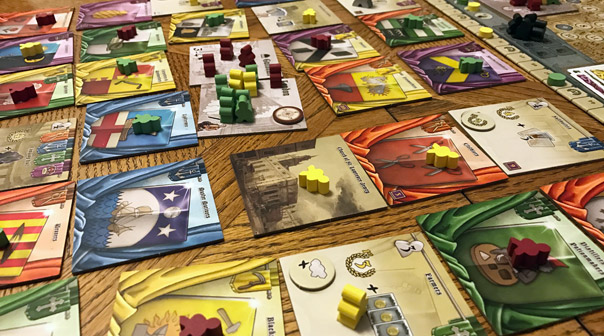
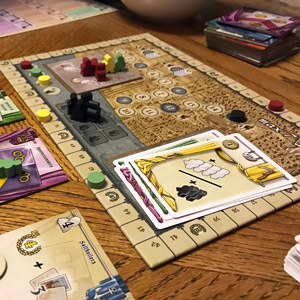
Guilds of London comes with: cardboard scoreboard and tiles; lots of very teeny meeples; linen-textured cards; and a few other cardboard and wooden bits.
 | |
 |  |
Quality: Everything is well-produced, with the cards being especially notable for their sturdiness. 4+ out of 5.
Beauty: The game generally has good graphic design. The fronts of the tiles, which make up the board, are a bit plain, but the backs are quite beautiful. 4 out of 5.
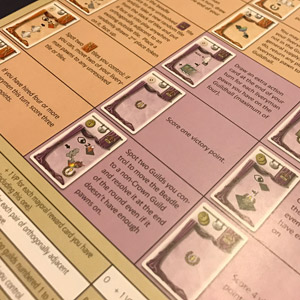
Usability: Unfortunately, Guilds of London has multiple and notable usability problems. The biggest issue is the iconography: specifically, the iconography for the special powers on the cards. It's often nonintuitive, and worse it's sometimes inconsistent (e.g., an icon that means end-of-your-turn, but sometimes becomes end-of-the round). The designers clearly knew that the iconography was somewhat challenging, so they produced a quick-reference card. Unfortunately, it tries to save space by just showing one instance of each power, so often cards aren't in the right section and don't show the right colors, which makes them very hard to reference. By a second game, I could still only suss out 75% or so of the iconography without a reference, and I'm an icon-whisperer. Most of the players in both games were frequently lost, to the point that this is almost a show-stopper.
The mayoral reward card icons are even worse, on average — which is a big problem because players will often look at a few of them right in the middle of their turn. Fortunately, they have a more comprehensive and precise reference.
The board also gets very muddy very quickly. It's hard to tell which tiles are in play and which have been scored. (I finally came up with the idea of laying down meeples on scored tiles, and that mostly helps.)
Some of the graphic design work did come out OK. It's pretty easy to figure out how the tiles score, and there is some consistency to the icons once you figure them out, but as a whole this game's usability will cause problems every time you play it with new or inexperienced players. 1 out of 5.
Theming: The guilds of London could have been a pretty cool theme, but their names are almost unreadable, and you don't get much of an impression of what they are until the tiles are flipped over. 3 out of 5.
Guilds of London is a well-produced attractive game that's unfortunately held back by a very hard-to-understand iconography that's not helped enough by its reference cards. That keeps this game's Style down in the average "3" range.
Summary of Play
The object of Guilds of London is to earn the most points by taking control of guilds and gaining mayoral rewards.
Setup: The game begins with the guilds of London being setup: a guildhall is placed in the middle of the board, and then it's surrounded by several guild tiles. Each player gets to place a few meeples ("liverymen") in the guildhall and also gets several cards.
Taking a Turn: The gameplay of Guilds of London is all about the cards. A card can be used generically to move a meeple from a player's supply to the guildhall. Or, it can be used specifically to move to a colored guild that matches the color of the card. Or, the card can be played for its special power.
Card special powers can do a variety of special things. They can bring extra meeples to the guildhall or move them among the tiles. They can move meeples to the plantation. Perhaps most importantly, they can give extra card draws (usually at the end of the turn). Many of these special cards have a cost: one or two cards must be discarded to pay for them.
At the end of his turn, a player draws two cards (plus bonuses given to him by special powers).
Ending a Round: When all the players have gone, the guilds are assessed. Each has a "majority" value, which says how many meeples are required to cause scoring to begin for that tile. If this occurs, the player with the most meeples gets a big reward and the player with the second most gets a (usually) smaller reward. There is a lot of variation among the first-place rewards, which is what makes the game interesting.
The tile is then flipped over to show that it's been scored. The winner gets to leave one meeple on its as a "master". This breaks adjacent ties and can give extra points at the end of the game.
Negotiation. Players may gain special "neutral" meeples either through card play or tile victory. These meeples can be used to replace opponent meeples before scoring begins, possibly affecting who controls the tile.
Ending a Growth Round: Some rounds are marked as "growth rounds". At the end of these rounds, two other things occur. First, the plantation tile is scored. This is a hard-to-get-to space that accessible only through special powers. It scores high points, but players lose some of their meeples there afterward.
Ending the Game: The game ends after a set number of rounds. Players now get extra points for adjacent masters on the board and they also earn points for mayoral rewards. These are special bonus cards. Players got one at the start of the game, and may have earned others through majority-control. The cards give victory points for meeting specific conditions (like controlling certain numbered tiles or certain colored tiles or having cards at the end ...)
Adding up the points scored during the game, the linked master points, and the mayoral reward points determines a winner!
Relationships to Other Games
Guilds of London is a classic majority-control game, a field that's best-known for the super-classic El Grande (1995). There aren't as many majority-control games being published today as there used to be, but it's still an interesting mechanic. Guilds of London nicely expands the field with its one-time scorings that go off when enough meeples have been placed. It also offers a nice variety of rewards (not just points) and an ever-changing field of majority-control spaces.
The Game Design
Guilds of London is an interesting and thoughtful game design that combines several good mechanics.
The first is its multi-purpose cards, an idea kicked off by San Juan (2004) and Race for the Galaxy (2007). As in those games, you can use cards for special powers or to meet costs (either for playing other cards or for moving meeples on board). This allows players to see a larger range of cards for possible use, reducing randomness.
With that said, Guilds of London still can be pretty random. A number of cards (especially, the ones that allow for the draw of extra cards) feel like they're much more powerful than the others, but you might not see them for turns at a time. Meanwhile, the large count of cards that you draw (combined with the bad iconography) can cause serious analysis paralysis (AP) problems.
The majority-control is of course the core of the tactical play. You have to assess whether your meeples might be outnumbered by an opponent of if you're playing just enough to assure that someone steps up to earn second-place points. Alternatively, you can try to pick up second-place points either by leaping into nearly finished guilds or by laying down just a single meeple, hoping someone will come along to do the heavy lifting for you.
The dynamic board makes the majority-control even more interesting. Every few rounds you get to see new opportunities (and have to figure out how to take advantage of them). Meanwhile, the play always changes dramatically from game to game, as different guilds will come out each time.
Guilds of London is definitely a gamer's game. The wide variety of choices will probably keep casual players away. But as a gamer's game Guilds of London is interesting and not quite like any other majority-control game I've played. I've given it a "4" out of "5" for Substance.
Conclusion
The main factor holding Guilds of London back is its iconography, which is hard to figure out, badly referenced, and likely to challenge new players trying to play the game. If you can get past that, and particularly if you can get the game to the table with a regular group of players, then you'll have an interesting, attractive, and unique majority-control game to play.

