

 Search
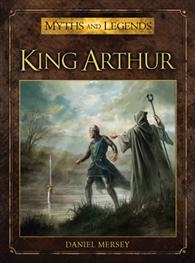
A Bit of History #54: Review of Osprey's King Arthur

A Bit of History
Finished? Right then, let's get this review started. King Arthur is eighty pages of beautifully illustrated text that covers three main views of the Arthurian legends, the Medieval Arthur, Celtic Arthur, and Historical Arthur. This book is not a simple retelling of the hundreds of thousands of words written on the subject, but a survey of the most important sources and analyses of the Arthurian legends. There are some tales retold, most notably a summary of Malory's Le Morte d'Arthur, but for the most part King Arthur is an overview rather than a deep source.
This was a good approach to take, for in a mere eighty pages you cannot begin to retell all the legends, tales, modern reimagining, historical hints, and other assorted media that makes up the massive body of work that surrounds Arthur, King of the Britons ("King of the Who?", alright, for the last time, no more Python quotes). Fitting all of this into one text would be a monumental task, and an unprofitable one. How many people would buy a 100,000-page book? Who would carry it? You would need someone to turn the pages for you, that's for sure.
Where King Arthur really excels, and this goes for all Osprey books I have ever read, is in the art. Here we have a combination of artwork from various historical periods going back to the 5th Century, with a fair amount of material from the Arthurian revival during the Victorian Era, as well as more modern works. As is usual with Osprey publishing, there are full one and two page color plates commissioned especially for this work. These are a great resource for inspiration, as well as information about historical dress, weaponry, and armor. King Arthur does not disappoint in this regard, and I heartily recommend it based on the art alone.
 Medieval Arthur
The bulk of King Arthur deals with the Medieval Arthur of legend and literature. This Arthur might be the one most familiar to readers, for the works of Chrétien de Troyes and Sir Thomas Malory are by far the most famous. This chapter deals with these two luminaries and their writing, but delves deeper to discuss the Arthurs of Geoffrey of Monmouth, the Vulgate Cycle, and others. For those unfamiliar with the work of Mallory, a short synopsis, or at least as short as a synopsis can be (at around fifteen pages) is given. From this section alone an entire campaign can be made, even if you do not read Mallory or Chrétien de Troyes yourself, though you would be doing yourself a disservice if you never explored these two authors.
Celtic Arthur
Less well known than the Arthur of Medieval legend and literature is the older Arthurian cycle that hails from Wales, Cornwall, and Brittany. In addition to Arthur, several other characters from the medieval cycles appear here as well. This should be no surprise, for in the Celtic Arthur are the roots of the latter Medieval Arthur. However, this Arthur is rather different. The Christian influences are lessened, ideas of chivalry are absent, the adventures do not involve a round table or knights, but Arthur and his warband. Also, whereas the Medieval Arthur ventures several times into Continental Europe, the Celtic Arthur generally does not, and when he does it is to Brittany, a nation in the Celtic sphere. Also, Arthur is not always, indeed rather rarely, depicted as a king, but instead a chieftain or warband leader. Campaigns using this Arthur have the freest reign, as even when these legends occurred is an open question. Some of them might even be pre-Roman legends that have been repurposed as part of the Arthurian Cycle, or even ones that have had Arthur added by latter authors.
Historical Arthur
This brings us to the most controversial question in Arthurian matters, was he real? King Arthur does not come out and say it, but it is deeply suggested that there was no real Arthur, at least not one as the Medieval and Celtic Cycles portray him. Several possibilities are brought up, and dismissed with sound logic and references to primary and secondary sources. Of all the sections of this book, this is the one that is the least useful to role-players, for it is more a scholarly discussion of the topic. There are fewer hooks to build upon, though some of the artwork is extraordinary and inspirational.
Playing King Arthur
Before you can start considering what system you are going to use for your Arthurian campaign, you need to think about what Arthur you are going to use, and what mood the campaign will have. While it is possible to run any of the three Arthurs using any mood, some lend themselves well to specific styles of campaign. The Historical Arthur works best in either a pulpy high action mode or a gritty and realistic style. Celtic Arthur can go gritty, but can also take on a mythical quality, especially if you play around with the idea that Arthur's tales date to a much earlier time. Celtic gods and goddesses can appear, heroes from other Welsh, Irish, Scottish, or Breton tales can guest star, and the whole campaign can have very high magic feel. I have found that Medieval Arthur works best in a high fantasy style with lots of fairies, talking beasts, evil sorcerers, and shinning knights.
Sadly there was not time to put together a short campaign, our group was too busy playtesting material for Rocket Age (episodes for the pdf series and new species, traits, and equipment for Heroes of the Solar System). However, I do have some anecdotes to share from several Arthurian campaigns I have taken part in over the years. I have used GURPS, Advanced Dungeons and Dragons, 2nd Edition, BRP , and of course Pendragon to run these games. Of these systems, Pendragon has been the best fit, which should be no surprise to anyone. Most of the Arthurian campaigns I have ran or played in have been based on the Historical or Medieval Arthur, though one based on the Celtic Arthur sounds like a lot of fun. In fact, I might just adapt some of the Celtic legends to a side plot that is forming in our Traveller the New Era campaign. One of the PCs is a barbarian from a planet that has a strong Celtic vibe, and the party might just need to take their far trader there in order to help save the planet from being conquered by a pocket empire that serves as the main rival for the campaign.
Using the Medieval Arthur as a base, most campaigns I have played have chosen a part of the story as the setting, such as the reign of Uther, Arthur's first years, the height of Camelot, or the Grail Quest. One of my favorite game sessions was set during the height of Camelot. The PCs were newly minted knights sent out to help quell rebellion in some of the outlying baronies. While assaulting a besieged rebel baron castle, the party managed to lead the vanguard through a breech in the outer walls and into the town. Street fighting became brutal, and most of the party was forced to dismount and fight on foot. They went through house-to-house, stable-to-stable, and privy-to-privy rooting out the rebels. Despite their heroics, the rebel knights and their lord managed to retreat through the gate of an inner wall and escape Royal justice.
At least the villains thought they had, for before the gate could close Sir Roan charged his horse (Sir Roan would become famous for never dismounting) towards the gate, used his lance to vault off the horse and slide under the portcullis as it slammed down, leapt to his feet and killed the first knights he saw. Then Sir Roan fought his way up the steps and opened the gate, thus allowing the rest of the party to swarm through.
Later in the same campaign the party had been questing for the nails used to hang Jesus Christ, and had discovered three. We had been playing the campaign for some time, and in game twenty years had passed. Our fledgling knights had risen to great heights of power and skill, but their peak had just passed, age and two decades of adventuring was starting to show. We ended a session with a cliffhanger as the knights charged on foot against an old foe, the same rebel baron as before. Five weeks passed as we waited for one player to be able to make the game, five weeks of one-shot games as everyone grew more impatient. Eventually we gave up and returned to our Pendragon campaign. As the GM, I ruled that the absent player's character, pushing fifty, several years of living large as a duke, all that fatty red meat, not as much exercise as he used to get, heavy armor, hot summer's day, had a heart attack and keeled over. Naturally this was the session where that player shows up unannounced and is ready to go. Sir Roan from before (now Baron Roan) pulls one of the nails out of their reliquary, offers a heartfelt battlefield prayer, and places it upon the dying duke's lips. Cue celestial music, holy light, the whole fanfare, and the duke is restored, but resorted to the body of a sixteen year old (which would actually have lower stats than when the duke was a neophyte knight). After the battle, Baron Roan tries to make himself young by driving a nail through his own hand. Naturally this did not work as planned, and the campaign split up as everyone started to fight over what should happen next, and a few PCs came to blows (one died) over Baron Roan's actions. The next week we returned to Traveller
Most of my Arthurian campaigns ran along similar arcs. Young knights start out on their adventures, gain power, and then the campaign dissolves for one reason of another. I have always wanted to do an Arthurian campaign that ran from the height of Camelot, or before, and ends with the Battle of Camlann. Alas, it has never happened. However, the memories of all these great campaigns, however brief, drive me to try again. Lady Anne the Barber, one of the greatest swordswoman in Britain who lopped off heads (she took a little too much off the top). The entire lineage of the Tallworts destroyed in one unlucky campaign (the player went through six brothers and three cousins before there was no one left to take up the title). The number of PCs slain by wild bears and boars, and the one who had the bright idea to try unarmed and unarmored bear baiting. That brief period in the 90s when we all wanted to play Picts (I blame the movie Braveheart). The failed attempt to make a sci-fi version of King Arthur's court, complete with bio-engineered Lancelot clones. Despite all this, the Arthurian legends, no matter what version of Arthur, are a perennial favorite, and one that I have turned to many times in twenty-nine years of gaming, and will likely in the next twenty-nine years as well.
Osprey publishing produces a number of titles that are great aids to campaigns using King Arthur. If you are wanting to run a Historical Arthur campaign, you can't go wrong with Arthur and the Anglo-Saxon Wars, British Forts in the Age of Arthur, Pictish Warrior AD 297-841, and Anglo Saxon Thegn. Celtic Arthur would benefit from some of the above, but also Bronze Age War Chariots Barbarians Against Rome (which includes Gallic and British Celts), Celtic Warrior 300 BC- AD 100, and The Forts of Celtic Britain (some of these might be slighting out of period, but are still good resources). Finally, for those looking for a Medieval Arthur of legend, complete with anachronisms, I would recommend the following: Knight Hospitaller 1 and 2, Norman Knight Ad 950-1204, El Cid and the Reconquista 1050-1492, Armies of the Crusades, The Knights of Christ, The Viking, and Viking Hersir 793-1066 AD (the last two can serve as sources for Saxon raiders). All of these are from my collection, Osprey publishes several others that cover these time periods, but as I have not read them I can't vouch for their usefulness (though it is likely very high considering Osprey Publishing's general level of quality).
Shameless plug time again. By the time you read this Rocket Age should be in general release or nearly there and you can order the hardcover copy. The pdf is already out, and some lucky folks managed to get the advance soft cover copy at GenCon or through pre-order. Newly available is The Lost City of the Ancients a free episode in pdf form that takes our heroes deep into the Western Highlands on Mars in search of a rumored Ancient Martian ruin.
Look to The Future

Article Info
Review of Osprey's King Arthur
2013-10-22
by Ken Spencer
An overview of the King Arthur legends.
Related Articles
Recent Articles
Column Info
by Ken Spencer
History as a source and creative tool in RPGing.
Tags: world building, history
Recent Discussions
URL: https://forum.rpg.net/api/forums/107/threads/
POST: 1{ "errors": [ { "code": "missing_scope", "message": "This request requires access to the following scope: node:read", "params": { "scope": "node:read" } } ] }