

 Search
Review Editing
Review of Unknown Armies First Edition
 Goto [ Index ] |
But I didn't buy my own copy, since I was the guardian of my friend's precious laser-proof while he went home. I ended up packing it up and storing it later however, just before I needed it to try to run a game of Blue Planet, since I wanted to use the beautiful and elegant system. So I went out and bought my own copy of it, and I thought I would review it for everyone's enjoyment, and to get it more publicity so that it sells and Atlas prints more supplements.
Anyway, on to the review itself...
Chapter One: Overview
This is the basic "What is Role-playing?" chapter that most games have, but it also gives the distinctions about the various "levels" the game can play on, Street, Global, or Cosmic Level. A nice little idea to simply delineate them out, showing strengths and weaknesses of each. The chapter also gives a brief idea of what you do in a role-playing game, as well as some broad categorizations of the types of games that can be run.
Chapter Two: The Occult Underground
This is the introduction to the basic idea of the setting of Unknown Armies, the idea that people who embody archetypes well enough can actually ascend to become those archetypes. But there are only so many "slots" that can be filled, and once they are all filled, the Comte de Saint Germain, the first and the last man, walks through reality, shuts off the lights, locks the doors, and the world begins anew, built upon the composition of the Invisible Clergy, those ascended archetypes.
The chapter talks about both the major and minor forces working through the world, as well as some of the more well-known magicians (adepts) in the underground and the organizations that move through the world. Not a lot of detail, but each piece of information adds more to the mood of the game than anything else, and that mood is a strong one that permeates the entire book.
Chapter Three: Game Mechanics
The shortest chapter I have ever seen in a role-playing game, it takes only two pages to adequately describe the entirety of the game mechanics. Roll percentile dice, trying to get as close as possible to your skill rating without going over. A 1 is an automatic success while a 100 is a terrible fumble. Pretty simple. While I don't like linear, one-die systems (as I said in my Fading Suns Second Edition review), I don't mind it here because the rules also stress how rarely one should roll against the skill. Only when the outcome is seriously in doubt, as opposed to all the time as with most systems. Most of the time, the skill rating is to be used simply as a guideline by the game master to determine how long it takes to perform an action.
Chapter Four: Character Creation
This is where the beauty of the system comes out to shine, in the characters. The best character-based game I have ever seen, Unknown Armies is extremely free-form with just enough detail to keep people like me who didn't entirely warm to Over the Edge happy. You build a character in Unknown Armies by choosing your personality (some examples are given through the western zodiac), your obsession (your driving motivation) and your passions (the things which draw out your fear, anger and noble side). I really like the system for this aspect, as it puts a heavy emphasis on character motivation and personality.
The more number-intensive (but not much) section is with the stats and skills. You have four stats, Body, Speed, Mind and Soul (both emotional and supernatural). You have 220 points to distribute, and the average is 50 (on a 1-99 scale). The stats are pretty self-explanatory and simple, although Soul encompasses both magic as well as empathy and emotion. Each stat is also paired with a qualifier, a word or two describing the most notable feature of that trait, like "bulky" for Body, or "shy" for Soul.
You get as many points for skills (each of which fall under one attribute or another) as you put into that attribute. A Body of 50 allows you 50 points for Body skills. In addition, everyone gets a set of skills automatically, things like Struggle and Swimming. The skills are really innovative, you can take nearly anything as a skill, from "Shooting" or "Squeal like a girl and sissy-slap people into submission." This allows for nearly any trait to be simulated by a skill, from academic knowledge to magic to society connection.
In case that seems too abstract and confusing, the chapter gives two running examples of character creation as well as a discussion of how to control and guide skill choices. It tends to work out really well in play if people can get into the right mindset.
In addition, you get to pick on skill that relates to your Obsession (see above). Any roll you make with that skill can be "flip-flopped," meaning that you can change the number you rolled around (91 becomes 19) to either succeed where you would have failed or succeed even more.
Finally, you have to gauge your sanity on the madness meters. You can either be "Hardened" or "Failed" to Violence, the Unnatural, Helplessness, Isolation and Self. Hardened is just that, being "immunized" to that particular stimuli and failed means that you can be strongly affected by it. Paradoxically enough, you can be both Hardened and Failed to the same stimuli. As a starting character, you can choose to take as many as 3 failed marks in return for 3 hardened marks. This system is later explained in greater depth in chapter six.
Chapter Five: Combat
This chapter deals with, surprisingly enough, combat, from the basics to how to run a more cinematic combat. I tend to gloss over combat, but in play I found this to be a fast, brutal, and entirely realistic system. Furthermore, it is the game master who keeps track of wounds, so the players only have and idea about how damaged they are, they can never be sure until they black out.
This chapter has all the information on how to hit and how to record damage, all of which is based on the single to-hit roll (and doesn't involve any charts), and there is even a nice discussion of real-world gun laws, just to add to the realism of the game and give a refresher to those gamers who might forget that running around with an assault rifle is considered bad form by the police.
Chapter Six: Madness
This chapter deals entirely with sanity and its effect on the character, surprisingly enough, and explains just what it means to be hardened or failed to certain stimuli. The chapter is short, but the rules actually work very well, especially since the different stimuli are independent of each other, allowing amore accurate description of madness. While some of the stimuli don't seem to make much sense (according to the chart, I'm rather unbalanced, but then again, most people I know would say that as well), they are, on the whole, both very good and very unglamorous. This is not a game where you can murder the innocent and not be affected by it psychologically, and I like that a lot.
Chapter Seven: Magick
This is one of Unknown Armies weak points as well as its strong point. The magick system is simple enough, but there is just something lacking in them. Unlike the general skill rules, they don't have the same vibrancy. That is not to say that they don't work, however, they work fine and have such an interpretive elasticity that you could run either a "magick is rare and weak" game or "magick is the key to all power and is stronger than you can imagine" game, depending on how you give out charges, or magickal energies. The three Laws of Magick, however, are very evocative. The Law of Symbolic Tension states that all magick arises from some sort of paradox. The Law of Transaction is basically the statement that you only get out what you put in. Finally, the Law of Obedience forbids an adept to study more than one school of magick. Since magick in the game is based around obsessions, it is hard to being entirely devotedly obsessed with two things.
One neat thing about the game is the idea that anything can become magickal. Like Mage: the Ascension in that respect, it doesn't matter what you're doing so much as how you feel when doing it. On the other hand, it is different in that magick is no where near so versatile, and two mages of differing schools cannot duplicate the others powers. It is in the schools that the Unknown Armies once again gains its feel. With evocative spells and effects, the various schools seem natural. The example schools in the book include Cliomancy (History-based magick)m Dispomancy (Alcohol-based magick), Entropomancy (Entropy-based magick), Epideromancy (Flesh-based magick), Mechanmancy (Clockwork-based magick), Plutomancy (Money-based magick) and Pornomancy (Sex-based magick). None of the schools actually work out quite the way you would expect them to, but they are all interesting indeed.
Chapter Eight: Playing the Game
This short chapter is on how to play a character, surprisingly enough. I have seen few basic books that include a section on how to really get into a character's personality in the game, and it was a welcome read. Not ground-breaking, but the comments on Passions and Sanity were very useful.
Chapter Nine: Campaign Creation
This chapter is devoted entirely to planning out the campaign. As with most other chapters in the book, it is not long, but it is one of the better done "How to build a plot" chapters I've read. There is the discussion of theme that I've grown accustomed to reading in White Wolf books, but it also have a section on how different games focused on different organizations and goals will feel, as well as tips on staying within the theme. A nice chapter that tries to show how to look at an idea from many angles and forge a better game from it.
Chapter Ten: Running the Game
At about this point in the book, I figured out that the authors like having lots of chapters, because most books combine this and the previous chapters into one. It doesn't really matter that much, though, the material is still here. This chapter focuses on the concerns that game masters have while running the game, from skill checks to combat actions. There are a few tips to remember and refresher lists about the system, as well as information on drugs and alcohol, how to run magick, tricks that can be used to better the game, how to build NPCs and the best way to narrate the story. Like the previous chapter, another useful section, nothing staggering, but nothing useless either.
Chapter Eleven: the Unnatural
This chapter covers those beings and phenomena that are truly magickal in nature, from astral parasites to demons to bizarre and inexplicable "spirits." In Unknown Armies style though, everything is neither as you expected nor as it seems, and everything is a damn sight more interesting. Demons are the souls of the dead desperate to get some time to live again, but not necessarily evil. Lycanthropes are bizarre creatures possessed of a dead soul and an animal spirit. Unspeakable servants are things crafted from their master's eye and sacrificed animal parts. The description and implications of the monsters reminds me of Call of Cthulu and Delta Green, and adds another layer of mood to the game.
Chapter Twelve: the Unexplained
Here the book looks at those events that are not magickal in nature, just unexplained.Things like spontaneous combustion, cattle mutilations, UFOs, vampires and zombies are all completely explainable through science, they just haven't been examined yet. I like the creative ideas that the authors use to explain all of these, but I was somewhat disappointed that vampires and zombie had been taken from the realm of the mystical into the world of the misunderstood. It is just a personal like for the two, but I would have preferred them to be in the previous chapter. It is not a difficult switch to make though, so I cannot count it as a game flaw.
Chapter Thirteen: Archetypes, Avatars, and Godwalkers
Here is where Unknown Armies' brilliance shows through again. Some of the archetypes that have ascended into the Invisible Clergy are given as examples here, as well as just what one must do to become an archetype yourself. As you walk down the path of an archetype, you become an Avatar of that ideal, and may eventually ascend to embody it yourself. The closer you are to ascension, the more power you can draw upon, emulating the abilities of your archetype. For example, the embodiment of the Fool gets luckier and luckier as he walks his path until you are nearly immune to harm. This system of emulation and power through belief reflects the magick system in many ways, and sets much of the mood for the game. Unknown Armies is not a game for apathetic characters, it is a world filled with the driven and the obsessed.
Chapter Fourteen: Artifacts
Chapter fourteen deals with the artifacts and items of the occult underground, from something like the legendary Hand of Glory to the Naked Goddess Tape, the basis for the entire Pornomancy school of magick. Short like all the other chapters, there are some very interesting artifacts here, like the Magic Bullet that killed JFK or a book that possesses those who read it, granting its author a form of immortality.
Appendices: Supporting Cast & Intro Scenario
These two appendices contain sample characters and a short introductory adventure. The characters are all nice and varied, and include many of the movers and shakers in the occult underground, as well as information on some of the larger organizations. The adventure is good enough, but not much of an introduction. Much of it will fly by those unfamiliar with the setting, sadly.
A resounding recommendation
This game is beautiful. While the system is not for everyone, since it is extraordinarily loose, it works well, especially in a game with the kind of mood that Unknown Armies holds tight to. I have a few problems with the game as presented (like how everyone seems to know about the Invisible Clergy when they seem like they would more naturally be a Big Secret), but there is nothing major that needs changing at all. The book nearly drips atmosphere and mood, and my biggest concern when running the game would not be "What do I need to change to make it good?" but "How can I make sure that the game lives up to the book?"
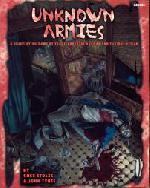
The appearance of the book itself, however, somewhat belies its wonder. The cover is nice, but the interior art is generally poor to okay, with a few really nice images. Most of it sets the mood reasonably well, though, and that is what is important. The layout is simple and workhorse, nothing great or bad about it, and typos weren't an aggravating annoyance. The book just looks simple, like any other small-print game. Once you actually read it, however, you will realize the gem you have in your hand. Unknown Armies handles its subject matter with more skill than almost any other game I have seen, it reminds me of Delta Green in many ways...
Style: 5 (Excellent!)
Substance: 5 (Excellent!)

