

 Search
Review Editing
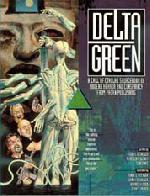
Review of Delta Green
 Goto [ Index ] |
The opening fiction is very well done, and sets the mood for the book quite well, I think.
The book starts off with an overview of itself, telling readers what is where. Giving a passing familiarity with the major faction players so that the reader is not lost later in the book was nice. There is also a look at the Mythos in the 90's, describing what the monsters and things are doing now. The only complaint I had about it, and something that is never addressed later in the book, is that Delta Green, despite its size, still requires good familiarity with the Mythos already, something that I lack. Because of that, much of the impact of the book was lessened, and I think I missed a great many references.
There is also a somewhat in-depth look at the fungi from Yuggoth, or the Mi-Go if you prefer. They are surprisingly alien aliens, very well done in that respect. Alien in biology and psychology, they were a refreshing change from "men in suits" which fills much of the material (fiction or games) with aliens out there.
The next chapter is on Delta Green itself, from its history to its modern day operations. It is here that some of the major strengths of the book really show through, because the writing is excellent and the detail is more than welcome. Instead of presenting some nebulous conspiracy that did "stuff," we get Delta Green, a tiny conspiracy that grew out of a once-legitimate government agency. The history provides a realism lacking in many products lack. The detail and scale presented makes suspension of disbelief amazingly easy. This is not a fantastic game, it is a realistic one, despite the presence of Things Which Must Not Be Known. Delta Green has had its ups and downs and lefts and rights, and its lack of complete knowledge as well as less than stellar track record keep the organization from falling into two dimensional heroes.
Following that is the information on Majestic-12, the government organization presiding over extraterrestrial matters. Delta Green has the almost singular distinction (shared only by the Man Kenneth Hite) of being able to take Roswell, alien abductions and the greys and not make me either want to laugh out loud or throw the book away in disgust. In addition, there is enough historical information here to choke a horse, and it was quite a read for someone like me who would not know Majestic-12 from Majestic-666. This is a must-have for anyone running any kind of "alien encounter" or "government coverup" kind of game. Again, as with the information on Delta Green, Majestic-12 is presented in a wonderfully believable and plausible manner. MJ-12 is a group of people, some doing good, some thinking that they are doing good, and some just in it for themselves. This is exactly the kind of work and thought that should have gone into the Technocracy in Mage: the Ascension. Delta Green is a great source for those who want to develop the Technocratic Union beyond the Borg.
Following that is the Karotechia, the remains of the Nazi occult tradition from World War II. Again Delta Green manages to pull off the almost impossible by making Nazis mages into something interesting and even frightening. The short section details their history and goals, and does not just transplant the old regime into modern times, it allows it to grow. An organization staffed with terribly interesting characters and with an "obviously evil" agenda, the Karotechia manage to be interesting and compellig.
Saucerwatch follows that, and while Saucerwatch is a public organization staffed completely by people who have no idea about the "Truth" behind the greys and the rest of the Mythos, it does serve the very important role of showing the ramifications of little ploys higher up in The Conspiracy. Information trickles down to Saucerwatch, and as such, they are a great holder of examples of Mythos activity (in their records) as well as looking at just how Majestic-12 is changing the world.
The Fate is the criminal organization in the world, and it takes up the next chapter. Manipulating nearly all other crime syndicates, especially in New York, the Fate are incomprehensible agents in the Mythos. They serve as much to show just how the Mythos has evolved from the earlier part of the century as they are power players in The Conspiracy.
This is the half-way point in the book, but instead of having more chapters to get through, all that remain are appendices, and lots of them. Appendices A and B are the bibliography and the surprisingly interesting glossary. Appendix C details security classifications within the U.S. government, explaining how to create realistic "secret documents" (of which several examples are supplied) as well as explaining just how security works. Appendix D are those examples, the modern day tomes of the Mythos. Appendix E consists of Adventures. I skimmed more than read this chapter, but it was quite well-done on the whole, with open, flowing adventures that do not require a rigid schedule. Very nice for introduction into the game or a continuing campaign. Appendix F looks at 34 important federal agencies, providing short histories as well as operational proceedures. Appendices G, H, and I are for the players, primarily, dealing with character creation, skills, and new equipment.
Overall, Delta Green is a superb game, its only flaw being the fact that it is inherentyly a supplement, not a full-fledged game itself. You need a reasonable understanding of the Mythos to fully appreciate the game as it is, but even without that the lessons on conspiracies and how to run them makes the book immensely useful. This is one of those books that can be used for virtually any game, and the comparatively tiny amount of rules makes such porting even easier. The only other problem I had were the infrequent asides about how to use one character or another. "Keeper Advice" is scattered throughout the book, instead of being centralized. The breaks and comments on how to use a character or what a group was intended for were very annoying and quite disruptive of the overall flow of the book.
Also, for one mysterious reason or another, I could not shake the "Unknown Armies feeling" while reading Delta Green. Neither is a copy of the other, but their writing style and attention to detail and inherent moods are so incredibly similar that I cannot read one without thinking of the other. Fans of one should definitely check the other out.
Style: 4 (Classy and well done)
Substance: 5 (Excellent!)

