

 Search
Review Editing
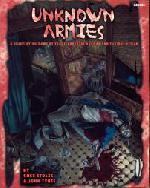
Review of Unknown Armies First Edition
 Goto [ Index ] |
Unknown Armies
Summary
Unknown Armies is a game of metaphysical intrigue. The fate of the universe walks right along side any naïve normal. All in all, it describes a rich setting with various levels of play, even if you are playing a beginning character. Plotlines run along the never-ending battles for a higher purpose, any higher purpose, and the means by which to attain godhood by following any path. The extremely extreme people of the universe become members of the invisible clergy, a loose term to describe the higher order of existence that is occupied by cardinal archetypes. The thing is that membership is limited, competitive, and ever changing. Which means that anyone has a shot at becoming a god and tipping the fate of the universe in some way.
This also means that anyone can dispose of a god-to-be. For many individuals in the UA setting, just having the deciding bullet or piece of advice to make sure some make it and some don’t is good enough. And others simply have their own opinions that somehow make it into the mix. All in all, for a magic-is-real and the-truth-is-out-there style of game, this one really has some genre nuts and bolts worked out.
But that is where the buck stops. Some of the mechanics that were put into this game are very insightful and realistic but others seem far-fetched at best. In average play, this one looks like an argument waiting to happen for experienced players and blank looks of “I don’t know what to do” for beginners. The genre is tight, but the basic mechanics are flimsy.
Good Points
The Genre. 100% of every person’s life can be fit into this world. Plotlines are just bursting from the pages and even the small adventure at the end is intriguing and complete. The character types are not limited by classes and provide a broad base of possibilities within the occult underground.
Their magic system is generic latitudinally, which means that different styles have similar effects at similar levels. Magic is also tied into the cosmic and local environment of the character, giving ever person with any special power insight into their world.
And speaking of systems, there is an insanity system in this book that is bar-none the most realistic and applicable I have ever found. It integrates mental strength and weakness into the same spectrum like The Call of Cthulu. But unlike the Cthulu system, this one gets down to the specific effects of different stimuli along 5 separate vectors. And everything that could be considered mental trauma either weakens or desensitizes the characters along those vectors. This lends more realism to the types of insanities the characters can fall victim to.
Weak Points
The system appears to be simple – 4 basic stats, 1 obsession, 3 passions, a short list of skills and you are on your way, right? Wrong.
The system is based upon a 2d10 system similar to percentages. But doubles are special. And you can switch your tens die and ones die sometimes. And there are a variety of factors that influence any roll. And some skills aren’t listed in the text. And the specialty perks, called cherries, aren’t well defined either (how powerful can they be?). And what happens if I want to combine magic with that?
You get the picture. The system is overly complex and doesn’t seem like it has to. In the introduction, it is stated clearly that the game was more oriented towards detailing stories, not mechanics. It is puzzling, then, why such a complex system of doing things is included.
The other failing of the system is its general naming. A good game describes and names its mechanics to fit the genre of play. D&D 3rd edition features Feats. UA features cherries? Mage Revised calls them spheres. UA calls them ____mancy (pornomancy, plutomancy, . . . Dipsomancy!?!). Call of Cthulu calls it sanity. UA calls it a madness meter? There is something lacking here. All of these elements alone would not be so awkward but together they form a chaotic vision of how this all applies. Style, therefore is lacking.
The Bottom Line
There is a lot to learn in the Unknown Armies Role Playing Game. One is the rich paradigm they create that can enhance anyone’s chronicle in any genre. Another is that system counts for a lot in the basic rulebook. Whether you are intending on having heavy handed rules like the GURPS line or very light rules like the “Rules to Live By” line, they should work in some way that makes sense. Because the rules comprise a good 50% of the text, some might not see this as a worthwhile investment. But the other 50% is prime material and not worth passing up. Like I said, the genre material here is the best. Period.

