

 Search
Review of Cthulhu City
 Goto [ Index ] |
Okay, before I go any further let me say Who Should Not Get This. Just like I don't want to try and sell a vegan on a hamburger (no matter how good I think it is), I don't like people to read through an article just to realize at the end why they might not like something. In this case Cthulhu City is very much a "GM only" sort of product; if you're playing Trail of Cthulhu (or any Cthulhu-based RPG really), reading this would only deprive your GM of a nifty resource. And if you're a GM... expect to still have to do some work. Not a lot necessarily, and the nature of the work might even be fun (as I'll try to explain below), but there is some work to be done as this is very much a book that expects GMs to do some heavy lifting. It just that it gives you some safety bars to help with that lifting.
So, with that out of the way.... Beyond this there may be spoilers! You have been warned.
Okay, so Cthulhu City is... not what I was expecting. See, I was expecting something along the lines of Al Amarja from Over the Edge: a place that was well defined and for PCs to explore and experience an abundance of already developed mysteries. And Cthulhu City is not that. Instead, you have notes, ideas, suggestions, and seeds, with the GM expected to take all these pieces and cherry pick the ones they like. How does that convey? Well, to start with Great Arkham is broken down into a collection of lightly described districts, each filled with some generic people and buildings you might find in the district, along with other people and locations specifically tied to the district in question. For example, in the University District we have laboratories, student houses, professors, and students for stock locations and characters, and Miskatonic University, the Orne Library, the University Exhibit Museum, Dr. Henry Armitage, and Councilor Clarence Engler for landmark locations and named characters.
Each location has a "Masked" and "Unmasked" description, so that if the GM wants to run things in a Mythos-heavy light or a more down-to-earth way there are some ideas pregenerated. Likewise, people are presented with options to use them as Victims (those the Mythos is destroying), or in a Sinister manner (the person is advancing the cause of the Mythos, most likely knowingly), or as a Stalwart (someone who might help the PCs in their fight). Also of note is that pretty much everything is given enough options that a GM can easily rework it to do double or triple duty. Generic buildings have their two variations, but you're also given two or three names for each building variant to use as you see fit. Generic NPCs have their three variations, but you're given four different names and descriptions to mix around (or combine). The idea here is to help GMs build the city in a kind of "pick and play", but there's also enough material to help you generate your own ideas.
I should probably mention that all of these locations and people often have ties to various organizations and cults in the city. Since this is a setting of mystery, uncertainty, and discovery, I don't think it fair to go into great detail regarding which Great Old Ones are active in Great Arkham, what horrible servitor races lurk in the shadows, or where to find connections to inhuman lands throughout the confines of this prison city. Just know that there are multiple factions operating throughout the city, and they're all pretty nasty. I mean, when the folks down in Innsmouth are reeling from losing power, you know the ones who ousted them are bad news.
Did I not mention this is a prison city? It's a prison city.
The nature of this prison is up to GMs to determine, and the book hints at many possibilities throughout the text. But the one constant is that the (N)PCs aren't expected to easily be allowed to leave; the implication is that even the odd looking folk in Innsmouth or who hang out in the sewers beneath the graveyard may be trapped as well. Or not. Regardless, the masked Transit Police are quick to turn you back with a warning, or a threat, or a mysterious chemical hose down (they have to protect people from the years-long typhoid outbreak after all!). Meanwhile, all the great movers and shakers within the city secretly squabble over the Ritual of Opening; what you need to perform it, where you need to perform it, when it can be performed, and what it does. Maybe it's actually a Ritual of Closing? Nobody (save perhaps the GM) really knows, but everyone knows it is the key to... something? But regardless, they plot and scheme and jockey for power within public view and out of it both and give GMs a good MacGuffin Device to drive stories in the city.
Calling Great Arkham a city is a bit of a misnomer perhaps. Not because it's actually a false construction on the back of a dreaming Great Old One, or a holographic simulation constructed by alien magic that's since been corrupted through Nyarlathotep's gaze, or a parasitic alternate history trying to bring "the Mad Arab" back to life. No, Great Arkham is actually a collection of several smaller towns, the eastern bay outside the city, the woodlands to the west of the city, and everything in between. It's kind of like how people talk about Manhattan being a part of New York when it's also a city in its own right. Only in this case, the various districts and history of Great Arkham are call outs to Lovecraft's country. The Innsmouth Docks are a sizable borough where the Esoteric Order keeps out converts from the Church of the Conciliator (a "Chrsitian" denomination started by John Whateley), Kingsport is a little media empire, and so forth. You don't have to be well read on Lovecraft's stories to appreciate this, but it certainly helps (and if you're playing any Cthulhu-inspired game, it's probably a good idea to read a few of his works).
The description of the city fills up the majority of the book, but there's also a 17 page adventure called "The Whisperer in the Light". It's not bad, but it's not particularly tied to Cthulhu City either. Which, fortunately I suppose, means you could easily enough export it to any urban setting. Heck, with a little work you could migrate it to Victorian or (with more work) modern settings. "What's it about?" Well, I don't want to say since players read these things too, but I will say that it feels like an adventure you could play out in four or five hours (more or less, depending on the speed your group runs through things) and it's more in the "mad science" vein than straight up Lovecraftian horror.
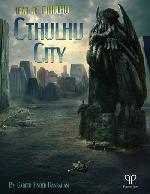
Style: The book is a nice hardback, with B&W illustrations, and an easy to read layout on glossy paper. Those familiar with other Trail of Cthulhu or Pelgrane Press products should have some idea in terms of what to expect regarding general print quality (for those who aren't familiar, it's good). The writing is easy to digest, and while there are a few (very few) typos, there's nothing that hurts the usefulness or clarity of the product. The art is generally "adequate". It's typical for recent Pelgrane Press products in that there's some pieces that are quite good, and some that make me wonder if the art budget for the book ran out and they got a friend to fill in at the last moment. But for the most part the art is just kind of there and often feels somewhat generic. Overall, this is not a book you should buy for the inspirational pictures. A special point should also be made regarding the city map. At the front (and back) of the book, there's a two-page spread map of the city. It has no key, only showcases major areas, contradicts the text in places, and leaves some stuff (like the city hydro-electric dam) completely off. I get that the city is supposed to be ill defined and many things left to the GM's imagination, but the map could have (and should have) been more useful than it currently is. If 3 is an average book, 4 is good, and 5 is something pushing the boundaries of RPG as an art (you know, the kind of book you'd loan to your non-gaming friends because it's so good just for a read or to look at as a picture book), Cthulhu City is a strong 4. More art that feels specific to this city controlled by the forces of the Mythos (as opposed to just general urban Mythos investigational art) and especially a better map and I'd happily bump that up higher.
But the real saving grace here is the tone of writing throughout the book. It'd be painfully easy to slide Cthulhu City into some sort of parody of Lovecraft's Mythos, with terrified monsters cowering in paranoid fear as apathetic citizens on their way to punch in a time clock are instead gobbled up by giant sky monsters as the masses collectively shrug their shoulders in bored apathy, but the text never goes that route. It maintains an atmosphere that is equal parts Franz Kafka, Thomas Ligotti, and Lovecraft himself, with one major addition. See, this is a city on the verge of upheaval and destruction, but its open ended nature also makes it one of hope (even if it's only in escaping the city). And I'm pretty sure I'm on the verge of becoming a Gareth Ryder-Hanrahan fanboy.
Substance: It's a 5. Easy. See, the city never clicks for me as an actual city. And while some of that is by intent and some of that is by the limits of page count, some of it is that the city never really pops alive. A major trick Over the Edge used to make its island city-nation seem more real-yet-alien was to touch on things like local customs (e.g. the hangsman nooses used as neckties and the different ways people say "yes") ; odd quirks that the entire town shares with only itself and don't really mean anything. Cthulhu City doesn't really have anything like that. Yes, there's giant black monoliths and mystery foods and organized crime in Innsmouth and mysterious Black Ships that trade with the city, but I want to know what it's like to wake up in the morning, eat your breakfast, go to work, and come home in this city. I want an idea of what life is like for someone who just tries to get by from day to day. Most of the pieces are there, but enough are missing and expected for GMs to make on their own that (for me at least) it doesn't quite work as an actual living setting for me.
And yet it's still an easy 5 for Substance.
Here's the thing, Cthulhu City is this big collection of seeds, hooks, and story ideas. Many are specific to the setting, but almost all of them could be exported outside the setting. And despite my near incessant complaining, there really is a lot (I mean a lot) of setting building going on if you want to run a campaign in Great Arkham itself. I wanted this book to be the next RPG product that expands beyond itself and defines a bold new sub-genre, and instead... it's merely a great gaming sourcebook. I know I keep harping on how it feels incomplete, and how not all of that is by design, but I have to confess that there's also a part of me that wants more of this rich, delicious and original setting specifically because what is offered is so useful and inspiring. It's like a Monster Manual or Bestiary in a way, in that I don't think anyone will like everything, but everyone should find plenty of stuff they can be happy to use.
Use in Other Games: While this is made for Trail of Cthulhu and set in the 1930's, the mechanics are fairly minimal and you could most certainly "idea mine" the book for other games. Converting to classic Call of Cthulhu would be easy, and the hardest part of using this for Delta Green is the difference in time periods. Personally, I'm toying with using it in the Strange, as an example of a recursion itself becoming a planetovore, but really it'd make a great alternative for anyone wanting to run a darker game where the Mythos is more omnipresent and visible.
Conclusion: It's good, and you should get it. Also, Pelgrane Press, you need to do a follow up volume!

