

 Search
Review of Cosmic Kaboom
Players: 2-4 Playing Time: 30 minutes
Summary of the Components
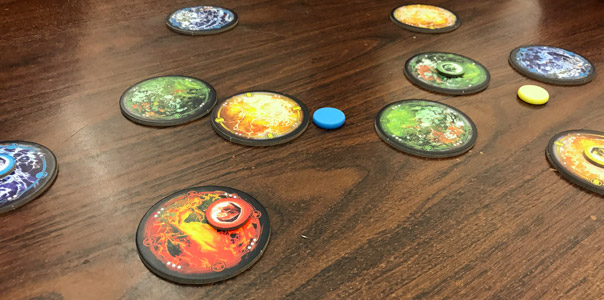
Cosmic Kaboom comes with cardboard planets and bases, cardstock cards, plastic energy cubes, and wooden spaceships discs to flick
 | |
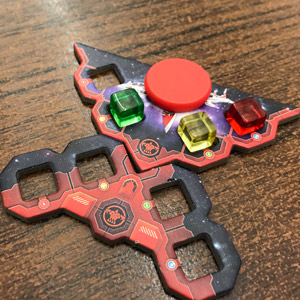 |  |
Quality: Everything is very good quality. The cardboard is thick and linen-textured, while the cubes and discs are both sturdy. The cards are medium-weight, but seem sturdy as well. 5/5.
Beauty: The various planets and bases have attractive artwork that is somewhat abstract. The cards and box cover art are all quite nice. 4+/5.
Usability: The game is quite simple, so there's not a lot of question of usability. Cubes, planets, and bases share colors, and they're easy to distinguish. Being able to hold cubes in the bases and/or cargo holds is quite a nice innovation, though when you have cubes on your base it's hard to launch your disc from that base. And that's pretty much it for usability.
The only notable issue with the game is its rulebook, which doesn't do a great job of explaining when you move between the various sorts of actions and which doesn't provide any extra reference for the cards, though they could use it. 3/5.
Theming: You're fighting to gather energy cubes to build bombs to blow up planets. It's pretty abstract, but most flicking games are. 3/5.
Overall, Cosmic Kaboom is a well produced and attractive game that could use a better rulebook. I've given it a "4" out of "5" for Style.
Summary of the Gameplay
In Cosmic Kaboom, the object is to blow up valuable planets.
Setup: Each player sets his home base at the corner of a rectangular playing space. The players then place twelve planets within that space: three planets in each of four colors. An "energy crystal" marker goes on one planet of each color.
Flicking: On his turn, a player flicks his ship-disc. If he hits an energy crystal planet, and he hasn't collected that color of crystal yet, he takes a cube of that color and goes again. (Meanwhile, a different planet of that color becomes the "energy crystal" planet for that color.)
A player can also decide to go home at any time, allowing him to store all the crystals he's collected so far. This can be quite useful because a player loses all of the crystals that he's collected but not stored if his ship goes out of bound — either due to bad flicking or enemy assault.
Tossing: After a player has collected all four colors of crystals, then on his next turn he tosses the Ka-Boom (which is a big piece of cardboard) instead of flicking. If the Ka-Boom lands on planets, it destroys them and the player takes them to earn points. However, he should try to destroy the planets matching other players' colors, not his own!
After a successful toss, the player loses all of his crystals and will need to return to flicking on his next turn. If the player misses his toss, he'll get to try again next turn.
Carding: Players start with an advancement card each, and get more as their planets are destroyed. These let them take special actions in the game.
Ending the Game: The game ends when sufficient planets have been destroyed. Each player earns points for planets he's destroyed that match the colors of other players and for his own planets that are still on the board. The player with the most points wins.
The Game Design
Cosmic Kaboom is a simple flicking game. With that said, it's quite enjoyable too. Any flicking game succeeds or fails based on whether the flicking feels important and whether it's exciting, and Cosmic Kaboom succeeds on both criteria. You know to aim for the crystals you currently need, and you'll feel great if you manage to "run the table" by collecting them all in a single turn.
There are some issues with flicking, related to the possible vagueness of the results. Players might ask: did that disc hit that planet? Did it go out? This could easily lead to arguments in an argumentative group, but they're pretty common hazards for any flicking game.
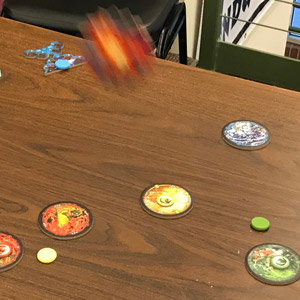
The flipping of the Ka-Boom is certainly a different type of dexterity play, but it still feels both like it's appropriate and skill-based. You can flip the Ka-Boom well or poorly, and it's a nice change of pace.
Of course, the Ka-Booming leads to the destruction of planets, and this creates an evolving game field, which keeps the play from stagnating. It also makes the game easier as it goes, as the playing field clears, which nicely accelerates the game.
There's one element to offset the core simplicity of the game, and that's the advancement cards. They create some depth otherwise missing, but they're also highly varied in power: some are terrific and some are almost worthless. So, I'm not convinced they're a great addition to the game (but the game is light enough that the power imbalance really doesn't matter a lot).
Overall, Cosmic Kaboom is a fairly standard flicking game that's enjoyable and amusing but not deep. I've given it a "3" out of "5" for Substance.
Conclusion
Cosmic Kaboom is a fun flicking game in a small little package. It's fairly standard for the genre, but also proves to be entertaining and fun to play.

