

 Search
Review of Saboteur: The Duel
Players: 2
Playing Time: 30
The Components
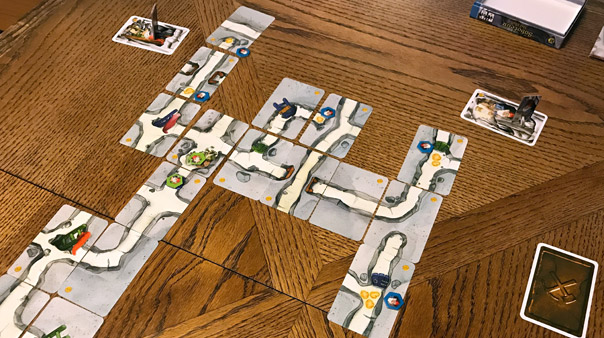
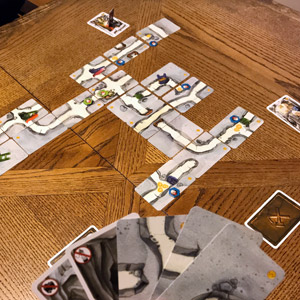
Saboteur: The Duel is a card game which comes with 76 cards, several cardboard tokens, and a rulebook. The cards are divided into: playing cards including path cards and action cards; and goal cards. (There are two dwarf cards too, so you remember what color you are.)
 | |
 | 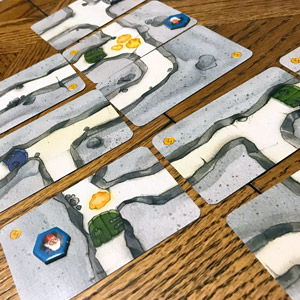 |
Quality: All of the cards are printed on high-quality linen-textured cardstock while the tokens are similarly on textured cardboard. 5/5.
Beauty: Most of the cards are "path" cards, which show tunnels and (sometimes) gold. They're fairly plain. There's larger artwork on the dwarf cards and the action cards that's attractive. 3+/5.
Usability: The path cards are tunnels, which are simply placed next to each other. Most of the action cards either destroy or repair equipment, and they're marked clearly with the equipment in question. Overall, The Duel is a simple game and the cards make it simple to play. Unfortunately, the rulebook misses several vital elements about how the two players tunnels might combine, making it hard to learn from. 3+/5.
Theming: Dwarves are digging a mine, and each is trying to get to the gold first. The theming isn't very dense, but it works. 3+/5.
The Duel is a slightly above-average game with good-quality components. It earns a high "3" out of "5" for Style.
Summary of the Gameplay
The Duel is played out over three rounds. In each round, a playing field is set out with start cards for each player and a set of six face-down goal cards.
Playing Cards: The main action of a turn is playing a card from your hand, then redrawing. This could be a path card intended to eventually connect your start card to a goal or it could be an action card, most of which either damage one of your opponent's tools or repair one of your own. (If a tool is broken, you have to fix it before you can continue play.)
Alternate Actions. Alternatively you can either discard two cards to fix a digging implement (which leaves you a card short for the rest of the round of play, as you only draw one card as a replacement) or pass to replace one or two cards in your hand.
Extending Your Paths: The ultimate goal is to extend a set of paths from your start card to the goals. Whenever you do, you'll get to flip the card up and if it shows gold nuggets, claim them with one of your tokens.
But, there are catches. The two start cards can be connected together, which gives both players control over the network of paths. Or, they can be separated with player-colored doors. Bribable trolls, playable cards with gold nuggets, and additional start ladders all make the game a bit more chaotic and fun. (Who claims a gold nugget if it's connected to both players' start cards? The rules don't actually say, which was their biggest omission. Frederic Moyersoen online says it's the player who played the connecting card.)
Ending Rounds & The Game: A round of play ends when either the goal cards have all been flipped up or enough gold has been claimed. The players take the cards with their dwarf markers as score markers.
After three rounds of play, the players count up their total gold won, and the player with the most wins the game.
Relationships to Other Games
The Duel is a two-player game that revisits the base card-playing mechanics of Saboteur, but which doesn't revisit that game's hidden teams.
The Game Design
I always felt that the core gameplay of Saboteur was the hidden teams. The whole game was about figuring out who everyone else was, while both hiding who you were and playing to advance toward your goals. The actual cardplay of building paths and connecting to gold (or not) was just the backdrop for all that scheming and subterfuge.
So how does The Duel work when that cardplay "backdrop" is the whole game? It does an alright job, in part because Moyersoen correctly added some depth to the passage building, with new doors, keys, trolls, and bribes. Paths are no longer simple binary affairs that exist or not, but instead they can exist just for one player. This allows some cleverness of play: you can trick your opponent into helping you, then cut them off at the last moment.
More generally, The Duel focuses on brinksmanship as you try to advance just far enough that your opponent won't be able to grab the goal, but you will on a future play. It's definitely a different sort of play than in Saboteur, despite the same mechanics of path building.
The randomness of The Duel also deserves some note. It exists very much as it does in Saboteur. You can get great paths and great actions or you can get totally non-helpful paths and be unable to respond to your opponent breaking your tools. In the original Saboteur this is mitigated in large part by having (hidden) teams. Even if you can't effectively build paths, your fellows probably can. Other than passing and redrawing, there's no such amelioration for bad path cards in The Duel, which makes it feel more random. Fortunately, the ability to fix your tools with card discards, which is an excellent design element, prevents similar problems from arising from the action card play.
With all said, The Duel is a good adaption of the original cardplay to the two-player genre, but the loss of the interesting team mechanics is notable. I've given it a "3" out of "5" for Substance.
Conclusion
Saboteur: The Duel has the tricky task of adapting the excellent teamplay mechanics of Saboteur to a two-player game. It does a good job of maintaining the path-laying mechanics, and revving them up for two-player play. The result is an OK game in its category, but not as amazing as its multiplayer predecessor.

