

 Search
Review of Fall of Magic
 Goto [ Index ] |
Laying Out the Bits
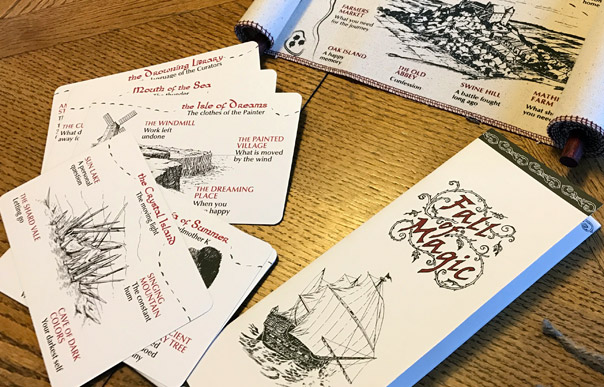
Fall of Magic certainly has some of the most unusual and exciting components of any roleplaying game (or, if you prefer, story game) ever produced. It comes in what looks like a tall shoe box. The main component is a silk-screened scroll that's rolled up, but would be about five foot long if unrolled(!). It's beautifully produced, with wooden dowels, sewn edges, and a string to hold it together.
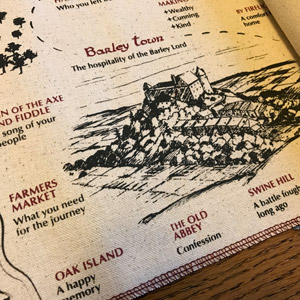
When you unroll the scroll, you discover a map of a fantasy land, but closer inspection reveals something more. Each location is surrounded by the names of places at that location, along with a little text. That's because the scroll isn't really a map. It's a scrolling series of story prompts. Each location helps you to tell your story.
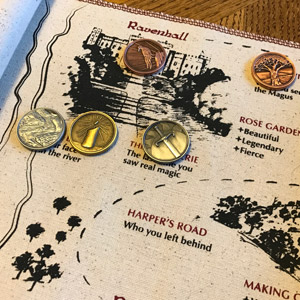
The metal coins are the other masterful component in Fall of Magic. They're thick and beautifully produced, with unique pictures on each side of the five coins. They're used to represent the characters in your story, and they can be yet another prompt.
The rest of the components are all more normative, but produced better than you'd expect. For example, the island cards are huge, Tarot-sized cards and they're quite sturdy for their size. The rulebook is similarly produced on thick, luscious cardstock and paper.
 | |
 |  |
Starting the Game
The heart of Fall of Magic is its scroll, which prompts you in your storytelling, and that starts with the setup. The left side of the scroll gives you a small list of names as well as some choices of titles, all associated with place names. So, you could be "Justice, Apprentice of Ravenhall" or "Vago, Heir of Stormguard", or "Justice, Giant of Mistwood". These names and titles are interesting and evocative; they immediately get you thinking.
You also take one of those fancy metal coins to represent your character, which might might give you additional ideas.
Telling Your Story
Fall of Magic is the story of a magus and his group of fellows moving across the lands, searching for the land of Umbra, where magic was born. Usually, play is quite simple: the magus coin will already be placed at one of the locations. You put your character at one of the location's scenes. There, you describe the scene and then use a short story prompt to help you form the tale of what happens there. Other players may question, interject, and otherwise interact with you, but you're the master of the scene (and your character is at the heart of it).
Some scenes include the very, very minimal elements of a game system: a few have traits that you give to one character; others indicate that you should change something about your character; and a few more have a random result after you've played out the story prompt. However, that's it as far as the "rules" system goes.
Later in the game, there's a tiny bit of increased complexity. There's an underrealm which is accessible from multiple points, and there's a Sightless Sea, where different Lost Islands cards are placed every time you play.
The storytelling prompts are generally quite strong. Some touch on events and others touch on emotions. They do a great job of giving you ideas for constructing a story, but they're vague enough that I'm pretty sure they'll lead in dramatically different directions in different games.
But, will they actually tell a story? I think that's the real question, and the answer depends on how cooperative and collaborative your group is. The organization of the scroll seems to be intended to drive the story through plot beats: some have more opportunity for action and some are more reflective. But it'll take a group willing to work together and desirous of creating a story to meld them into a cohesive whole.
I also think that the fantastical elements of Fall of Magic are somewhat understated. It was easy to descend into our characters and to forget about the bigger story of magic disappearing from the realm. Again, this required player guidance to push the storyline.
Moving Along
Play rotates around the table. If it's your turn, and you've already engaged in a scene at the current location, then you may chose to move the magus to the next location. Sometimes the path splits, and later it gives you increasing choices when you might descend into the underrealms or cross the Sightless Sea.
When you take a magus turn, you choose one of the various paths. On the way to your destination, you talk about the journey and use a story prompt underlying the new location. This is probably the best opportunity to draw various story threads together and to advance the overall narrative.
Ending Your Game
There is a "fin." on the map, in the faraway land of Umbra.But you're unlikely to get there in one 2-4 hour session, which is why the box says game might take 1-3 sessions.
Nonetheless, you can stop at any time. The game suggests calling a final round of play, and having everyone bring some closure to their stories. Then, if you want to play again, you can pack up your notecards, which contain tour names and traits, and continue onward next time.
Even in a two-hour game, where you're just starting to skirt the more interesting locales in the game as things come to a close, you can have a fulfilling and interesting session ... which is what we did.
Our AP
Our characters were: Harp, Swineherd of Barley Town; Caspian, Crab-Singer of Istallia; Kabu, Fugitive of Stormguard; and Piccolo, Fox of Mistwood.
In Ravenhall, we met each other, with Piccolo driving the introductions. I was playing Harp, so I introduced myself as an aspiring bard in the big city for the first time. The maga was awaiting us, so after Piccolo had gathered us, we headed out.
This was one of the places where I could really see how non-cooperative players could mess up the game. We all needed to build our connections to the maga before we left Ravenhall, or we'd be stumbling through those at the next location, and if anyone had chosen to have the maga leave town before we were all ready, that would have been troublesome. (Fortunately, it wasn't.)
In The Oak Hills, we got to know each other a bit better, and I got tagged with the Cunning trait because I could make a fire. I thought it was more practical than cunning, but accepted it, and ultimately decided I'd constantly be trying to live up to everyone else's expectations.
Barley Town was my home, and I wasn't entirely happy to be back. I recalled my last fight with my mother over her not wanting me to take my dog, Alfie, with me, because he was needed at the farm. But here he was, sitting out on Swine Hill, where I used to play songs to herd my pigs back and forth. So I took Alfie with me this time. The rest of the party was busy gathering supplies. A rather funny sequence involved Piccolo going to Mathilda's Farm, and buying as many eggs as he could carry, even though the rest of us thought they'd go bad too quickly. But then Caspian convinced me to play in front of the crowd. My one song was as poorly received in Barley Town as ever, and the audience bought our eggs to pelt us with, leaving us with more money than we started with (and some supplies we'd purchased).
We sped through each of these first three locations, just one round around the table, then the first person who could move us did, but we slowed down in Mistwood, as we were captured by the mist. I foraged us some hallucinatory mushrooms and we all wandered around seeing things for a while. Kabu saw a white doe, and tried to hunt it for a while, which led him the Trail of the Rangers, ultimately our way out.
In the Hall of the Woods, those self-same rangers showed us hospitality, but told us we needed to learn the ways of the wilds to survive our journey. Kabu went out hunting after the white doe again, and just as he prepared to kill it with the rusty knife he'd purchased in Barley Town, Piccolo leaped in the way, shouting, "Don't kill my sister!" and was struck down by Kabu's knife! The rangers told us of a ritual which could cure Piccolo, but it would require a sacrifice, so we all set out into the woods to find something to bring back. Kabu went to the Spirit Lake but had no fishing line. (That was what Caspian had bought in Barley Town, and he held it close.) I tried to capture a stag, but was wounded. Finally Caspian pulled me aside, and suggested I charm a big pig, just like I did back at home. Duh. So I did, and we led an enormous boar back to the Circle of Ancients.
There we expected to find the old maga and a dying Piccolo, but instead we found an old dying magus and a young, female, and healthy Piccolo. They'd somehow changed places (again!, according to the scene we players witnessed), but we didn't understand more. I thought this was the best moment of magic in the game, really pushing the possibility of the story. We made the sacrifice to heal the magus, and continued on our way.
At this point, I called time, because we'd been going for just short of two hours. That meant our last location would be Spirit River, on the raft we boarded after leaving the Hall of the Woods. But, we were being followed by the white doe, now become a white woman, and we were also been spied on by white women from the banks! Piccolo said that her sister would follow us to the ends of the earth, and now had us trapped on this river.
Overall, the Spirit River was a bit hard of a place to form an ending, because it was mostly contemplative. Fortunately, I was able to turn my contemplation into action. I was feeling sorrow, as were many of my fellows, but I directed that into my song, and for the first time truly attracted the attention of my listeners and moved them emotionally. I felt that I had become a real bard.
Among those moved was the white doe, who released us from our entrapment and let us land in Istallia.
We felt that was a good enough ending, though it would have been just the first chapter in a story two or three weeks long.
Final Thoughts
Fall of Magic is a very freeform game, footloose and rules-free. Don't expect much in the way of mechanical guidance. Fortunately, there's lots in the way of story guidance, from good titles, to recurring locations, to great prompts, to interesting random possibilities.
Because the game system does such a good job of getting out of the way, it shouldn't be intimidating even for players not familiar with roleplaying or story games. All you need to do is tell a little bit of story when it's your turn; that's pretty much the game.
My biggest concern with the story is ultimately the replayability. That's because the map is set, and you're always going to visit at least some of the same places and have the same big tropes. Fortunately, Fall of Magic has plenty of branches, including different paths on the road, the possibility of going into the underrealms, and the totally variable islands. There are still some limits, but given how much of the game is built into the components, they're as minimal as possible.
Overall, if you're a story game fan and a fantasy fan, then Fall of Magic is a must buy. It will be quite hard to find a better game for this sort of faerie tale story telling.
I've given Fall of Magic a "5" out of "5" for Style due to its magnificent components and evocative story prompts. I've given it a "3" out of "5" for Substance due to its minimal game system that mostly gets out of the way.
If the printed game is too pricey, there's also a digital-only version which is considerably cheaper.

