

 Search
Review of Agricola Family Edition
Summary of the Components
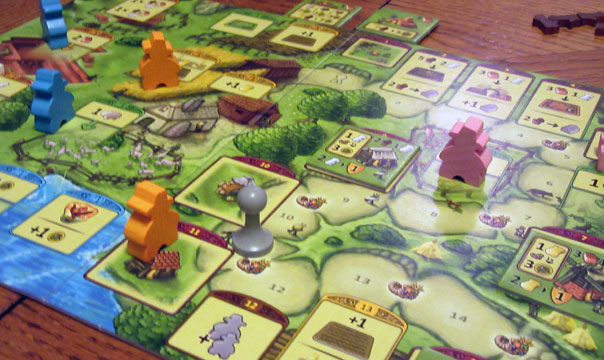
Agricola Family Edition contains cardboard boards; cardboard tiles; and wooden meeples of various sorts.
 | |
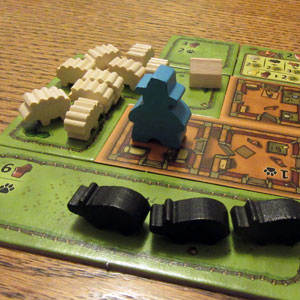 | 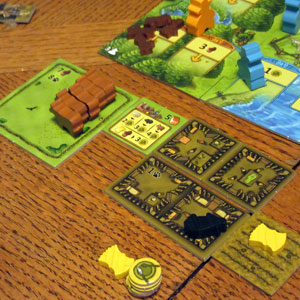 |
Quality: Like the original Agricola, this Family Edition has great components, including attractive wooden bits and linen-textured cardboard. 5 out of 5.
Beauty: The Family Edition also has the same benefits in its Beauty as the original game: Lookout Games, the original manufacturer of Agricola, has developed a simple and attractive style of artwork that almost looks like colored woodcuts. It's used throughout the game, and is very good looking. This edition of the game also features a lot of cute, shaped meeples for the various animals and other resources. 5 out of 5.
Usability: Agricola has always been great about encoding its actions in easy-to-understand icons, and that's the case in the Family Edition too. One of the big changes for this new edition is that all the actions are permanently ordered on the board, which makes setup of the game much simpler (and thus makes the game more usable). Overall, the simplifications of the Family Edition make it slightly more usable than the original game, earning it a perfect score. 5 out of 5.
Theming: Again, the strengths of the original Agricola's theming are matched here: you're a farmer, raising animals, planting crops and trying to keep your family from starving. Though this is a eurogame, the theme really comes across in all the actions — from animal breeding to crop growing to house upgrading. 4+ out of 5.
Agricola Family Edition is almost a picture-perfect example of game production. It's even a little easier to play than the original, as is appropriate. I've given it a full "5" out of "5" for Style.
Summary of the Gameplay
Agricola Family Edition, like its predecessor, is a game of farming. In fact if you know how to play Agricola then you mostly know how to play the Family Edition, because it's a simplification of the standard Agricola rules. But here's the general synopsis of play, which is a slightly modified version of the play description in my Agricola review.
The object of Agricola Family Edition is to earn the most points by raising animals, growing food, multiplying your family, and expanding your farm.
Setup: Each player starts the game with a tile that shows two rooms of a farm house; it houses his two workers. More rooms will be added over the course of the game, as will field, pasture, and improvement tiles.
Taking an Action: On his turn, a player takes an action by placing one of his workers on an action space. This monopolizes the space, so you have to think carefully about what actions you really need, and what actions other players might grab.
There are numerous actions, which allow a variety of different paths to victory. This actions also expand over the course of the game, with a new action appearing at the start of each round of play.
- Homes & Family. Actions allow players to add rooms to their house (providing space for more family members), to improve those rooms (earning victory points), or to add family members (providing more actions in the future).
- Pastures & Animals. Actions allow players to build pastures (providing space for animals), to build stables (increasing space for animals), and to buy animals.
- Fields & Planting. Actions allow players to take grain (providing seed for planting), to build fields (making space for planting), and to sow fields (planting those seeds). This creates food.
- Improvements & Occupations. Actions allow players to play major improvements, which tend to allow for the cooking of food or grant victory points at the end of the game.
- Food! Food is very important. It can be gained from animals or from grain, often in conjunction with certain improvements. However, if a player is desperate, certain actions allow for the acquisition of pure food.
The Harvest: Each round of play continues until all of the players have played all of their workers. After certain rounds of play, a harvest occurs. This means:
- Grain is removed from fields where it was planted.
- All workers must be fed, using either food tokens or through the cooking of animals or grain in a variety of ovens that can be built as improvements.
- Animals multiply.
If you fail to feed your workers, you're punished with negative victory points.
The Game End: The game ends after 14 rounds of play. Then everyone earns points based on a really simple formula: workers are worth 3 points; markers gained when you failed to feed workers are -3 points; and every other tile (except wood rooms) and every wooden bit on a tile is worth 1 point.
How Agricola Has Changed
The biggest change in the Family Edition is the removal of cards; the original game includes minor improvements and professions which allow for more strategy and more variability, but also more complexity; you won't find them here.
The other big change is that new actions that appear over the course of the game appear in a set order that's printed on the board. Again, this decreases variability, but it makes setup a lot easier.
There are lots of other tweaks such as simplified scoring (with almost everything being +1 point), simplified animal management (through animal holding limits printed on the tiles), simplified purchase costs (through a more consistent system) and simplified land management (through the use of tiles). There are also more limited varieties of everything. For example there's no vegetables and no stones.
The Game Design
Here's what I said about the design of the Revised edition of Agricola:
Worker placement was a great mechanic from the start. It produces options for actions that are constrained by the fact that other players can get there first. Add together meaningful alternate paths to victory and real strategic variation, and you have the solid core of a game. Agricola takes advantage of all of that, and combines its worker-placement mechanics with an intriguing scarcity design. Everything feels desperate because you're frantically trying to stay ahead of the harvest, and it never feels like you have enough time for the actions that you want.The new Family Edition has all of those advantages, but it's part of a simpler game. The question is, "Does it really support family play?"The varied strategies in Agricola including collecting animals, collecting and planting food, building up houses, and taking advantage of your improvements ... This doesn't just provide lots of different options, but also introduces some nice balance: if you do something that too many other people are doing, then you'll be in contention for action spaces, but if you go your own way, you'll lose points for not including whatever game elements you're ignoring.
As for an answer: I'm unconvinced.
I do think it'll be a lot easier to play with kids using this edition of the game. The lack of improvement and profession cards means that there's no hidden information. As a result, it's a simpler to give kids advice.
However, Agricola remains a pretty dense game that's also pretty unforgiving, even in this Family Edition. It's easy to get behind the curve of feeding your family, and if you do, you're doomed. Because of that, I'm not convinced that Agriocola will ever be a great family game. But, if you wanted to give it a shot, this design is how you'd do it, because all of its simplifications are quite elegant.
As a more serious player, I'd hoped that the Family Edition might give me an Agricola that hits the table more because of its shorter playing length. Though there indeed is a notably shorter playing length, the lack of the cards impacted strategy too much for this to be a particularly great game for serious gamers.
So, to a certain extent I think this is a game that's neither here nor there. The result just isn't quite as great as the original. But Agricola is still a pretty superior game, and even a Family Edition that might be a little too complex is still pretty great. So, I'd still recommend it if you've got a Family, and the original might be too much for them ... if you think they can handle some serious gaming. I've given it a "4" out of "5" for Substance.
Conclusion
The Family Edition of Agricola contains quite a few simplifications that are quite elegant. I think it's still a little too complex and too unforgiving for family play, but if you've got fearless family players wanting to try one of the best eurogames out there, this is a nice alternative to the full release.

