

 Search
Review of Isle of Skye
Players: 2-5
Playing Time: 60-90 minutes
Summary of the Components
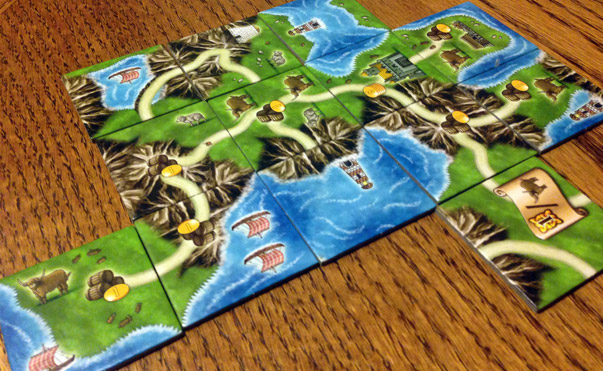
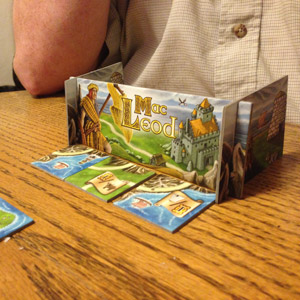
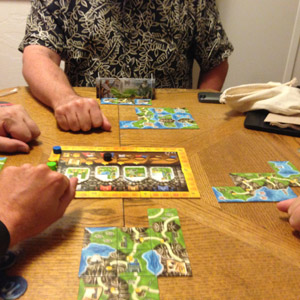
Isle of Skye obviously comes with a bunch of tiles and a canvas bag to hold them. There's also a lot of other cardboard (including a small game board and a set of player screens) and some wooden scoring tokens.
 | |
 |  |
Quality: The cardboard components are all good quality linen-textured cardboard. 5 out of 5.
Beauty: The tiles all have attractive, but simple drawings on them. THe rest of the pieces are good looking as well. 4 out of 5.
Usability: The tiles depict a collection of terrains, buildings, and animals which are all easy to discern. The main iconography appears on the "scoring tiles" and on tile with scrolls, which all list special victory points. A few are initially confusing, but once you've seen all the icons, they're pretty obvious. 4 out of 5.
Theming: Much like classic tile-laying game Carcassonne, the theming here is relatively light. You're laying down tiles which have some relation to the setting (here, Scotsmen rather than generic Medieval people). 4 out of 5.
Overall, Isle of Skye has very nicely produced components that other otherwise stylistically good. It earns a somewhat high "4" out of "5" for Style.
Summary of the Gameplay
The object of Isle of Skye is to earn the most victory points, primarily by playing tiles according to rules set out by scoring tiles and tiles with scrolls.
Order of Play: Each round is played out over six phases:
1. Income Earning. Players earn a set income each round, possibly suplemented by additional income from tiles.
2. Tile Selection. Each player randomly draws three tiles, shows then openly, and then secretly sets prices for them. The player puts a discard marker behind one of the tiles, while he puts some of his money behind the other two tiles, setting prices.
3. Tile Discard. Players reveal their pricing and discard the designated tile.
4. Tile Purchase. Now each player gets the option to buy one tile from another player. If he does, he pays that player the set price and the player gets the money back that he used to set the price. Afterward, each player gets his own unpurchased tiles (but loses the money he used to set those prices).
5. Tile Placement. Each player has their own little country of tiles, centered around their castle. He places his new tiles in that country, edge-matching everything except roads.
6. Point Scoring. Each round of play ends with everyone scoring points. These points are based upon four random scoring tiles that were selected at the start of the game. Each of the tiles is scored three times over the course of six rounds.
The tiles can give players points for different things, like: having built tiles into certain shapes; having certain animals or locations on tiles; having majorities in certain things; having a good road system; having completed landscapes; etc. It's a real hodge-podge, which should also make each games different.
End Game: The game ends after six rounds of play. Players then add on end-game points for certain scroll tiles they got during play, which all give points for animals or locales. Gold earns a few points too. The player with the most points wins.
Relationships to Other Games
Isle of Skye will obviously be compared to Carcassonne. They're both tile-laying games that are primarily about connecting up tiles with the same types of terrains. However, other that fairly superficial similarity, they're quite different.
Carcassonne is all about meeple placement and either sharing or spoiling terrains in a shared landscape. There's a heavy focus on majority control (or shared victory).
Isle of Skye is all about price-setting and auctioning, with the goal being to place good tiles in your own individual landscape.
The Game Design
As a tile laying game, Isle of Skye is about what you'd expect. You match up edges and you try to get things into good configurations. However, that's just the end result of the game's play. There are two very innovative game systems in front of it.
First, you have the auction system. On the one hand, it feels a bit like Modern Art, the classic game of trying to figure out the right level to buy or sell item at. However, the seller isn't just setting his price, he's also simultaneously measuring his need for money and perhaps even setting a level that is high enough that other players won't take the tile. The result of all of this is a very nice bit of decision-making, combined with good economics.
Second, you have the victory point system. This feels a lot like Kingmaker (which sets various criteria for placing houses in different locations). However, it's also a great system that I'd like to see more, because it makes every game different.
Put all that together and you have a game that's innovative, interesting, and light. It'll probably appeal most to families and casual players. But it's a good game for that category, so I've given it a "4" out of "5" for Substance.
Conclusion
Isle of Skye is an interesting game that mixes auctions and tile placement in some original ways. It'll probably be enjoyed most by casual players. It may not be a replacement for Carcassonne, but it's probably a nice alternative if the classic of tile games has gotten a bit dull.

