

 Search
Review of Star Trek: Five-Year Mission
Players: 3-7
Playing Time: 1 hour
Summary of the Components
Five-Year Mission comes in a box containing: cardboard player and dice boards; lots of dice; lots of cards; and a three-minute timer.
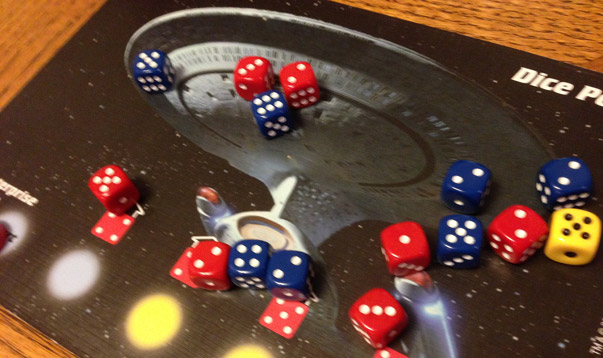 | |
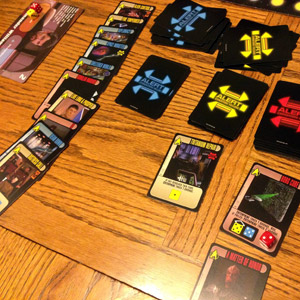 | 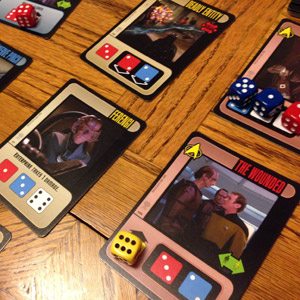 |
Quality: The cardboard is thick and linen-textured. The cards are a little on the lightweight side, but fairly sturdy. The dice and timer are pretty standard components. 4 out of 5.
Beauty: The graphic design for the cards and boards is simple but good-looking, and it features lots of nice shots from Star Trek: The Original Series and Star Trek: The Next Generation. 4 out of 5.
Usability: Five-Year Mission depends heavily on icons to tell you what dice to play, and what special powers to use. They're generally good, though in a few cases players found them too subtle (particularly the small arrows that show that you can roll a range of numbers). There's also good attention to the design of the player boards and to a quick-reference sheet on the back of the rulebook, all of which makes the game easier to play. 4+ out of 5.
Theming: Each of the players will get to play a character from the TOS or TNG crew, with appropriate abilities. In addition, all of the alert cards is drawn from the voyages of one of the Enterprises. Though the core mechanics of the game are somewhat abstract, the game is just dripping with theme if you choose to pay attention to it. 5 out of 5.
Overall Five-Year Mission had good production that rise up to the next level in its great theming. I've give it a high "4" out of "5" for Style.
Summary of the Gameplay
The object of Five-Year Mission is to solve enough point-scoring alerts without too many failures along the way.
Setup: Players are each given a character (who has a special power) and a set of five starting dice, spread across the three colors (red, yellow, and blue, of course). An initial alert is placed out.
The Characters. The characters add both detail and evocative strategy to the game. For example the doctor tends to focus on people's injuries and rolls blue dice to heal them, while the engineer tends to focus on red problems (including repairing the Enterprise).
Drawing an Alert: Each player's turn starts with drawing an alert card. There are three levels of alerts: easy blue, medium yellow, and tough red. Though you often want to draw the easiest level of alert, there are several reasons for drawing a harder one:
- You may be forced to draw a yellow or red alert if the Enterprise is damaged.
- Because there is a limit of three of each color of alert out at a time, you may choose to draw a more difficult alert to prevent an automatic failure.
- You may want a better chance at victory points, which are more common on yellow and red alerts.
- You may need a higher level alert, because you need some of each level to win the game.
Replenishing Dice: At the start of his turn, a player may have some dice in his action pool and some (unusable) dice in his damage pool. If he has less than five total, he gets to draw more from the common dice pool … which can allow him to get the colors of dice needed for current alerts.
Rolling Dice: The player rolls his dice. Usually, he just makes one roll and that's it, but there are some special powers for certain characters and available from certain cards that may allow a reroll.
Resolving Alerts: This is the heart of the game. The active player takes the dice he rolls and places them on active alerts. Sometimes he might be able to completely finish one or more alerts (by playing any dice required to finish it up), sometimes he might just be able to contribute some dice to tough alerts, and sometimes he might find his dice entirely wasted!
Other Dice Uses: Doctors can use blue dice to heal other characters, while everyone can use red dice with sufficiently high results to repair the Enterprise.
The Dice Ecology. When an alert is completed (or failed!), all of its dice go into a central dice pool, making them available to players on future turns. (Similarly, dice used for other purposes and even "healed" dice go back to the central pool.)
Ending the Game: The players win the easiest level of play if they finish 10 point-scoring alerts, at least one of each color; or the hardest level of play if they finish 20 point-scoring alerts, at least two of each color and at least one requiring a timer.
The players lose if the Enterprise takes too much damage or if they fail at five alerts.
Relationships to Other Games
This is the second Star Trek co-op, the other being Reiner Knizia's Star Trek: Expeditions (2011). However, they're very different games. Expeditions was an exploration game of skill-based task rolls, licensed from the new movies, while Five-Year Mission is a dice game, licensed from the classic TV shows. I also personally find Five-Year Mission to be a superior game.
There's one other dice-based co-op of particular note, Elder Sign (2011). It similarly uses a formulaic system for applying dice to tasks — though I again, I have to say I like the design and play of Five-Year Mission better.
The Game Design
I have strong opinions about both dice games and co-op games, and I'm happy to say that Five-Year Mission comes off well in my assessments of both genres.
A dice game needs to have the opportunity for huge excitement, when you get just the roll that you need, and that's exactly what Five-Year Mission does. You can know that you're looking for a yellow "3" or an unlikely set of three red dice that are "5" or higher, and when you get that, you'll feel great elation.
A co-op game needs a challenge system that keeps players on their toes, that constantly surprises them, and that balances them on the edge of loss while holding out the hope of victory. In Five-Year Mission this is done through the alert system, which offers enough varied results to allow the unexpected. It keeps the players constantly striving, but it doesn't have quite the same level of danger and difficulty as some of the classics like Pandemic (2007). This lighter gameplay may be more appropriate for Five-Year Mission's more casual play and/or its theming, but don't expect the game to be as daunting as most co-ops.
And a co-op game also needs to encourage cooperation, something that Five-Year Mission definitely does. You're jointly placing dice with other players to finish off alerts, but you're also constantly talking about what's been rolled and how the dice could used. It's one of the most constantly cooperative and communicative games that I've played.
I will note that Five-Year Mission is pretty light. The rolling and placement of dice is pretty simple, even when spiced up with things like the urgent missions, which suddenly cause you to raise against the clock. However, if you're looking for a casual co-op game that's not quite as demanding or punishing as the rest of the field, Five-Year Mission earns a full "5" out of "5" for Substance.
Conclusion
Five-Year Mission has great theming and solid game design. It doesn't set the co-op or dice fields on fire, but it's enjoyable game that has all the excitement you'd want in a dice game and all the challenging cooperation you'd want in a co-op game. Be warned it's not as tricky as some co-ops, but if that's OK, and especially if you're a classic Star Trek fan, take a look!

