

 Search
Review of Villainy
Players: 2-4
Playing Time: 1-3 hours
Summary of the Components
Villainy comes with: lots of cards; player boards with turnable dials; and lots of cardboard bits.
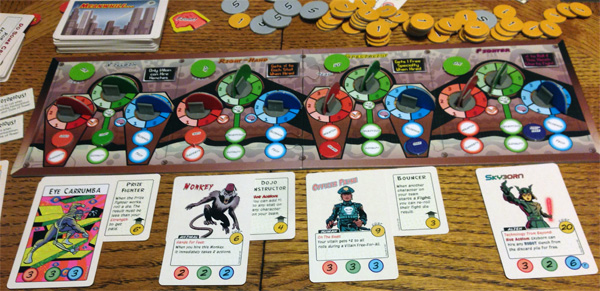
Quality: The cardboard bits are all thick and linen-textured, while the cards have a gloss texture, but are still fairly sturdy. The dials are really cool: they're cardboard mounted on a plastic base, which is then set in the player boards. They turn, which gives you a cool visceral feeling … but you do have to be careful not to knock them around. Nonetheless, they're a great addition. 5 out of 5.
Beauty: Most of the components are unfortunately plain, featuring simple layout and lots of white space. The villain and henchmen cards are the one exception: they spotlight fun comic art that's often satirical. (The layout is still very plain though.) 3 out of 5.
Utility: The game makes good use of three standard stats (strength, intellect, and charisma), which are color-coded and so easy to assess wherever they appear. Goal cards, which shows requirements for those stats and for related "specialties" are also well laid out, though the specialty icons are a bit small. Together, these nice features make the game easier to play. 4+ out of 5.
Theming: The game is about somewhat pathetic villains who are trying to make their name against Fantastiman. They do so by carrying out often hilarious Evil Plans and somewhat silly crimes. It's generally funny and shows a good understanding of comics. 4+ out of 5.
Overall, Villainy is well produced and has good utility and theming. The only thing holding it back is the somewhat plain design of the components. I've given it a high "4" out of "5" for Style.
Summary of the Gameplay
The object of Villainy is to complete three evil plans: an origin, a villainous act, and a magnum opus. Each requires that the members of a villain's team have certain stats and skills.
The Villainous Team: Each player starts off with his villain, a character that has 3 Strength, 3 Intelligence, and 3 Charisma. Over the course of the game, a player can hire three henchmen: a right-hand man, a specialist, and a fighter. Each of these characters comes into play with their own stats. Sometimes they also get a specialty (related to a stat) and sometimes they have a special power. Any of these characters can improve their stats and gain additional specialties over the course of the game … eventually making them good enough to undertake the villainous plans.
Taking Actions: On most turns, a player will have one of his characters take an action. This can be one of six things:
- Assume an Alter Ego. If he meets its qualifications, the character takes an alter ego card, which gives him income and possible special abilities.
- Hire a Hench. Only the main villain can hire a henchmen for one of his three positions, by paying money.
- Do Crime. The character takes a crime card, which might adjust his stats, provide specialities, or give money.
- Start a Fight. The characters fights the other players' teams. Everyone rolls a die, and the active player can win various bonuses like money, specialties, and stats if he beats his opponents.
- Buy A Specialty. The player pays money to add a specialty to the character.
- Take a Character Action. The character takes a special action based on his hench power or alter ego power.
If his characters are tired or he needs cash, a player might work, which untires all his characters and lets untired characters and the villain earn money.
Alternatively, a player may complete his current villainous plan. This requires that certain characters have certain stats and specialties, and that they be untired. If he can complete a plan, the villain then gets to take his next plan.
The Magnum Opus. The final villainous plan, the magnum opus, works a bit differently. The player has to roll an 8+ on a 6-sided die to succeed. To get bonuses, he fights Fantastiman, which does bad things to him and his characters, but provides bonuses to the die roll. The player decides how many times he's willing to fight Fantastiman, hopes he doesn't lose stats or skills that will cost him his magnum opus, and eventually makes a die roll and hopes to succeed.
Winning the Game: If a player rolls high enough on his magnum opus, he instantly wins the game.
Relationships to Other Games
Villainy has some very unique mechanics. It's essentially a resource management / goal completion game, where players get goal cards that require them to gather certain resources. Its uniqueness comes from the fact that those resources are fed into an adventure game system; instead of gathering traditional resource cubes, a player instead has to improve his characters. It's an interesting variation from the norm that adds a lot of color to the game.
The Game Design
The resource management and goal completion of Villainy create a strong strategic basis for the game. Unfortunately, it's hard to keep a handle on. For your first goal, you just have to match the stats and specialties of two characters, but by the time you get to your last goal, you have to match four different characters. Villainy includes some cubes to help you remember which characters you're advancing toward which goals, but it can still be pretty rough.
These core mechanics also offer a nice variety of choices, as you decide between tiring characters, gaining money, and improving scores. It often feels like a puzzle, like many of the best euro-influenced designers do
With that said, Villainy often felt underdeveloped, which resulted in some awkward elements in the game. The worst was the management of the crime/alter-ego deck of cards, which is constantly reshuffled. Not only was this annoying, but it impacted everyone's ability to strategize, because cards rarely remained available from one turn to the next.
I also felt like the ending of the game left something to be desired. The push toward the final stats for the final goal was somewhat dull, because it became very methodical. Then, the very random ending felt false to the serious strategic play of the game up to that point. I understand the designer's desire to create an exciting end game rather than something that was entirely set, but it resulted in a series of (random) failures before one player finally met (random) success, which means that the "best" player probably doesn't win. That'd be fine in a 300minute game, but less so in a 2-hour game. Fans of American style games like Munchkin may disagree, as this type of setback ending in very common in those designs.
On a whole I give Villainy a "3" out of "5" for Substance: some nice elements, but they didn't all gel, resulting in more average gameplay.
Conclusion
Villainy has a unique goal-completion system, but that's offset by some underdeveloped play and an ending that's too random for the two-hour game length. Players of American hobbyist games like Munchkin won't care, and for them I'd happily recommend Villainy, but more serious strategy players may wish to be a bit more cautious.

