

 Search
Review of Johari
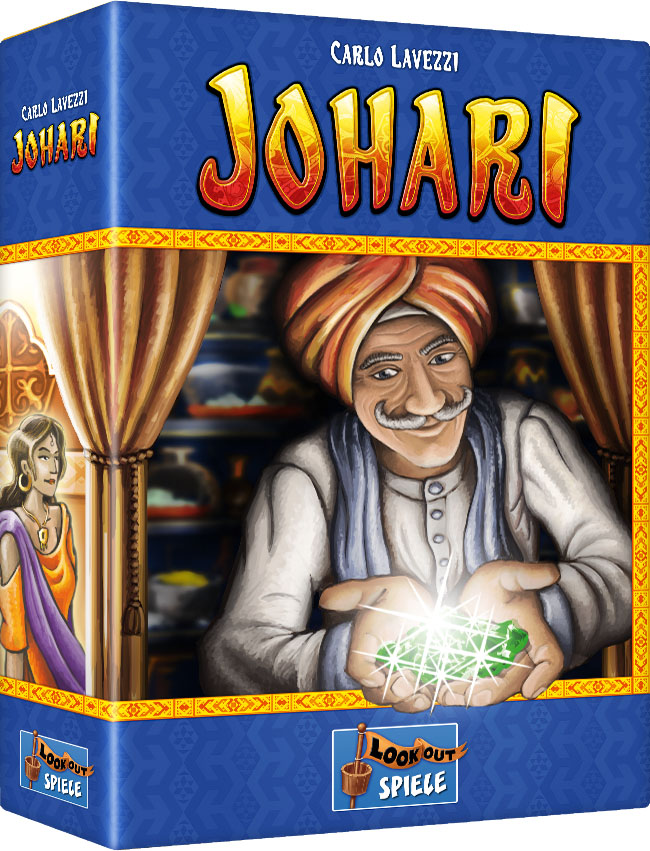 Johari is a gem-themed game of action selection by Carlo Lavezzi, published by Lookout Games and Mayfair Games.
Players: 2-4
Playing Time: 60-90 minutes
Summary of the Components
Johari comes with several cardboard boards, a few decks of cards, and a few plastic gems and wooden discs.
Quality: The cards are all sturdy and glossy, while the boards are thick and linen-textured. 4+ out of 5.
Beauty: The action cards have nice artwork and good layout; even the relatively plain gem cards are nicely laid out. The boards are also good looking. 5 out of 5.
Usability: Though Johari is relatively simple and easy to play, it makes several missteps with vocabulary that can have real consequences for gameplay. My players were frequently confused on the difference between "gems" and "gem cards" and between "stores" and "Bazaar booths". The rules were also a little sparse, such as not explaining how the timing of the "bribe" card works. Denser rules and a few icons could have helped things out. 3 out of 5.
Theming: For some reason, games about gems are popular, with other notable examples including Basari, Gem Dealer, and Queen's Necklace. I've never entirely understand the interest, because it's pretty sparse, unless it's propped up with a great subsidiary theme. Here, the subsidiary theme is Arabic, including elephants, nobles, and bazaars, and that helps to add some fun depth to the game. 4 out of 5.
Overall, Johari is a well-produced, attractive game whose only notable flaw is in some confusing language. It earns a "4" out of "5" in Style.
Summary of the Gameplay
The object of Johari is to earn points primarily through the sale of gems, but also through the acquisition of nobles and prestige cards.
One Day at a Time: The game is played out over ten market days, with the start of each day marked by a new noble entering the market place and some new gems being placed in the shops (where gems of only one type are sold: rubies, sapphires, diamonds, emeralds, or prestige/gold) and the bazaar (where gems are randomly mixed together).
Prestige & Gold. Most of the gems are acquired solely for sale. The prestige and gold cards are special. The prestige cards are simply worth victory points at the end of the game. The gold points can either be traded in for advancement on the gold track or kept as wild cards when selling gem sets to jewelers.
The gold track is very important because it controls turns order and it also gives you the resources for paying for your action cards.
Taking an Action: During each day each player will take three actions. They simultaneously select actions one at a time, reveal them, then take their actions in decreasing order of gold on the the gold track.
Players choose actions by playing their actions cards to the table, which means that each action can only be taken once (with one possible exception). Each action also costs between 0 and 4 gold, but second actions are discounted and third actions are free; this creates an interesting economy where players decide if it's worth paying more for the expensive actions, so that they can go early.
There are seven actions.
- Purchase. Take a set of cards from a store or booth.
- Trade. Take a set of cards from a store, but keep them unavailable until the end of the market day; or discard gems to get a noble (who might have special powers or be worth victory points).
- Sale. Sell a set of like cards to a collector or sell a set of one of each type of gem (possibly using a gold as a substitute) to a jeweler.
- Bribe. Keep your fake gems safe for the day.
- Exchange. Swap a card for a card of the same type in a store or booth — presumably upgrading the card's value as you do.
- Baksheesh. Take 2 gold.
- Doppelganger. Repeat the previous card you played.
Selling. The sale of gems is the heart of the game. If you sell unlike gems to a jeweler, you get to go up 1-3 spaces on your gem track for one of the gem types you sold. If you sell like gems to a jeweler, you must have the most of that gem, then you compare how many gems you have of that type to the player with the second most, and then you move that many spaces up on that gem track.
There's one catch: about half of the gems are marked as fake. Whenever a sale occurs, every player loses one of their fake gems to a "supervisor" — unless they already bribed him.
Ending the Game: Many of the game's points come from the gem track: you get a lot of points for having sold a few of each gem type, but there are diminishing returns as you climb each track. Nobles are also worth points, and some of the final nobles can be worth quite a bit if you take good advantage of their victory conditions. Finally, prestige cards are worth points. The player with the most points total wins.
Relationships to Other Games
I find Johari the most similar to the gem-selling game Basari. They both feature simultaneous actions (as you select cards at the same time) and they both focus on the ebb and flow of gems in and out of your possession. However, Basari is largely a game about second-guessing your opponents and playing contrarian, while Johari is much more about trying to outwit your opponents by taking the good actions just before they do. They're somewhat different takes on the simultaneous action genre, with Johari being less punishing.
The Game Design
Though Johari isn't as punishing as Basari, it's still got plenty of tough choices to keep players on their toes. As in any good resource-management game, you feel like you never have enough resources of any type (in particular, gold or sets of cards), and you're trying to use those scarce resources to stay just ahead of your opponents — to gather the scant resources that are available before them. This creates good tension and constantly difficult decisions.
Though this isn't a heavily social game, there is still some interesting interplay. You're frequently looking at your opponents' supplies and seeing what they have and what they might do as a result. You're also considering whether to take a sale action primarily to hose your opponents, who might lose great fake gems as a result. Finally, because turn important is vitally important, you're constantly weighing how to get ahead of your opponents on the gold track (and so the turn order).
Johari is slightly one note, but beyond that it's a solid game that will appeal to casual players and serious strategists alike. I've given it a "4" out of "5" for Substance.
Conclusion
Johari is a tense game of staying ahead of your opponents to get the best deals at the gem market. Though it plays simply, it also has some depth and lots of tough decisions.

