

 Search
Review of Rough Magicks
 Goto [ Index ] |
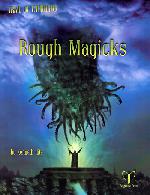
This is truly a magnificent supplement worth having for Trail of Cthulhu, as one neglected (although, not all together abandoned) area of inquiry in Cthulhu games is the area of Magic. Unlike, other supernatural games, Cthulhu posits Magic is bad, and bad things happen when you start to meddle with it. As the old adage, when you see an old book promising to reveal the secrets of the universe and provide you with unlimited power – LEAVE IT ALONE! That said, magic does enter into the worlds of Cthulhu in different ways and this supplement is designed to address those different ways. It superbly well-written and researched like the main rulebook, there are lots of allusions back to Lovecraft’s writings and the illustrations are in keeping with Trail of Cthulhu’s signature montage*** awesomeness which are almost photographic in quality. Drooling over the art aside, the text is very accessible (once you know the basics of the GUMSHOE system), clear and concise. Littered throughout there are allusions of the greatness that is to come by suggesting that there are other modes of play beyond Purist and Pulp that were introduced in the expansion volume - Bookhounds of London. And, even if you play BRP or d20 Call of Cthulhu, Hite’s essays on game play make this a worthy addition to your library.
So, what does this slim but sinewy volume contain...first up, there is a discussion of what is magic or more accurately, which magic. These two pages are pure gold, as many players who come to Cthulhu with atheistic and scientific tendencies that tend to cast aspersions on the supernatural and play Scullys to the Keeper’s Mulder. This chapter provides options for the Keeper to help them believe in the truth and reality infinitely more nuanced than what our standard perceptions and sense making abilities tell us.
Next up is the discussion of the Magic Ability which firmly gives players the chance to have magic, although, in keeping with Call of Cthulhu RPG traditions – there is a price to be paid. And, it explains the different ways from which magic can be “obtained” – Tomes, Titans, Teachers, and lastly and excitedly from territory/places. I love the last for every game has blasted heaths or cornfields or crumbling ruins – and connecting a simple set of rules with these places without resorting to fantastical explanations is one of the things that I love about Cthulhu. And, once the players have Magic – how it to be used forms the bulk of this chapter and it concludes with the brief discussion of monsters and magic (who unfortunately – for the players that is) do not suffer the same penalties or hindrances as players.
The next chapter introduces some new spells that are quite familiar to other versions of Cthulhu and their translation into Trail of Cthulhu rules along with a list of notable mages. There is an aside discussion on the Elder Sign – the all important ward that basically gives Keepers the right to blast players’ minds...something that I have long played with in my games – the Elder Sign is cultural and has a thousand and one permutations across the different cultures of the earth whether they be First Nations petroglyphs, Tibetan sand drawings or complex computer algorithms – the point is player should not have Elder Sign ammunition rather it is there as a tripwire. More in keeping with sandbox play and Trail of Cthulhu rules is a discussion how different skills can be used to detect the presence of magic. Thus, giving players and Keepers the clues necessary for action to move forward, good Keepers will have already formulated many of these but it makes it easier to remember now that they are in print. Somewhat related is a discussion of what a fully fledged sorcerer (lead cultist, wizard, etc.) is capable of – thus, providing the clue that this is the baddie in the adventure along with his/her ultimate ace in the sleeve – Time Travel.
Next up is a discussion of idiosyncratic magic which was first introduced Bookhounds of London campaign frame. This include the ability to boast general abilities of the investigator – this section of the rules – I found rather poor (maybe, because I tend toward more purist forms of play) – as it renders magic to Macgyvering solutions and Cthulhu does sometimes work that way but it should as the thumb in the proverbial dam with cracks beginning to appear around the transdimensional gate. Thus, these rules render Cthulhu into something else. Perhaps, the next chapter which traces through the different uses of magic in Lovecraft’s own works is meant as the Purist corrective to the previous chapter. Thus, providing the underlying “science” to what could have just been a theological discussion (Magic is because it is Magic). Hence, the term Magick is purposely introduced to differentiate from other more pulpish and religiously inclined writers, thus reconciling Lovecraft the atheist and materialist with the higher metaphysical and cosmic horror that makes his writing so contemporary and timeless. And, lastly, there is a revised Character Sheet.
All in all, Rough Magicks was a surprise for me. I avoided it when it came out believing it just to be a collection of spells and rules for spells. Instead, what I got was an intelligent treatise on how to introduce magic into supernatural gaming without being too overly dogmatic or critical of any mode of play. While this is clearly aimed at the Trail of Cthulhu and Call of Cthulhu audience other game systems might appreciate a venture into the darker side, assuming the players are comfortable with confronting cosmic horror and therein lies the game master’s ability to create a convincing narrative. A hideous monster romping down dark and incessant corridors, blood oozing from the walls, sounds of children crying for their Mummy are all ingredients of horror but not the horror itself – the horror comes from building up the level of fear and the greatest fear is the fear of the unknown – magic is one such unidentified dreadful shock. And, bringing that to the gaming table is what Cthulhu does best. This supplement reenergizes the horror while not distracting from the fun of play. Excellent work – Pelgrane Press...
***Pelgrane, please put together an art book in the near future – I desperately want A5 reproductions of all your art, as props and pleasure browsing.

