

 Search
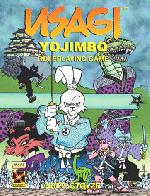
Review of Usagi Yojimbo Roleplaying Game
 Goto [ Index ] |
The Usagi Yojimbo Roleplaying Game
It seems that one of the things that distresses roleplayers most is the lack of interest for the hobby shown by the outside world. No outside interest means no new blood, no new blood means a static, or even shrinking population of gamers, means a drying up of base audience, means a dying off of gaming companies, means no professional gaming companies, which, all together, mean no roleplaying. (Or at least that's the way some of us gamers may feel.) So when something new comes out that might possibly attract new gamers, we may feel anything from minor relief to great elation. However, gamers may also look on these niche games with some disdain - if they look at them at all. (To be fair, it would probably be more accurate to state that gamers don't look at a new game because of time or money limitations on their end, or on distribution limitations on the producer's end - rather than claiming Earth-shattering hubris, or a holier-than-thou-"I don't need an introductory game" posturing).
Which brings me, in a roundabout fashion, to the game at hand. Every male 18-29 years old knows Usagi Yojimbo - he was the bunny samurai who sometimes made guest appearances on Teenage Mutant Ninja Turtles. But how many people really know Usagi? Seriously speaking, though, I only recently picked up a Usagi Yojimbo habit, and, being a longtime addict of roleplaying games, I had to pick up the small (96 pages) roleplaying game book. After all, it was written by Greg Stolze (known for his innovative games, including Unknown Armies among others). It's about Japan in the 17th century, which seems like an excellent era to roleplay (and I should mention that this Japan is populated by anthropomorphic creatures). Not to mention the fact that it's a "Complete game in one book" (as the sparse text on the back puts it). How could I go wrong?
How I went wrong.
I'm one of those people who believe that the art in a roleplaying book is not just a nice addition to the text, but rather an integral part of the book as a whole, and extremely important in setting the tone of the game. And the artwork in Usagi Yojimbo is where I had my first problem, though a small one. All the drawings were done by Stan Sakai himself, the creator of Usagi. That's a good thing. But all the images are taken directly from the comic books - which gives a disjointed feeling to many of them. Some of them are quite evocative, and work very well as single pieces of art - samurai charging, ninja crossing a roof at night, a determined and solemn wanderer. Many however are distracting because of the way in which they were excerpted from the comic - word balloons intact, but sans continuity. For a fan, that's not a problem; the fan has seen this all before, and seeing it again inspires a warm glow of nostalgia. For the roleplayer who is not yet an avid fan though, these pictures do very little to inspire much of anything. The most I could hope is that it inspires the hypothetical roleplayer to read some comic books. The mini comic in the back of this book may help with that, but I'm not that optimistic.
Though this does point up something that should be obvious from the beginning: the intended audience for this roleplaying book is people who are already fans of the comic. Which certainly explains the choice of art, the inclusion of a mini-comic (though game fiction has become common in all sorts of roleplaying books, and this comic does an admirable job of setting the mood), the Official Usagi Yojimbo timeline (now behind the times), and the Character Index (which readily finds use as a source of Japanese names I imagine). All of these items are somewhat useful to the roleplayer who doesn't know Usagi, but not as useful as, say, more information about daily life would have been.
Which is another problem that this book has. It's only 96 pages, and there is only so much information that one can cram into 96 pages. So that we get only 4 pages of setting is almost understandable. But that doesn't make us any less irritated. More than anything else it's this lack which damages this game most. We get some information on NPCs, on samurai in love, and we even get a small chart of various clans and their crests. But there's nothing on the law, on the tea ceremony, on geography, religion, history, customs, etc. There's not even any other mention of the clans. I know the symbol of the Geishu clan, but nothing else. There's a fine line between "leaving them wanting more" and "leaving them in a lurch," and this book unfortunately does the second in this category.
The last issue I had with this roleplaying book as a roleplaying book was in its emphasis on the comic book. Sure, that sounds like I'm being foolish - "It's the Usagi Yojimbo Roleplaying Game, of course it's going to have Usagi mentioned on every page." A roleplaying game based on outside source material will be most interesting to people who want to recreate the lives of the characters of that source material. Naturally. Well, that's why I'm not complaining loudly about this - but I don't want to play Usagi Yojimbo himself. I rather play Neko Yojimbo. And I wish there more background material for me to do that.
How I went right.
But even with all the issues I had with the book I still like this game. Part of it is definitely that I am a fan of the comic book, that the art, which for others might be disorienting, caused the aforementioned warm glow of nostalgia for me. However, if that were all, I would not be writing this review. I think this is a very good game for the beginning roleplayer, and I think it may very well attract (or rather, to put it in the right tense, might very well have attracted) new people to the hobby. But that's not the only way it may be useful to us. This game is not without value for the established roleplayer. Let me explain why I think this.
(I won't do more than mention the things about this book does well that are intended to help the neophyte roleplayer; my reason for doing this is that I assume almost everyone on RPG.net is not a beginner. What makes this an excellent introductory roleplaying book are the informative "What is Roleplaying" section that was better than most, I thought; the simple rules; the one page rules summary, and the one page combat summary - which are both good for everyone, not just beginners; a good, basic introduction to the art of gamemastering; and two different adventures that are both useful.)
One of the best things about a roleplaying game based on outside source material is that the source material is there to be used by the GM. This is not a benefit that is unique to UY, but there are many stories in the comic book that are just waiting to be written up as adventures. As I said this is not restricted to this roleplaying game; I'm sure a GM of Sengoku or Legend of the Five Rings could get some story ideas from the comic book. Still, it's a benefit I thought worth mentioning.
Another strength that this game has is its simple system, based on the Instant Fuzion rules. (For more information on Fuzion, try The Fuze and/or Atomik Fuzion.) I agree that a game's engine usually should be highly integrated into the setting and the tone (Deadlands's cards, Conspiracy X's cards, Castle Falkenstein's cards, etc); but if the system is generic, I think it's best to be as simple and streamlined as possible. The UY Fuzion system is that. And just a little more. Stolze has added an extra bit of flavor to the combat rules, dividing attack/defense styles into total attack, cautious attack, and total defense. This system works very well with the setting, and I think is certainly worthy of some attention. (Perhaps in a few more years people, when talking about innovation, and setting-specific mechanics will mention UY's combat styles alongside Deadlands's use of cards. As usual, I'm not optimistic.)
Stolze's other addition to the Instant Fuzion system is the choosing of a species and a job during character creation. I don't think that these choices aren't restrictive, as some find race-class systems to be. Each of the species and jobs is well-balanced, with something a little special to make it stand out. They are all in keeping with the comic book world, and they are an easily followed template for the creation of homegrown species and jobs. They simplify the choices for the new players, but don't limit them for experienced players. There are also quite a few (11 species, 9 jobs), and more coming out all the time. He also has a nice version of character advancement that ties it more tightly to the story; a character has to do three special things in order to improve a skill. These can be finding a great teacher, or getting special tools, or a Karate Kid-style montage of trial and error.
The Fuzion system is a strength all to itself, if considered from a certain point of view. Anything can be possible in a Fuzion-powered game. The Plug-Ins, both official, and fan-developed, are formidable, in quantity, and (for most of them) in quality. UY is also completely compatible with all of the other Fuzion-powered games. If I reject Stolze's reasoning against magic, then I can port in any number of magic systems - and with Fuzion and the Plug-Ins this is not an epic task, but a simple addition. Suppose I want Lord Hikiji to have some steam-powered mecha - well, that's easy. Suppose I want some Super powers to simulate a wuxia film - that's also easy. (Though UY is better suited for chanbara - samurai swordsmen films; for wuxia, I like Dragon Fist, the free game by Chris Pramas, which can be found still at here.)
Gold Rush Games also seems dedicated to this game (and this genre). UY is completely compatible with Sengoku, which seems to have the background that we need to run a really satisfying UY game. They have their first supplement out now, and more on the way. And they have fairly simple rules for conversion to many other systems (including FUDGE, and, in the Monsters supplement, D20).
Conclusion
Because of its lack of background material this game is flawed as it stands. If this were Random Samurai Roleplaying, or even Furry Samurai Roleplaying it would not be as interesting to me as it is. I think I may be being a little generous when I rate this book as a 4 for substance, because, on one level, it's really a skeleton. It's a simple rule system, and a sparely delineated world.
But at the same time, it's a good system, and it's a world that could be very good. Ultimately, it may be skeletal, but at the same time, it's also meaty. With a little work on developing the world, with a little background research into Japan of the 1600s, after seeing a few select films, etc, I think this could be the beginning of a very good chanbara epic. With furry animals.

