

 Search
Review Editing
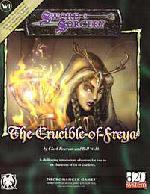
Review of W1: Crucible of Freya
 Goto [ Index ] |
Just off a major trade route is the town of Fairhill, a town blessed with an abundance of crops and happy citizens. The characters arrive just before the town is attacked by a band of Orcs who set fire to the local temple and make off with a significant religious item. This item, a crucible devoted to the goddess Freya, is vital to the well being of the village and it is up to the characters to return it.
Presumably the characters will take off in hot pursuit of the Orc raiders and will eventually catch up and destroy the raiders. At this point the characters will have technically fulfilled their goal, the recovery of the crucible, but will realize that a larger band of Orcs has taken up residence in a ruined keep deep in the woods. Plus, why would a band of Orcs go straight for a religious icon in the first place?
Thus begins the final act of the adventure, an assault on the ruined keep. This section has the most “first edition feel” in that it is a dungeon crawl with monsters, an evil cleric and traps. As I will discuss below, this part is quite dangerous to a low level party.
Crucible of Freya is nicely broken up into bite sized parts. The first part describes the environs around the town of Fairhill and provides four adventures hooks that can be used in conjunction with the main adventure or independently. These hooks let the characters take up residence in the town and slowly clear out the environment of monsters. In a sense it is reminiscent of the old module Keep on the Borderlands that also had a smattering of unrelated creatures living within close proximity of the town.
The next part describes the actual town of Fairhill and the population inhabiting it. There is enough description to use the town as a base for an extended visit and the population is varied though fairly stereotypical.
Following that comes a description of the ruined keep in which the evil cleric has taken up residence with his obligatory Orcs. The keep is the former home of a wizard, now an undead creature bumping around in his crypt.
The final part is the actual adventure. While linear, it doesn’t railroad the characters into particular actions. In fact, the designers took the time to list different possible character actions and discusses how to handle them. The main problem is that it is deadly, perhaps too deadly. The assault on the ruined keep has the strong possibility of character death, maybe more than one.
The greatest strength of the module is the fact that it isn’t a “use and discard” supplement. Even after completing the enclosed adventure the supplement offers the GM possibilities for future adventures. There are a total of four adventure hooks included and the town itself makes a good home base for characters. A GM will get mileage out of this product.
The second strongest part of the product was the various character action variables that the designers took into account. At most possible junctures in the plot, the designers speculated and came up with two or more possible actions by the characters. Granted, players are notorious for coming up with a new angle of attack, but the designers tried to come up with logical possibilities. Points to them for making the adventure easier for a beginner GM.
The greatest problem with the product is that it simply is too deadly for 1st or 2nd level characters. Using the Dungeon Master’s Guide as a reference (pg. 101) “An encounter with an Encounter Level equal to the PC’s level is one that should expend about 20% of their resources…,” indicates that a Challenge Rating of 1 is what four 1st level characters should be able to handle. Crucible of Freya goes way beyond that. The four Wilderness Area encounters range in CR from 4 to 6. The actual adventure features Orc Warriors (CR 2 and CR 3), a Green Slime (CR 4), Monstrous Spiders (CR 2), an Ogre (CR 2), Zombies (CR 2), the master villain, an evil cleric (CR 5) and a Shadow-Mage (CR 5). In short, the characters have the very likely chance of being ground into the dirt unless they come well prepared (i.e. lots of healing magic) or if they manage to sneak around without alerting the other monsters.
The encounters with the Shadow-Mage and the evil cleric also border on the unfair. Being undead, the Shadow-Mage gains the power of Incorpreal which makes it nearly immune to most attacks that a 1st or 2nd level character can toss. The party had better have a cleric and the cleric better make his Turn Undead roll or things will get unpleasant. The encounter with the evil cleric can also be lopsided as the cleric has a magical weapon designed to battle good characters and a Special Quality - Death Touch (Once per day, he makes a melee touch attack. If it succeeds he rolls 4d6; if the total is equal or greater than the opponent’s current hit points he dies with no save). This attack will most likely hit a character as the cleric has a 4 to attack and ignores the target’s armor. A poor roll of the 4d6 attack (say all two’s) still results in a total of 8 which is effective against low level characters who have probably sustained damage already. Even worse is the strong possibility that the characters will encounter the evil cleric with a pack of Orcs to back him up.
The GM will want to seriously reconsider the strength of the characters and adjust these encounters to a more reasonable level. Furthermore, a GM should expect to do some dice fudging if he runs the adventure “as is.”
So, what is the final verdict for Crucible of Freya? As a starting point for a campaign it wins big points, along with the central adventure there are several side treks that can each be turned into a full evening of adventuring. The central village is well described and can be used as a base for characters. The adventure itself is far too intense for 1st or 2nd level characters and requires adjustments. Beginner GMs may find this to be more work than it is worth. Those wishing for a decent starting point of a campaign will find this to be a good product to consider.

