

 Search
Review of Noir: the Film Noir Role-Playing Game
 Goto [ Index ] |
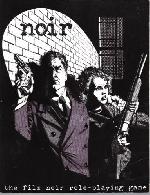
The game is noir, and this is my review. Let me hit the physical side first, before getting into the meat. The book is your standard soft-cover core rules release; excellent cover art from Mr. Chaykin, and the ARCHON symbol in the middle of the back. The title makes it pretty clear this is "the film noir role-playing game".
The layout is single-column, margins all around with large type. The art is scattered throughout, and is of varying quality. All of it does, however, work towards the mood of the book. My personal feeling is that the book could benefit from a smaller font and a 2 column layout, to fit more information in or lower the page count. As it is right now, it looks well behind the 'state of the art' of even the 1980s. Aside from the few pieces of excellent art, it falls into the average category.
On to an overview. The game is attempting to simulate the genre of film noir. Briefly, film noir is a term used to describe a kind of film mostly made in the post-war years (Detour, Double Indemnity, The Postman Always Rings Twice, etc.) and dealing with subjects like adultery, murder, and crime. Many of the same themes appear in the works of Raymond Chandler, Dashiell Hammet and James Cain (who worked in the 20's and 30's), or are dealt with in neo-noir's like Body Heat or Blood Simple.
It's a world of betrayal, manipulation, danger and corruption, among other things. The rules spend a few pages trying to get this across, then get onto the mechanics of the game proper. Better than the overview given in the rules is the filmography in the back of the book. To properly play noir, you should make an effort to see even just 10% of the films listed.
Character creation is pretty simple. Come up with a concept (Gang boss looking to be seen as a nice guy, for example) and a personality (He's got a temper he tries to keep in check). Nothing too out of the ordinary here.
Then you get points to spend, ranging from 75 (for average starting characters) to 150 (for epic heroes). These are used to build the character, starting with Traits. Characters are defined by Brawn, Smarts, Savvy, Guys, and Moves. From these, Reflexes, Toughness and Body are calculated. The Traits range from 1 (really crappy) to 5 (epic in stature), with 2 being average.
My first problem with the game comes here. The trait range is oriented around producing heroic level characters. Noir is about the normal guy in circumstances beyond his control, not epic Schwarzenegger type heroes. The Trait scale is weighted toward the latter, and doesn't provide enough range for the average person. In the playtest, most of the attributes ended up at 2 or 3, which didn't lend itself to much differentiation between the characters (and this was with 100 pt. characters).
Then you pick up a Schtick, costing more of your points. This is an occupation, like Mobster, Torpedo, or Femme Fatale and each comes with a choice of Edges, Tricks of the Trade and Tools of the Trade. For each level in the schtick, you get to spread some points out in the skills. You only get to pick one Edge, however.
The second problem came here. It costs 12 points for a level in a Schtick. The first level gives you an Edge (5-10pt Pro), and 6 skills at level 1 (6 pts). So you don't get much of a point break. A second level doesn't give you an edge, and gives you another 1 level in 6 skills. If you don't want to pay more for less, you'll want to take those levels in the same skills (12 pts). If you go to level 3 in a schtick or higher, you finally start to get a point break, but only if you continue to focus.
Which means during character design, it makes more sense to buy only level 1 in a schtick and use the saved points to buy up the 'Tricks of the Trade' later on as normal skills. The flaw is that you have to spread the 6 levels given out over 6 different skills at each level, which prevents the Schticks from being cost-effective. Since levels past the first in a Schtick have no real roleplaying benefit, either, it doesn't quite work.
Back to Character Creation. After you've gotten the Schtick, you spend the rest of your points on skills and Pros. Skills have names that fit well with the genre (Leadfoot = Driving, Doc = First Aid, Hoofing = Dancing), as do the Pros. To get extra points to spend, a PC can have Cons, as well. Each Pro & Con is explained well, and this section is well handled.
The mechanics of skill resolution follow the dice pool model. Take the Trait plus the level in the skill and roll that number of dice. There are wrinkles on this in noir. The Trait + skill is just the base number of dice. A GM (Director) can add or subtract dice from this to reflect various difficulties, such as hurrying or taking your time. The GM can also add a bonus die for efforts to maintain the atmosphere of the game. Then the GM sets a Difficulty number ranging from 8 (easy) to 50 (impossible). The dice are rolled, totaled and the result compared to the difficulty. If a player rolls all 1's, it's a botch. Any 6's rolled are re-rolled and added.
In play, the mechanics of adding and subtracting dice before the roll seemed to slow things down. After a while, I just started to adjust the Difficulty Number instead. The players didn't seem to mind, and it made resolving skill checks less intrusive into the roleplay. Nothing seemed to grind the game to a halt like having to explain why I was taking away a die from the skill check for the wet conditions, then adding a die for the atmosphere. Just telling the player roll the dice, and mentally setting the DN to what seemed right seemed to work better.
I also would have liked a more expansive list of example tasks and difficulties. How hard is it to sneakily open a window? How easy should it be to find out general information? Saying it's 'Tough' still leaves you choosing from a range of 20-35, with 35 being a lot harder than 20. A few more guidelines would really have helped.
Noir includes a 'fate point' mechanic, in the form of Moxie. Moxie points can be spent to reroll a failed test, to negate a botch or to temporarily double the number of dice you roll. Like Force Points, you don't get Moxie back unless you spent it for a good reason. This is handy for keeping characters alive in combat.
Speaking of combat, noir presents us with a fairly involved system, which is one of the things I didn't particularly like about it. Combat is resolved in 5 steps. Step One, everyone determines initiative. Step Two, everyone declares action in reverse order of initiative. This gives the high initiative a chance to react to what others might be doing. Step Three, everyone rolls dice to generate a Defensive Value. This is the number needed to hit you with an attack. Assuming you declared a Dodge or Parry in the previous step, you may get skill dice to roll here.
Step Four, everyone rolls to see if they hit. This is where things get a bit confused. From a straight reading of the rules, the results of the attack are noted (the difference between the roll to hit and the difficulty), but damage is not resolved. So even if Lou, with the initiative, shoots Thug #1 first … Thug #1 will get to shoot back at Lou.
Step Five, Damage effects are all resolved. Add the result to the base damage of the weapon, subtract the results of a soak roll and that's the damage done. This is checked to see if the target is clipped, wounded, or dead. If enough damage was done, a chance exists for the target to fall unconscious or to suffer a major trauma. Also, character wounded in earlier rounds suffers a die of bleeding damage.
The problems here are in the realm of detail. Noir shouldn't be a combat game, and it is a bit disturbing to have two chapters dedicated to combat (one chapter covers combat, the other healing the results of combat). I'm pretty sure the soak mechanic doesn't belong in this game. In the playtest, a lucky roll allowed one of the PCs to shrug off the effects of a Tommy Gun burst without requiring medical attention, which somewhat jarred our suspension of disbelief.
The combat rules include options for aiming, facing (facing?), lighting, range, and cover. All of this is fairly basic, but it also makes combat a tactical, rather than dramatic, affair. Weapon quality rules, ammo, range concerns … all of it struck me as more detailed than most film noir combats I've seen. In the films, combat tends to be a shot from the dark, a brutal clubbing from surprise, or maybe a slap or two.
The quirk of damage resolution also seemed wrong, so in the last combat in the playtest, I resolved damage immediately. The play of the combat felt better, with initiative having some value and actual tension being generated. In the first two fights, the feeling was that whatever happened didn't matter, since the opponent would still get a shot off. Yawn.
The rules finish off with a section on being a Director, sample NPCs and scenario ideas, and the setting (The City). The setting is a mish-mosh of every cliché you can find, something that actually works for the game. By having it just 'The City', a GM could set their game where ever, and tweak for a particular cultural climate. The appendices contain an extensive filmography and a list of suitable authors, along with flavor pieces and an index.
The playtest, aside from the problems already noted, went very well. My group has a grounding in the genre, which helped. I brewed up a gangster story, complete with a femme fatale and dangerous opposition. My themes going in were friendship and trust, and the players (without prompting) began exploring them. I ended up tweaking the system as we went along, mostly because the story started to become much more interesting than the idea of 'playtesting'. Still, at the end, the players liked the way the game played (with the tweaks) and there's some interest expressed in running another story.
The comments from the players about the game included suggestions for less combat skills and more range in the attributes. After a few of them had skimmed the rules, the general feeling was it needed a better look and there wasn't a whole lot to the game beside rules. "More setting and tips for running and playing film noir games," was their demand.
I think noir is a middle of the pack game. The rules aren't all that new, the look of the book isn't really modern, and the genre and setting aren't entirely gripping. A revision to clean up the errata and sort out rule peculiarities would be a great help. Folks looking for a Feng Shui-level exploration of a genre will be disappointed.
I don't like to be completely wishy-washy, and those of you who've read my reviews know I like to find the good in every game. Well, in noir, that good is pretty much confined to the atmospheric skill names, the appropriate Pros & Cons and an respect for trying something different (in tone, if not rules). The rest of the game doesn't have a lot to recommend it. On the other hand, there isn't anything in the game to make me say 'avoid it', either. If the topic interests you, it is worth a look.
Style: 3 (Average)
Substance: 3 (Average)

