

 Search
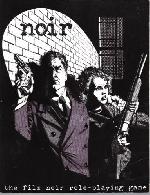
Review of Noir: the Film Noir Role-Playing Game
 Goto [ Index ] |
Unfortunately, my cautions were justified. Is Noir bad? No, but considering some of the terrific RPGs and supplements that have been released in the last few years, and the potential of the crime-and-melodrama genre, there just isn't much room for a mediocre RPG.
That's not to say there aren't some good things here. The general premise for the setting is inspired. Rather than be tied to a specific time and place, Noir is set in The City, which is a combination of all the film noir and gangster movie urban clichés, but with lots of room for GM (or "Director") to customize to his own tastes -- your city (or "City") can be have 1950s Los Angeles suburbs, 1940s Chicago industry and 1930s New York Art Deco skyscrapers, or it can be a Gotham-like mass of retro-futuristic spires, or a crumbling, snow-bound, Depression-era Montreal. As long as the basics are there, a lot of the style is left up to the GM. The book also describes a number of generic and not-so-generic neighborhoods to fit into the City as backdrops, hooks and local color (my favorite: New Harlem, where the jazz is hot, the party never stops, and the Tik Tok club is _the_ place to be).
It's too bad all this stuff is crammed into the last chapter, because the rest of the book is nowhere near as interesting. The biggest problem is the biggest section -- the rules. The book is 208 pages long, and 150 of those pages are devoted to the system, in large type, with lots of white space. The rules aren't really very bad, but they aren't especially good, either. I've played over a dozen RPGs, and by this time, the idea of reading, learning and teaching a new rule system just makes me cringe. And the Noir system adds nothing that I haven't already seen before, often better done.
Character creation is point-based, with attributes, skills, "pros" (advantages: they cost points) and "cons" (disadvantages: they give you more points), but it's also archetype-based: you pick a "Shtick" (a film noir or gangster movie character-type cliché, like Private Investigator, or Femme Fatale), which determines how you assign your skills, pros and cons. I have no idea why the authors felt the need to do it this way. It gives players all the flaws of a point-based system like GURPS ("Damn, I'm still ten points over; I guess I'll have to be deaf/poor/ugly/alcoholic to get the skills I want"), without any of the virtues (like flexibility of character concept -- there no way to do characters like Joel Cairo and Caspar Gutman from The Maltese Falcon, or the drifters from The Postman Always Rings Twice or Red Rock West). Sure, if you're an experienced GM, you can tweak the system to get what you want (and you'll probably have to), but what did you pay all that money for, t! hen? The skills, pros and cons have slangy names, like "flyboy" for "pilot, and "songbird" for "sing" to give them a 1940s feel, and I think that's a nice touch, but it isn't enough to warm me to the system.
Action resolution and combat seem fairly smooth, and are based on rolling multiple six-sided dice. Just about all new systems these days are based on rolling multiple d6 or d10 exclusively, and I think that's a good trend -- it gives you all the randomness you need without junking the table up with polyhedral dice that get used once a session. But the system doesn't do much to complement the genre or intended feel of the game, like Feng Shui's John Woo/Jackie Chan-inspired combat system, Over the Edge's abstract-to-the-point-of-Zen rules, or Call of Cthulhu's slowly spiraling Sanity. It doesn't even have any fun gimmicks like the card systems of Deadlands or Castle Falkenstein. Again, there are no serious problems, but there's also no reason I would bother to learn all the ins and outs of this system when I could just convert it to FUDGE, which is far more elegant (and free!).
Also, I didn't mention the editing, which is as bad as anything that wasn't a White Wolf first edition, and the writing, which isn't much better. Virtually every page has spelling, stylistic and grammatical errors, often, extremely stupid (like sentence fragments, and using apostrophes for plurals, and beginning half the sentences with "this" or "these"), which should have been picked up way before it went to the printers. Paragraphs are often larded with meaningless or sentences that should have been cut out or rewritten. Just opening the book at random, I find "In order to design an adventure, you need an idea." Do we really need to be told this?-- a college paper written like Noir would get lousy marks for composition.
Another problem is that the GM and player advice seems geared towards beginning gamers, and while I don't know Noir's intended demographics, I doubt many beginners would pick it up. For the players, there's a lot of "what is roleplaying?" and obligatory "violence is bad -- combat can kill you"-type stuff, some of it going on interminably, and not nearly enough "here's how Noir is different," and "here's how you can contribute to the mood." GM advice is either obvious (don't hose minority PCs with lots of racist NPCs, don't allow anachronistic, balance-shattering technology) or puzzling (why is every sample adventure "hook" basically a morality play? -- there's a lot more to noir than Noir lets on). And despite claims to the contrary, I can't see how a group with, say a Gangster, a Cop, a Femme Fatale and a Journalist could possibly stay together for more than one session.
Overall, Noir was a bit of a disappointment, and I can't recommend it. While the setting is very cool indeed, it makes up such a small portion of the book that it isn't really worth it, and the system is just dull. If Noir had been released as a book for FUDGE or GURPS, or with greatly abbreviated mechanics (and crisper, to-the-point writing would really have helped here), making more room for the interesting setting, it could have been something I would have gotten excited about. But as it stands, it's just good enough to make me wish it was better.
Style: 2 (Needs Work)
Substance: 3 (Average)

