

 Search
Review of Obsidian: The Age of Judgement
 Goto [ Index ] |
(To provide the most comprehensive review, I will first comment on the strengths and weaknesses of the book in general. This will be followed by a commentary on the content, by chapter.)
On the Outside
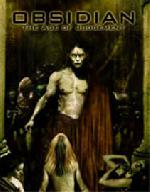
The book is a standard-sized hardcover, 264 pages in length. The cover artwork by Christopher Shy is stunning, depicting a subtly inhuman male standing before three scantily clad females, and it is awash in tones of brown, gray, and green. The look in the infernal man's eyes is unsettling, all the more so for being directed at the reader, and the gradual apprehension of the armored figures lurking in shadow behind him is a bit chilling. This is quite an appropriate image for a world where "desperate humanity wages war against the manifested legions of Hell itself," as the back cover states in simple, white text.
The final sentence on the back cover states, quite simply, "This is the Zone." That immediately conjured up images of William Burroughs' Interzone and Tarkovsky's excellent film, Stalker within my mind. Eager to see if the game lived up to such heady references, I opened the book...
The Look
The text is presented in a clear font on white pages, with simple, circuitry boardesque border about each page. The head of each page offers the chapter number, and the page number is clearly marked at the bottom of every page. The text is double-column and justified, which proves to be a little exhausting to the eye after extended bouts of reading.
The interior artwork is of high quality, and tends to be evocative of the intended "horror in a technological future" atmosphere for the most part. Some of the illustrations seem rather generic, with men in intimidating battle armor brandishing firearms of deadly appearance and immense size that would fit equally well in other books. There are many more images of toothy demons, mysterious figures shrouded in robes, and a couple of female subjects who can scarcely contain their nipples. I was reminded of the art featured in many White Wolf products, with frequent flashes of SLA Industries, which both speaks highly of the quality and offers a point of reference for much of the style.
There is no index included, and the table of contents only offers the page number on which each chapter begins coupled with the often vague chapter title. As it turned out, locating specific text within the book proved to be quite laborious with so little to go on.
The Words
The first substantial flaws in Obsidian became evident when I stopped perusing the artwork and set about reading. To say nothing of what the words said (see below), there were significant problems with how the words were put together. There were a great many typographical errors throughout the book, with approximately one appearing on every other page. There were also repeated occurrences of a homonym being used in place of the intended word; two examples being the frequent use of the word "populous" rather than "populace" when referring to the masses, and the recurring substitution of the word "ordinance" for "ordnance."
Much of the text was, to be blunt, poorly written, frequently rendering entire sentences indecipherable. All books of substantial length suffer from the occasional awkward sentence, but Obsidian was rife with invented words, strange combinations of noun and verb, vague usage of personal pronouns, contradictory text separated by a single sentence, and substitution of one proper noun for another without clarifying that the words are interchangeable. Not a few sentences bordered on the non sequitur. So as not to seem capricious, I will provide several examples from the book.
"Actions that stupefy the person performing them, and infusing abject awe or terror from those witnessing the action. Hopeless actions are beyond the scope of even semi-logical reasoning." (p.61)
"It is important to note the Players are playing Characters of extraordinary talents...Most encountered within the world of Obsidian are of equal or greater power, while some are lesser value." (p.39)
"First we roll 4D6 to figure out his Starting Essence. Four six-sided dice are rolled revealing that Gabriel has 15 Maximum Essence, a slightly higher than average roll." (p.53)
In the latter example, the phrases of "Starting Essence" and "Maximum Essence" are used, for the first time, in close proximity to refer to the same value which appeared earlier in the text only as "Spirit" and "Spirit Rating." Taken singularly, these instances seem easily dismissed. Strung together upon page after page, as they are in the book, the vague nature of the text is not a little mentally exhausting and confusing.
The writers of Obsidian also exhibit the inexplicable tendency to capitalize hundreds of words and phrases, ranging from those important to the gamers to those important within the fictional setting to those which are mistakenly capitalized in the mix. The function of capital letters, to set words apart as being noteworthy or unique, is completely lost in the veritable deluge of upper case. It is quite overwhelming reading about the Circles of Hell, their associated Kults, the Convokations of the Kults who wield Spirit Blades, the Mystics who oppose the Kults with their Rituals, and so on. It is not unlike reading e-mail written entirely in capital letters, and is compounded by being present on each of the 200+ pages.
Maze
This is an introduction to the world by way of short fiction. It was a bit foreboding of the problems in tone to come in that it was the account of disciplined soldiers performing actions of questionable wisdom. Upon reading this short story, I was reminded of other role-playing fiction that detailed cunning "veterans" performing actions that were more flashy and foolhardy than skilled, and I felt a twinge of concern.
Chapter One Obsidian Epoch
History
"The reputable nature of Humanity has never been fundamentally important, that is until the truth was discovered."
That is the rather vague sentence which opens the chapter, and was an appropriate harbinger of the confusion to come. Beginning on page 12, the history of the world of Obsidian begins...in the year 10,000 BC. What follows are 10 pages of mostly actual world history that is combined with the fictional world of the Circles of Hell and their servants, the Kults. While the premise of the corruption of Hell by Humanity and the subsequent manipulation of Humanity by the unseen Daemons is interesting, the presentation is convoluted and confusing. The history of the Circles of Hell is presented in slightly abbreviated form here, and is absolutely unnecessary as the same history is presented later in the book in a more complete fashion. Most of what is said in great detail throughout these ten pages could have been summarized in one, and would have proved far less confusing. Upon completion of the book, it becomes evident that there is absolutely no need for the inclusion of details about the Median Empire under the rule of Astyages in the year 570 BC, and that holds true for most of the other minutiae included here.
This confusing history also marks the appearance of a major flaw in layout, one which is carried throughout most of the book. The Nine Circles of Hell are mentioned, and each is fed by a sin of Humanity. The Circle of Torment, for example, if fed by the sin of Envy. The connection between each Circle and the associated sin is often tenuous, as evident by the example: torment and envy are not clearly connected terms. To make matters worse, a Kult serves each Circle, and the names of these groups are peripherally connected to the Circle or the sin, at best. This would not be a problem if that fact was stated clearly to begin with and the connections explicitly spelled out, but this connection is not made explicitly clear until page 107. In the midst of this detailed history which opens Chapter One, and which is filled with enough capitalized jargon to baffle the first-time reader, factions with names such as Internalists and the Undead begin appearing on page 15 with nary an explanation of who they might be. The grocery list of proper names is thus further muddied by the inclusion of names that lack any definition at all. The Internalists, it turns out on page 107, are the Kultists who serve the Circle of Avarice which is fed by the sin of Lust. That is actually one of the more intuitive Circle:Sin:Kult hierarchies.
This is simply more than the gamer needs to know. To play AD&D it is not necessary to know the detailed evolution of the Elven species, and to play Obsidian there is no need to know that the Assyrians were actually serving the Circle of Avarice in 900 BC. Even if this history is useful to the Narrator for providing a sense of the antiquity and perspective to the Daemons within the game, it is hardly useful coming so soon in the book.
On page 22, the history makes it to the late 20th century which seems a bit more relevant, and even that is basically dead knowledge to the human beings living in the world of Obsidian in 2299 AD. There follows details of the full-scale Daemonic invasion of Earth in the year 2026 AD, and some rather confusing references to the number of people left alive in North America. It seems that the history is indicating that only 513 people were left alive in the year 2072 AD, but later references to this period seem to contradict that figure.
This brings up another problem with the writing. Clearly contradictory terms and sentences are common, sometimes within the same paragraph. An example from this chapter would be when the number of trained combatants left alive is put at 125. Two sentences later, it is said that "most of the soldiers" refuse to respond to a distress call. The word "most" would seem to indicate that 63 or more of the soldiers did not respond to the radio distress. However, in the next sentence it is stated that 80 soldiers, or trained combatants (they are not necessarily equal, although the text uses the terms interchangeably) "went, and were never heard from again." This would put the number of soldiers who did not respond at 45, which is not "most" in any commonly used definition of that word. Coupled with the range of errors and quirks mentioned above, this frequent "yes means no" turn of phrase makes deciphering the text a chore.
Setting
This section details the Zone, a gargantuan city that stretches 22 miles in diameter and is a towering 15,000 feet high. The description of the Zone makes it seem very much like a city out of a cyberpunk setting, being both a Sprawl horizontally and vertically in this case. There is not much in the way of unique ideas here, outside of the "city" taking the form of a megalithic high-rise, and even that is a theme similar to other sources (i.e. Judge Dredd). There are curious abstractions present here, such as the fact that the Zone equivalent of television shows only court proceedings, public schooling, and combat matches, specifically "Arena and Colosseum matches." First, this seems like the writers are glossing over details for the sake of expediency. In addition, the fact that the Zone would broadcast combat matches at all, let alone exclusively, in light of the Unity and Darchomen (the closest thing to "good guys" in the setting) running the Zone and being aware of the sins which feed the Circles of Hell is simply not very believable. This would, at the least, seem to fan the flames of Hatred, if not Murder and Depravity if the matches are to the death, as the significant use of the term "Colosseum" would suggest.
I should take this opportunity to address what is a significant and deeply ingrained problem of the theology of Obsidian conflicting with the atmosphere the writers were shooting for. The forces which control the Zone are comprised of survivors of the Daemonic slaughter, who were gifted with their powers through the graces of the Greater Divinity in 2072 AD. It is not very subtly suggested that the Greater Divinity is the being called God by the Christian, Jewish, and other faiths. These first 45 humans to be granted supernatural powers were called Mystics, who then adopted the name Protectorate while fighting back the hordes of Daemons threatening Humanity, before finally becoming the Darchomen which works behind the scenes to direct the events playing out in the Zone. It is implicit that the Darchomen knows which sins are the food of Hell, yet the cyberpunkish setting of the Zone is filled with the typical dark future touches: combat matches on TV (death sports), drug use, legal prostitution, corporate culture and government sanctioned killing. All of which, of course, fall within the definition of hate, lust, depravity, greed and murder, which are most of the sins fueling the Daemonic hordes. The fact that these activities exist within what should essentially be a heavy-handed theocracy (since to violate the codas of religion within this world results in multi-limbed monstrosities being born into the world) reveals that the writers are not entirely sure what they want the world to be. Is it to be cyberpunk with the attendant vices and excesses and gray areas, or is it to be a battle between Good and Evil in a dark future where gray areas are tantamount to sin? Regardless of the efforts of the Kultists who work at cross-purposes to the Darchomen, the 35 very powerful Mystics, who quite clearly know that sins threaten their continued existence, would not allow the Zone to exist in the state described in the book, as it is made clear that they call the shots from behind the scenes. This is independent of what the reader's view of sin and Hell and God might be. It is internally inconsistent with the fictional world of Obsidian as outlined by the writers.
Chapter Two Elements of the Story
The Setting
This section simply defines the terms associated with role-playing, with advice on how to describe setting, provide direction for the characters, and develop themes.
The Players
The process of character generation begins here, and continues over thirteen pages. Character generation rules should be crystal clear and easy to follow. Enough examples of how to make the process intuitive and simple have been published by this date to provide a model for the process. Curiously, Obsidian falls resoundingly short of making the process simple, mostly through poor choices in layout. Again, terms are mentioned frequently here several pages before they are defined. To make matters worse, the example of character creation included does not follow the 7-step process clearly outlined in a bold black box on page 53. The Narrator would have to be intimately familiar with these rules prior to inviting players to generate characters, as some of the details must be ferreted out from the multiple pages and even further on in the book and the process if far from intuitive. The writers even admit that the "process may seem long and full of page flipping," which is far from a ringing endorsement.
The concept of Motivations is interesting, and should encourage role-playing if used as indicators of goals and ambitions. This is not particularly innovative, but a nice touch nonetheless.
The chapter ends with the complete rules for Experience, both how to spend it and to award it. It is a curious inclusion within the character generation chapter. Furthermore, there are optional rules for including a force known as "Ominous Fate" within the game. This fate is randomly assigned to a character at the beginning of each game, and allows the Narrator to inflict such unpleasant abuses as "a gun jamming during combat, falling while running from the Law, or the need for the Narrator to randomly choose one Character to be shot at." Essentially the unlucky character suffers the effects of what would be called "critical failures" or "fumbles" in other systems, but the dire consequences are doled out solely at the whim of the Narrator. The character can avoid such effects, however, by paying Experience points at the start of each game. A strange, admittedly optional, form of RPG extortion, and I can't imagine many players being very happy with the mechanic. Of course there is the option of buying the flipside of "Ominous Fate," which is "Destiny." This allows the character who hoards Experience points to be effective through blind luck, rather than through increased skills which would be the result of spending Experience in the traditional manner. Certainly a unique idea, although arguably a poor one which will alienate players.
Chapter Three Regulations
This chapter starts out strongly, with the writing becoming more coherent and focused. The first section is...
Mechanics
This details the dice rolling conventions and rules of the game. It is a simple mechanic for task resolution, with the Attribute or Skill being rated as a number of six-sided dice which are rolled, tallied, and compared to a set difficulty number. It is a binary system of success and failure, with no rules included for spectacular success or dismal failure. Apparently the need for unexpected fumbles and noteworthy efforts must be fulfilled with the aforementioned Ominous Fate and Destiny rules. Incidentally, the difficulty level of Impossible is superceded by the even more difficult level of Hopeless. This will probably provide for some unexpected, and perhaps misplaced, amusement amongst players if my gaming acquaintances are any measure. It might spoil the moment when the Narrator looks somberly at the player whose character must "shoot the knife out of the hand of a victim at 40-feet while in a car pulling a spin reverse" in order to save the Zone from imminent destruction, only to have the player dissolve into laughter when he is informed that the chaces of succes are beyond Impossible...they're Hopeless.
The descriptions of Skills are adequate and concise, leading to the next section,
Combat
While not ground-breaking, these rules are brief and effective. Being only five pages in length, they are readily understood and very straight-forward. Being somewhat abstract, there might be much missing here to frustrate a realist. The chances of striking a target with multiple rounds increases with burst fire, without any penalty for recoil, for example. The mechanics definitely lean towards transparency over realistic simulation. That is not a judgement of quality, simply an observation.
Driving
Comprising only a single page of text, this section presents vehicle movement and combat in an abstracted fashion. There is the unnecessary inclusion of jargon here, with 10 M.P.H. being termed a "mark." As many instances of the term "mark" in the book are accompanied by a parenthetical translation of the value into M.P.H., the utility of the jargon is questionable.
Explanation of Terms
This curious and inappropriate section title is seemingly the result of poor layout. It details the effects of Radiation, lists the dire mechanisms of Disease, offers a lengthy summary of the Spirit in game terms, goes on to explain how to construct a Portal into Hell, and closes with an explanation of self-installation of cybernetics and vehicle systems. The range of topics is formidable and haphazard, but rarely fit the bill of "terms being explained." All of the rules and expository text is clear when compared to earlier chapters, although the juxtaposition of these unrelated topics in the vacuum of a chapter dealing with game mechanics results in the text seeming abstract and free-floating for the most part. For example, it is difficult to see the practical effect of cybernetic self-installation coming as it does a lengthy chapter ahead of the equipment descriptions. The description and mechanics of Portals, likewise, would have been more at home in the section detailing the Kults in Chapter Four. Much of these topics tend to make more sense if read after the respective sections they are seemingly orphaned from.
Chapter Four Inhabitants
This is a marathon of a chapter, detailing the factions which influence the existence of the Zone, and detailing their various and sundry Rituals and Convokations. Being as lengthy and comprehensive as it is, it will be impossible to provide a detailed examination of the content. I will concentrate, rather, on the salient points.
Mystics
Humans gifted with the supernatural ability to wield magical forces. There are pure Mystics who strive to uphold the Code of Humanity, and two offshoots; Alters and Visionaries. Alters are dedicated to destroying Kultist society, and tend to play fast-and-loose with the Code of Humanity in order to achieve this end. Visionaries are concerned with defending Humanity from Hell, and tend to believe a strong defense is the best offense, which is diametrically opposed to the Alter philosophy. The Code of Humanity is not an abstract concept, but clearly dictates that the "following sins are to be avoided and halted: Hate, Greed, Addiction, Envy, Sacrifice, Murder, Depravity, and Stagnation." Regardless of the curiosity of the inclusion of Sacrifice amongst Murder and Depravity, the majority of these terms would serve as a fitting capsule summary of the society within the Zone. Which would mean that Mystics, and their mysterious and powerful counterparts the Darchomen, would be compelled to alter virtually every aspect of the Zone as detailed in the book, and as mentioned earlier. The text never states that the Mystics and Darchomen are actively working against the goals of the Zone. Indeed, the Darchomen "uses the resources of the Zone they created," which indicates quite explicitly that the Code of Humanity is scarcely adhered to, or even seemingly paid lip service.
Rituals
These are the abilities which set Mystics apart from their human counterparts. These Rituals are readily available during character generation, and many of them produce formidable results. This allows characters to be proficient users of "magic" from the outset, and a wide range of Rituals allows multiple Mystic characters to possess non-redundant Facets. The inclusion of such a well-developed system of "magic" is definitely a strength of the system, and the range of abilities is impressive and creative. The most noteworthy weakness of this section would be the routine use of archaic and obscure words for the Rituals, which is a direct descendent of the White Wolf school of naming uncanny abilities. The atmosphere it adds is frequently counterbalanced by the baffling names, forcing the reader to reference the description of, say, Fenestra, to determine that it involves the perception of the hidden. Furthermore, many of the Ritual names come off sounding a bit silly, especially the unfortunately named Ritual of Cyberrhea. This could unintentionally kill the dark and somber mood the game shoots for.
Kultists
These are the Daemonic counterparts to the Mystics, save for the Kult of Spiritual Essence which tends to work towards the same goals as the Mystics. Not to belabor the murkiness of the Good vs. Bad themes of the game, but one Circle of Hell, the Azure Hyaline, produced Jesus the Christ in an attempt to thwart their corrupted brethren on Earth. The Azure Hyaline is separate from the mysterious Ninth Circle, which sounds rather like Heaven with a sequestered God in the text, but tends to share the goal of fighting the Daemonic forces. All of which provides another quandry when all things as described in Obsidian are considered. The Daemons were once living in a unified Plane of "good," where they "lived a mindless existence of pleasuring and nurturing each other." All of this fell apart, however, as the sins and perversion of Humanity corrupted this Paradise, forcing the Divinity to split the Plane into Circles, each being corrupted by a specific sin from the Earth Plane. Only the Ninth Circle and the Circle of Azure Hyaline are seemingly uncorrupted when the game begins. Which begs the question: Why does the Divinity strive to protect Humanity at all, when it was the corrupting influence of Humanity that tore the Plane of good apart and resulted in the Circles of Hell? This is all the more baffling in light of Humanity's continued reliance upon murder, greed, addiction, and all of those other corrupting sins which continue to feed the denizens of Hell. Would not the Divine be better served by eliminating the flow of sin at the source by eradicating Humanity entirely? Perhaps all of this will be explained in future supplements, but that will hardly serve to satisfy inquisitive players in the meantime. The presence of the Kult of Spiritual Essence within the Kult chapter serves to emphasize this discrepancy, as they are described as working at cross-purposes to the "evil" Kults, when logically they should also be striving to destroy Humanity before their Circle goes the way of the other Seven Circles.
If this summary is confusing in the least, then the tone of the book in regards to theology has been adequately conveyed.
The Convokations of the Kults are specific more to the name of the Kult than to the theme of their Circle, for the most part. The Kult of the Machine, for example, wields Convokations predominately dedicated to influencing machines and electronics, despite being tied to the Circle of Torment. We all know how agonizing a hard drive crash can be, but the connection between Torment and Machine is tenuous, and it is somewhat curious that the Convokations of the Kult are not more centered on the concept of Torment, which is the source. The Convokations are plentiful, and mostly produce interesting effects. A beginning Kultist, for the record, has access to more powerful Convokations than a beginning Mystic's Rituals, and all it requires to produce the often powerful results is the sacrifice of a few of the plentiful homeless "scrags." A Kultist of the Internal, for example, could invoke the terrifying power of Body Flay, which results in "a violent explosion" in which serrated utensils "rip from inside the victim, turning them inside out." This effect can be achieved by killing two average humans, or one human with a high Spirit, and using their Spirit to invoke the Convokation.
Daemonic Creations
This lengthy section provides rules for summoning and binding Daemons, and includes rules for generating the Daemon summoned. Daemons command frightening abilities, which strangely enough are called only "abilities" without a capital letter, inexplicably breaking the pattern of capitalizing all important terms. The rules are clearly laid out, continuing the general trend of this chapter, and the presence of these Daemon servants makes Kultists even more powerful yet. The combination of powerful Convokations, and the ability to bind Daemons, might result in Kultists of unbalancing power within the game. The ability to kill with a thought and a sacrifice, coupled with a powerful inhuman servant, will undoubtedly offer clear advantages over the character who is a Corporate with a big handgun. The issue of character balance is definitely a concern.
Corporate Entities
This section provides additional details for running a character with the Corporate Ethos, and provides the framework by which to define their corporation. The advantages of such a character is a bit dry compared to the previous sections detailing Mystics and Kultists, but are not without merit. Again, the rules are concise and clear, and there are rules for generating corporations from scratch. These resources are useful, and would even prove useful if adapted to another setting, much like many of the Rituals and Convokations in the above sections. These eight pages include some interesting ideas on the strengths available to fictional corporations of varying sizes and resource levels. Resources are purchased with points, much like character generation, with advantages such as Large Clientele and Security Force costing differing amounts of points.
Contacts
This brief section details a variety of Contacts which are available to some starting characters. The archetypes range from The Pusher to Arms Dealer, and provide the sorts of perks one would associate with the occupation. This is not a terribly inventive or informative section, providing brief summaries of the obvious services and information these Contacts offer. Still, it is written with the usual clarity evidenced in Chapter Four.
Chapter Five Tools of the Common
This chapter is basically an extended catalog of technology, ordinance (sic) and body armor, cyberwear, and drugs available in the Zone.
There is a brief section detailing Credits, the cost of living, and the costs of specialized services, such as medical attention and prostitution.
This is followed by a catalog of general equipment, not unlike the sort found in many other cyberpunk games.
Armor and ordinance (sic) is covered next, and this section is quite detailed, as indicated in a prior review. Over two dozen specific weapons are detailed, and many of the names will sound familiar to fans of industrial music (with nods to Skinny Puppy and RevCo, amongst others). It is somewhat telling of the intended focus of the game that the weaponry is so resolved, and the reader gets the sense that this stuff if intended for frequent use by characters. A small section, almost an afterthought, is tacked on to detail primitive melee weapons. This nearly dismissive summary of knives and blades reinforces the idea that the writers are encouraging action and violence of the rapid-fire variety.
A section on vehicles and vehicular modification follows, and this is, again, mostly standard fare. Not to say it is bad, but nothing out of the ordinary, and most of this material might appear in other dark futuristic games.
The Cyberwear section is quite detailed, and provides some interesting modifications which are not too far removed from previous cyberwear described in multiple games.
The chapter closes with a summary of Security Systems and Biochemicals (i.e. drugs, not amino acids and nucleotides). Again, these sections are concisely presented, achieve what they are intended to do, but do not break much new ground in terms of what has come before.
Chapter Five is rather straight-forward, much like the previous chapter, and the writers seem to remain better focused when they are providing lists of Rituals, Convokations, Corporate resources, and equipment.
Chapter Six Antagonists and Protagonists
This chapter begins by detailing the history and geography of Hell, much of which has been included in prior chapters. The descriptions provided here are less confusing, coming as they do near the end of the book, and better organized than earlier references to the Circles of Hell and Daemons. The aforementioned problems with the theology are repeated here, but do not bear repeating. Many of the descriptions of the Circles of Hell provide some evocative landscapes, although it is unlikely characters will be visiting them with the scant information provided here. The alien and cruel worlds do make future supplements detailing the Circles seem promising. It is not necessarily unique atmosphere, but the Circles manage to successfully reference several effective horror conventions, from the Barkeresque Box of Under to the nearly Lovecraftian Circle of Requiem.
There follows a listing of Corporations of importance, with each corporation receiving a paragraph of detail. This will allow specific details to be dropped into the world of the Zone, providing much needed detail.
Next is a brief summary of the structure of the Law, the Mystical police force which, well, polices the Zone. There is a selection of Law-issue weapons, equipment, vehicles, and cyberwear included here. The section closes with a summary of infractions and their associated punishment, with Kultist-related activity carrying the harshest penalties of death or exile into the Daemon-infested Wastelands which surround the Zone.
Finally, the chapter closes with the presentation of several religions practiced within the Zone, from those which are Kultist covers, to those which are sympathetic to the Mystics, to finally those which are neutral. This is a lengthy section, providing substantial amounts of detail about each religion or church. This provides an interesting insight of how the invisible Divinity Wars affect the everyday lives of Zone inhabitants.
Chapter Seven The Appendix
This provides a list of Arcane Artifacts, which are "rare and prized objects that are imbued with unfathomable or unholy powers." These are objects of antiquity, some of which come from the convoluted history which opened the book, which provide bonuses to Attributes and Skills when owned or utilized. The items are varied, and provide some interesting effects. The concept of magic items is a familiar one in many game settings.
Arcane Rituals and Convokations round out the chapter, being rare and nearly forgotten powers unavailable to starting characters. The effects follow the pattern established by the earlier Rituals and Convokations.
The final pages of the book are a glossary, a single-page summary of the charts and tables scattered throughout the book, two pages of advertisements, and a double-sided character sheet followed by six blank pages.
A Look Back
I have read Obsidian twice, and have referred to it often during the course of this review, so have a solid familiarity with the book. Upon reflection, it is a very uneven book.
The writing is not very good, either in grammar or syntax, and is near the bottom of the many games I have read in my 17 years of gaming in terms of overall clarity. Part of the problem is the writers' insistence on creating a clumsy and pervasive jargon, and also partly due to what seems like a struggle to make the words sound proper or important. Words like "visualistic" and "aphotic," and phrases like "be wary to judge for thyself upon unsubstantial evidence and inconclusive proofs" simply serve to cloud the meaning of the text. Much of the writing is rather overblown and self-important, which is made all the more frustrating when coupled with the frequent errors and dubious word usage. The proofreading is, frankly, atrocious, with 24-point boldface section titles incorporating clear typos, or perhaps the writers simply failed to realize that "ordinance" does not mean "small arms." Someone along the line certainly should have noticed errors of that magnitude in a book selling for $28 and probably costing no small sum of money to publish.
The layout is significantly flawed, with the confusion present in the first two chapters, and part of the third, presenting a daunting hurdle that not all readers will choose to clear. The history which opens chapter one is ill-placed, poorly edited, and unnecessarily convoluted. Followed as it is by the problematic character generation rules, few gamers will make it to page 60 where the text begins to flow, or at least begins to make sense consistently. Part of this problem might arise from the fact that a single person, Micah Skarita, is listed as a Writer, Developer, Art Director, and Layout artist and Typesetter. Common industry wisdom would have it that this is simply too many hats for a single person to wear, and the flawed layout might very well be for this reason.
The theological discrepancies, for example those individuals dedicated to eradicating sin actually creating and maintaining a 3-mile high Tower of Sin, is simply too much to expect many players to swallow. The reasons for these glaring discrepancies are probably revealed in the Foreword, in which the evolution of Obsidian is discussed. The game concept was developed over the course of eight years, during which "anarchy was replaced with an evil embodiment, the law traded with Mystics blessed by a Greater Divinity...Daemons were introduced relatively later in the project, as were the creation of Hell's Circles." This sheds considerable light on the distinct feeling that the game is two separate genres which are poorly superimposed. According to the writers, this was clearly intended to be a cyberpunk world, with elements of horror and religion grafted on much later. These rather fundamental flaws in the background make adapting the setting a daunting proposition, so it is questionable whether it is worth the work to end up with either a cyberpunk world or a dark future horror setting, both of which can be bought fully realized elsewhere.
The quality of the artwork is above reproach, as stated above. The content of the some of the works is a bit adolescent, but it certainly fits the genre(s) and complements the book for the most part.
There are several chapters which are devoid of the rampant errors of Chapters One and Two. The problem being that the majority of what these chapters offer can be found in other games which are not flawed by layout and concept. There are plenty of systems with rules for magic, summoning and binding demons, and cyberpunk technology and weaponry. While the game is not terrible when it presents these elements, the abovementioned problems certainly reduce the overall value of the book. It is questionable whether Obsidian in its currently flawed state is worth the price for what turns out to be an uneven mix of ideas and rules about magic, supernatural horrors, weaponry and cyberwear.
The problems are simply too frustrating and crippling, in my opinion, and the redeemable content is not worth the price and the required work to separate it from the chaff. In the simplest sense the game intended to be a dark future world plagued by horror, but it only managed to succeed at the "dark future" and "horror" elements separately, without ever managing to combine them efficiently into a cohesive whole.
A significant overhaul of the layout, a simpler and more direct writing style in Chapters One through Three, and a simplification of the background so as to eliminate the glaring discrepancies would certainly go far in improving Obsidian The Age of Judgement. I think with a bit of reshuffling of personnel and a simpler approach, the Apophis Consortium has potential as a producer of interesting games and products.
Style: 2 (Needs Work)
Substance: 3 (Average)

