

 Search
Review Editing
Review of Tribe 8 Companion
 Goto [ Index ] |
Personally, I dislike this continual reference to other products, mostly because I do not wish to be bound to the release schedule of any company when writing and running games. Also, and not insignificantly, I feel it is a heavy-handed way of doing business. This is my personal peeve, and I know that many gamers do not share it. Still and all, it is worth noting.
So is the content of the Tribe 8 Companion worth the price?
That depends on how prominent a role the Tribes and the Keepers will play in your Cycle.
Presentation
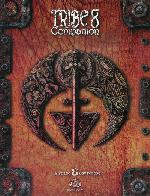
Yet again this is an attractive Dream Pod 9 release. In fact, I have yet to see an unattractive Tribe 8 product, and I usually end up buying them based solely on how well the cover artwork will complement all of the prior releases I own. Of course, the interior layout is equally impressive, so I can feel justified in being such an easy sell. The art is plentiful, and usually specific to the accompanying text.
A detailed Table of Contents is included, although the customary comprehensive index is sorely lacking from this release.
Introduction
This is a single page providing a hint of what is to follow through the usual first-person narrative. It is nice to see that Dream Pod 9 is maintaining the personal account style of presentation, and this meshes nicely with the subsequent chapter.
The Lost Tribes
This chapter provides narratives detailing the history and current state of the Tribes of Joshua and Mary, the dead Fatimas.
Without giving too much away, the Joshuans live beyond the borders of Vimary, having lost their place within the Tribes soon after the death of their Fatima during the Liberation. There is a definite fatalistic air to the Tribe, and their noble sacrifice is a nice contrast to the scheming and plotting amongst the followers of the Seven Sisters. The potential for tragedy through introduction of the plight of the Joshuans into a Cycle is tremendous. Interesting questions regarding the Fallen connection to Joshua and claim to the mantle of the Eighth Tribe would also be raised by the appearance of this Tribe.
The Marians, in contrast, live amongst the Tribes, while not abandoning the ways of their deceased Fatima. There is a strong sense of a dying tradition in the account of this Tribe, not unlike the Joshuans. The inclusion of Marians within a Cycle will provide an air of secrecy and covert activities, as they go about the business of their Fatima beneath the notice of the other Tribes.
The inclusion of both Lost Tribes in the same Cycle would not be required, and their very natures are nearly mutually exclusive. The appearance of Joshuans would fit best in an active Cycle which stretched beyond the safe borders of Vimary, while the Marians would work best as characters within the politics and scheming of the Tribes.
Quest Circles
This chapter is also presented as first-person accounts, providing atmosphere and background without cluttering either with numbers and rules. The Circles detailed are groupings of followers of various Fatimas to achieve wither short- or long-term goals. Harvest Circles are small groups assembled for the completion of a short-term goal. Horizon Circles are formed to address "far-reaching endeavors," and tend to survive through changes in personnel over long periods of time. Moon Circles are formed by the Fatimas, rather than the influential sponsors of the previous Circles, and their goals are usually secretive. Finally, the Shadow Caste Circles operate without the blessings of the Fatimas, working to achieve dubious or unpopular ends at the risk of being discovered.
The conceit of the Circle, of course, is ideal for a group of PC's. It explains why the diverse characters would be working together, and provides them with clearly delineated goals to strive towards. The downside, of course, if the characters are required to be Tribals, whereas most material in the Tribe 8 line so far has encouraged characters to be Fallen. This might not be easily adapated to an existing Fallen Cycle, but would certainly be useful for subsequent Cycles set within the Tribes.
The Keepers
This is another first-person account chapter, this time dealing with the details of the Keepers in the Rust Wastes. There is quite a lot of new information presented here, describing new Keeper locales (the Junkyard, the Shack, Bunker 13) and factions (the Derelicts). There is probably not enough to confidently run a complete long-term Cycle set fully amongst the culture, but there is certainly enough to create many interesting scenarios and settings. Depending upon the scope of the Cycle, the information provided might allow for a Keeper-exclusive group of characters. Combined with the information provided in the rulebook and the Vimary sourcebook, the Keepers certainly become a potential source of varied and convoluted sideplots.
St. Christopher
This is one of the two included quests. The plot deals with a Harvest Circle comprised of the characters, formed by Tera Sheba and Joan. The quest is convoluted and interesting with relevant NPC attributes provided, but is somewhat mutually exclusive with the following...
Sangreal
This is the second quest, and assumes the characters are amongst the Fallen. It might be possible to run the prior quest while the characters are within the good graces of the Seven Sisters, and then utilize this after their Banishment if the Cycle spans such a period. This, again, is an adequate story, complete with NPC attributes, although scarcely the selling point of the book.
Weaver Resources
This rather substantial chapter closes the book on a high note. There are game mechanics covering all of the "flavor" chapters, including rules for forming Circles, tips for using Keepers in Cycles as either NPC's or PC's, character creation guidelines for Joshuan and Marian characters, and new Eminences and Aspects for the two Lost Tribes. Of course, not all of this information will be relevant for a single Cycle, but it provides plentiful ideas for multiple Cycles involving Tribal, Keeper, and Lost Tribe characters.
Next are notes on the relative populations of Vimary, with each Tribe being defined with numbers. This is followed by a lengthy description on the bartering value and needs of each Tribe, and tips on using bartering within the game. Several pages of detailed combat rules are included next, many of which are modular to allow mixing and matching by the Weaver. With the included rules, combat can become quite detailed, or all additions can be ignored to retain the streamlined combat rules provided in the core rulebook.
The book ends with a Synthesis FAQ, which is available online at the Dream Pod 9 website. Its inclusion here is convenient, although not vital.
Summary
As I forsee running multiple Cycles within the world of Tribe 8, the disparate information provided within the Tribe 8 Companion promises to be useful in the long run. If you plan on Weaving Cycles within a narrow range, such as strictly from the Fallen perspective, you might not find the entirety of this book to be of use. There is enough variety, however, that even the narrowest of Cycles would benefit from some amount of the background and mechanics provided. It would be worthwhile to weigh how much of the book will be useful with the relatively substantial cover price. In terms of the absolute utility of products, this release definitely ranks below the Vimary sourcebook, but I found it a more worthwhile purchase than the heavy-handed quests found in the Children of Lilith.
Style: 5 (Excellent!)
Substance: 4 (Meaty)

