

 Search
Review Editing
Review of Spycraft
 Goto [ Index ] |
Spycraft
AEG is one of the established game publishers banking on a strong showing from d20 products. They began their efforts with their popular mini modules targeted at D&D players released under the d20 System license and went on to create source materials for their Legend of the Five Rings setting utilizing the D&D Oriental Adventures book.
Spycraft is AEG's first stab at a full d20 based game and will be the basis for an upcoming setting, Shadowforce Archer. As the name implies, it is a game targeted at recreating the over-the-top superspy tales perhaps most solidly characterized by the James Bond novels and movies.
A First Look
Spycraft is a 288-page hardcover book, priced at $34.95. This delivers a price per page of around 12 cents a page. This is similar to other d20 books of this size that I have reviewed (Star Wars, FRCS, and Kingdoms of Kalamar), but those other books are full color, have licencing fees, or both. It may make this book seem a bit expensive.
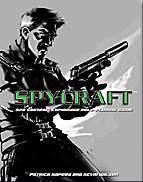
The cover of the book is silver and black, and depicts a shadowy image of a man bearing an automatic pistol with a silencer.
The interior is black and white, with borders and chapter and section headers printed in a silver ink. The silver looks attractive, but catches glints of light that can make the book hard to read. The art is comic book style ink art. The art varies in quality from mediocre to good. The layout is very attractive and displays high production values.
The typeface is compact but readable and delivers good text density. The writing style is very good, as is the editing; however, there is very little in the way of flavor text.
Based on the price per page, text density, and production values, the book delivers a fairly good value.
A Deeper Look
Spycraft is arranged into 9 chapters plus an introductory section and a character sheet. The introductory section touches on the basic concept of the game, expectations the players should have, an introduction to the upcoming Shadowforce Archer worldbook, basic changes in Spycraft from the core d20 system, and terminology used in the game. To touch on the last, in Spycraft, a gamemaster is called Game Control, and an adventure is called a serial.
The contents of the 9 chapters of the book are as follows:
Chapter 1: Agent Creation
The first chapter contains the rules and rules modifications you will need to create characters for the Spycraft system. It doesn't dive straight away into mechanics. It provides a short list of references elsewhere in the book to familiarize you with the types of activities your character will need to be familiar with, and some questions to think about when conceiving your character.
The first aspect of character generation in Spycraft that differs significantly from the baseline system is Department. Department is the division of the generic spy agency that trains the character, and it mechanically fills the shoes that race does in the base d20 rules; obviously, since Spycraft is set on an analog of modern-day earth, the only arguably intelligent race is human.
There are a total of 8 departments you can select for your character. Except for one, they are labeled by a "D" followed by a number. The departments are:
- D-0: The Home Office: The Home Office is the breeding ground of "prototypical superspies." Spies trained by the Home Office get a bonus to Action Dice rolls (see the section on action dice in the chapter four description), additional class skills, and a bonus feat related to covert operations or chases.
- D-1: The Power Brokerage: The Power Brokerage represents the political elite of the agency, who influence through guile rather than brawn. They receive a bonus to Charisma and a penalty to Strength. Members of the power brokerage also have a bonus to their Budget Points and Gadget Points, as well as bonuses to Diplomacy and Intimidate checks, and a bonus Style feat.
- D-2: Military Operations: The Military Operations department is responsible for the application of military tactics and hardware. They receive a bonus to one ability of their choice and a penalty to any one ability of their choice. They receive a bonus to any one class skill and a bonus Combat feat.
- D-3: Computer Espionage: Those of the computer espionage division are experts in using tools of the information age in their intelligence efforts. They receive a bonus to Intelligence and a penalty to Wisdom. They receive a free souped-up computer, a bonus to computer and electronic rolls, and a bonus Gear feat.
- D-4: Urban Assault: Those trained by the Urban Assault department focus on combat in close quarters. They receive a bonus to Dexterity and a penalty to Intelligence. They receive a bonus to Spot and Hide checks, a bonus to attack rolls when taking a ready action, and a bonus Ranged Combat feat.
- D-5: Black Ops: Members of the Black Ops department are tough and live among corruption. They receive a bonus to Constitution and a penalty to Dexterity. They gain extra vitality and wound points and a free Melee Combat feat.
- D-6: Wetworks: Characters trained by wetworks are experts at unarmed combat. They receive a bonus to Strength and a penalty to Constitution. They receive bonuses to initiative and Reflex saves plus a bonus Unarmed Combat feat.
- The Basement: The Basement is an obscure office that is relied upon to deal with fringe elements such as cults and serial killers. Characters trained by the Basement receive a bonus to Wisdom and a penalty to Charisma. They receive bonus skill points and a bonus to their Will save, and any Basic Skill feat.
It seemed to me that the Departments could easily get trashed by the GM's setting assumptions, and in some cases the Departments themselves seem a little cryptic in nature. Yet it does seem like they wouldn't be that hard to tweak, and like races would be a way to add an emphasis to a character.
There are 6 new core classes provided just for Spycraft. As with standard classes, the Spycraft classes define details such as class skills, base attack bonus, save bonuses, starting armor and weapon proficiency, and class abilities. In addition, your class and level provide a defense bonus (which applies to AC), an Initiative bonus, and new items called Budget Points and Gadget Points. Like d20 Star Wars, the bonuses use progressions not a standard part of the d20 System, but seem internally consistent.
The six core classes for Spycraft are:
- Faceman: The faceman is an expert in social interaction and disguise. In addition to a set of class skills relating to this pursuit, the faceman receives class abilities dealing with communications, discerning facts about others, disguising oneself, and lying effectively.
- Fixer: The fixer is a character specializing in acquisitions and stealth. The fixer's class abilities include d20 rogue staples such as evasion, sneak attack, uncanny dodge, and some rogue-like special abilities from which the character is allowed to choose.
- Pointman: The pointman is a leader and a sort of Jack-of-all-Trades. The pointman has abilities assisting other members of the team, as well as access to additional class skills and abilities.
- Snoops: Snoops are experts in gathering intelligence by technological means: computers, cryptography, and electronics. Snoops have class abilities that let them ferret out clues and to better repair or utilize electronic equipment.
- Soldier: The soldier is the combat "heavy" of the Spycraft system. The soldier receives extra feats as a d20 fighter does, but also gains other combat related class abilities.
- Wheelman: The wheelman specializes in the use of vehicles. The wheelman's class abilities allow him to handle vehicles better, and he gains bonus vehicle related feats.
Multiclassing is possible, and unlike the core d20 system (and like d20 Star Wars), there is no experience penalty for multiclassing. Additionally, one class ability of each class is called a Core Ability. A character may only receive the core ability for the first class.
Chapter 2: Skills
Chapter two presents skills to be used with a Spycraft game. The chapter contains many of the same basic attributes found in the D&D 3e PHB skills chapter; however, there are a few differences.
The most obvious difference is the skills that are available. Where possible, skills still appropriate to the setting from the core d20 system are kept, with perhaps some minor tweaks to accommodating the modern setting. Other new skills are added as appropriate to the setting: Boating, Bureaucracy, Computers, Cryptography, Cultures, Demolitions, Driver, Electronics, First Aid, Hobby, Mechanics, Pilot, Sleight of Hand, Sport, Surveillance, and Survival.
Another difference when using skills in Spycraft is that like weapons in the d20 system, skills can have critical successes if you roll high; they can also have critical errors if you roll low. You do roll the dice again to check to see if you get a critical. Rather, you can spend an action dice to get a critical success after you roll high enough, or an opponent can force an error if you roll low enough.
Chapter 3: Feats
As with the d20 base system, feats are special abilities or enhancements that your character gains while advancing levels. As with the skills, some skills are straight out of the core d20 system rules; others are new. In Spycraft, feats are divided into 6 categories:
- Combat Feats: Combat feats obviously enhance a character's combat capabilities. Combat feats are further divided into Basic Combat Feats, Melee Combat Feats, Ranged Combat Feats, and Unarmed Combat Feats. Many of the Basic Combat Feats are directly derived from the d20 System rules such as Improved Initiative, Iron Will, Endurance, Expertise, and so on. Melee combat feats include some classics such as Power Attack and Cleave, as well as a few new feats such as Flashing Weapon (allows the character an additional attack at -2, like the d20 monk's Flurry of Blows ability) and Master Assassin (increases the threat range with a melee weapon and does not require an action dice expenditure to turn a threat into a critical hit). Ranged Combat Feats include classics such as Point Blank Shot, as well as new feats such as Quick Reload (can reload weapons as a free action). Finally, Unarmed Combat Feats provide feats that improve your damage and other capabilities in unarmed combat.
- Chase Feats: Chase Feats are pretty much all new and add to a character's capabilities in driving in combat or other hazardous driving situations. Examples include One Hand on the Wheel (reduces penalties when doing some other task while driving) and In My Sights (increases your threat range when firing against vehicles).
- Covert Feats: Covert Feats enhance a character's abilities to get around and do things without too much attention. For example, Hidden Run lets you move at full speed without a penalty to Hide and Move Silently checks, and Traceless makes you more difficult to track.
- Gear Feats: Gear Feats are a small selection of feats that improve your access to equipment. Extra Budget and Extra R&D Support increases your Budget Points and Gadget Points respectively. Signature Gear and Signature Gadget or Vehicle provide you with a piece of equipment with improved characteristics when you use it.
- Basic Skill Feats: These feats are all basic skill enhancing feats similar to feats such as Alertness in the d20 rules. Each feat requires one or more ranks in the affected skills. Each such feat grants a 2 bonus to each of 3 skills, and the skills receive an improved threat range.
- Enhanced Skill Feats: Enhanced Skill Feats include feats that can improve on any Basic Skill Feat, and other Feats that allow you to use existing skills in new ways. For example, False Start reduces the time wasted on a failed skill check. Training simply gives you 4 extra skill points.
- Style Feats: These feats enhance the character's ability to interact and rub elbows. Card Shark makes you very good at gambling. Filthy Rich makes your character rather wealthy. The Look improves Charisma based checks against members of the opposite sex.
Overall, I have to say I am fairly impressed with the feat selection. There are plenty of options to make your character distinctive, they all seem mechanically sound, and other d20 publishers should sit up and take notice of the breadth of genuinely useful feats that aren't directly related to combat.
Chapter 4: Finishing Touches
The Finishing Touches chapter provides a number of additional details, most of them new and unique to Spycraft.
The first detail is Backgrounds. Backgrounds are somewhat close to flaws or disadvantages in other games. You must expend a number of skill points to get a Background. The Background becomes a sort of subplot (or even main plot) that the GM can use to torment the player. Whenever a Background pops up, the character gets bonus experience points for it.
I'm not sure what to think about Backgrounds. On the bright side, I think they are better than typical disadvantages that are simply credited to your "points" or other resources of a game; since you have to buy a Background with skill points, you probably wouldn't take one to add to your character in the short term. I think that I might have trouble parting with skill points for Backgrounds, however.
Action Dice are perhaps the most exciting innovation in the Sypcraft rules. PCs and major NPCs receive a number of Action Dice to use at the beginning of each session. For PCs, level determines the number of Action Dice. For example, a 1st-level character gets 3 four-sided dice that can be used during the session; a 20th-level character gets 6 ten-sided dice. Some uses of Action Dice don't involve actually rolling the cited type of die.
In addition to the automatic Action Dice all PCs get at the beginning of a session, the GM can reward players with additional Action Dice during the game for exceptional contributions to the game, such as exceptional role-playing, leadership, or problem solving.
Ways that you can use Action Dice include:
- Adding to a Die Roll: After you make a roll but before the GM describes the result, you can decide to roll one or more Action Dice to add to the result. This includes attack rolls, skill checks, damage rolls, and so forth. Action Dice cannot be used to modify permanent boons to the character such as hit dice rolls. Action Dice rolls are open ended, so if you roll the maximum roll on an Action Dice, you can roll the dice again and add the results together. This approach has some minor probability foibles, similar to the old Deadlands system (which uses an open ended dice system with differing dice for its basic resolution system). Under some circumstances, you are better off rolling a smaller die when you are working with an open-ended system with varying die types.
- Add to Your Defense: You can also roll Action Dice to add to your defense to keep from being hit in combat. The bonus lasts until the end of the round. Considering that the d20 System de-emphasizes the role of the round, I think it would have been better to have the bonus be until your next turn.
- Activate Threats and Errors: As mentioned earlier, the Spycraft version of the d20 system has threats for more activities than combat rolls. It also has a new converse effect, errors, which are the potential for an adverse effect if an opponent rolls low. Unlike the core d20 system, these events are not purely random; you must expend an Action Dice to turn a threat into a critical success, or an error into a critical failure. For example, if you roll a threat using a weapon and expend an Action Dice, it is applied directly to the opponent's Wound Points. Or if an opponent is trying to shoot you and the GM rolls a 1, if you expend an Action Dice, his gun might jam.
- Heal Yourself: If your character is not engaged in combat, you can expend one or more Action Dice to heal 2 WPs per die or VPs equal to a roll of the dice.
- Ask for an Inspiration Check: If you are stumped during the game, you may expend an Action Dice to make an inspiration check. The Inspiration check is a level check made against the DC set by the GM. If the roll succeeds, the GM gives you a hint to move the game along.
- Ask for a Favor Check: If you need assistance from the agency to perform a task (other than by fellow PCs), you can spend an action die to request a Favor Check. Like an Inspiration check, a Favor check is a level check against a DC set by the GM.
Overall, I like the effects that Action Dice would have on the game. It really is a fairly central mechanic that emphasizes the larger-than-life nature of the heroes, and I like that it gives the GM a resource to kick an investigative game along if the players get stuck, without giving the clues to them on a silver platter.
The chapter rounds out with details on personal gear and character details such as a name, codename, age, gender, physical characteristics, and personality traits.
Chapter 5: Gear
The Gear chapter covers equipment and the means of getting it. Equipment budgets are split into three categories: budget points, gadget points, and field expenses. Each is distinct and they cannot be interchanged. Budget points are used to buy relatively normal equipment. Gadget points are used to requisition superscience vehicles and equipment. Field expenses are handled in terms of dollars, and are used for in-play expenditures.
All agents receive an allotment of budget points for their own personal gear, depending on their class and level and Charisma modifier. Each agent also has a budget allotment depending on the difficulty and threat of the mission. Gadget points are determined by class and level and difficulty / threat of the mission. Field expenses are determined by a random number plus a number determined by class and level, and you can garner emergency expenses by trading in part of your XP bonus for the adventure. All of these except for personal budget can be shared between team members.
As you might expect, the remainder of the chapter is filled to the gills with modern equipment (including weapons, armor, and other equipment), as well as exotic gadgets that are the stuff of spy movies such as grappling hook belts and exploding pens.
Chapter 6: Combat
Combat in Spycraft uses most of the same conventions as the d20 System rules, but with a few differences. There are accommodations for modern weapons, as should be expected, with rules for firearms and automatic weapon fire. I must confess I prefer the automatic weapon rules in Dragonstar and Deadlands d20. A burst in Spycraft is merely modeled by combat modifiers. A narrow burst causes 2 damage but is -3 to attack. A wide burst grants 1 to attack.
As mentioned, the combat system uses a Vitality Point and Wound Point system similar to d20 Star Wars.
Spycraft handles actions slightly differently than the d20 System rules. There are no distinctions between standard and move equivalent actions. All actions are sorted into full and half actions; some half actions are attacks. There is no "full attack action."
Chapter 7: Chases
One staple of spy films that is not addressed by the existing d20 System rules is the chase. Spycraft provides a set of rules for resolving this old favorite.
Vehicles have given statistics that bear on a chase such as speed, handling, hardness, and wound points. There are also general categories for the terrain: open, close, and tight. Each terrain category can be applied to different types of chases: air, ground, water, or foot.
Chases, like normal combat, are divided into rounds. Each round, there is a chase speed and a lead, corresponding to the difference between the pursuer and its quarry.
Each round of the chase, each driver selects one of a number of maneuvers. What maneuver is selected is limited by the lead or other factors. Once both have chosen maneuvers, each makes the appropriate maneuver checks, and the effects of the maneuvers are applied. Random obstacles may come up, characters are allowed to perform other actions, and characters may need to make crash checks to see if they collide with anything.
There are a variety of maneuvers listed such as gunning, ramming, or bootleg reverses. Some feats are affected by the use of Chase Feats.
The chapter also has rules for resolving vehicle damage and handling different kinds of chases. There is also an example of a chase.
Chapter 8: Tradecraft
The Tradecraft chapter is a miscellany on espionage, apparently for both player and GM use. Some of the inspiration appears to be drawn from real world sources; other bits seem to be drawn from more romantic depictions of espionage such as modern espionage and action movies. Topics covered include means and motives for espionage, types of missions Spycraft PCs would be involved with, agency resources, team composition, and investigation techniques.
The majority of the chapter is non-mechanical in nature, but there are a few mechanical bits. The chapter discusses how to assign threat codes for missions, which helps determine agent resources. It also provides advice on adjudicating Inspiration and Favor checks (see the comments on Chapter 4 under "Action Dice").
Chapter 9: Control
Game Control is the title given to the GM in Spycraft, and the Control chapter is basically a collection of tools and advice for running the game.
Similar to the DMG, advice is provided for assigning DCs to various tasks. Spycraft touches on how to figure the probabilities involved. I thought finding probabilities in d20 was fairly straightforward, but they break it down for you in case you aren't a math guru.
The Control chapter outlines the rules for use of Action Dice by the GM. To start with, the GM gets a number of dice equal to the number of dice of the highest-level PC, plus one per team member. The GM, however, also gets an Action Dice each time the players do. Further, the GM always uses twelve-sided dice, where only the highest-level PCs use twelve-sided dice for Action Dice.
I can see a potential problem here: if the GM is not judicious in using these dice to keep the game fun, this has the appearance of heavily favoring the NPCs. If the players get this impression, it can actually discourage players from doing interesting things, as every action they perform that earns them an Action Dice earns the GM an Action Dice that is, in all probability, larger. Obviously, it is paramount that the GM not take up an adversarial role in the game and be willing to do things such as spend Action Dice on foils (potential allied NPC/love interest types) and save Action Dice so the big villain can get away.
Of course, there are two paragraphs that say as much, but that won't stop bad GMs from being bad GMs.
The chapter provides techniques and mechanics for introducing encounters and handling obstacles and hazards.
The chapter forgoes the CR method of assigning XP as in the 3e DMG. Instead, it provides experience awards for completing missions, performing appropriate and productive actions, following a trail of clues, and resolving encounters.
Though the Gear chapter provides a variety of gadgets, it cannot possibly list everything that a character would ever want. Thus, the Control chapter provides a simple system for designing new gadgets, primarily based on what the gadget does and how often you can use it.
Of course, what spy game would be complete without your suave agents mixing it up with arrogant villains and sultry foils at the blackjack table? A simple system is provided for using the d20 dice mechanic to simulate games of chance. As you might imagine from the escapades of the most famous superspy of them all, agents can be extraordinarily lucky, thus Action Dice can be used to modify games of chance.
Perhaps one of the most extensive subsystems in the Control chapter is the mastermind design system. Basically, it is a technique that theoretically creates a villain and his lackeys appropriate to handle characters of the PCs' levels. The GM receives a number of mastermind points with which to create the NPCs based upon the number of serials (adventures) in the season (campaign) and the average level of the agents. These points are then used to purchase the mastermind's levels, as well as the capabilities, equipment, and loyalty of other NPCs.
Other NPCs are divided into three categories: minions, henchmen, and foils. Minions are faceless lackeys and have no vitality points. Henchmen are basically PC caliber villains, but typically of lower level than the mastermind. Foils are characters of uncertain loyalty that are somehow involved with the mastermind and are often love interests of the mastermind and/or the PCs. You know the type. Solitaire. Paris Carver. Natalya Fyodorovna Simonova. Etc.
I am uncertain how much I like the mastermind system. It looks like it would produce effective opposition without too much GM fiddling, but I can see many instances in which it would not be entirely effective depending on the sort of investigation the GM is running, and it might be a bit too much effort for the return. This appears to be an aspect I may have to try in play before I decide.
After the mastermind system is complete, the Control provides you with a number of example "threats," each including a mastermind, minions, henchmen, and possibly a foil, as well as ideas for adventures involving each. It's a nice assortment and gives you most of the meat you need to run adventures without sticking you with a sample adventure of dubious value. I am particularly fond of Martin St. James, an interesting inversion of a familiar concept.
The Control chapter provides some advice on adjudicating encounters and NPCs, including a regurgitation of the encounter level charts from the DMG. Some quick NPC guidelines are provided. Unlike the DMG, there are not tables for each class of each level. Rather, the NPCs are broken out by role and allegiance, and common skills are provided for each of them in terms of levels.
Of particular interest in this section is a genre breakdown. Spycraft owns the fact that it is primarily targeted at the "larger than life superspy" genre. It does, though, take a look at related genres and discusses the sort of changes in both mechanics and GM styles that should be used to accompany each. Advice is provided for genres ranging from the Clancy style political thriller to X-files-ish supernatural conspiracy to more gritty and realistic espionage settings.
The Control chapter provides a slightly modified version of the NPC interaction rules called the "disposition" system. Some agent skill checks are affected by the NPC's disposition, which only makes sense. Someone who is hostile to you is less likely to believe a Bluff.
A good portion of the chapter is devoted to ideas and advice for running adventures and campaigns using Spycraft.
Finally, the control chapter contains a bibliography and a very exhaustive index in very small print (get out your magnifying glass!).
Conclusion
Spycraft is an enormously meaty book, with some very imaginative takes on the d20 System rules. The Action Dice system changes many assumptions about how combat works, and the new feats and gear and the chase rules really bring home the feel of the superspy genre. Though there are some subsystems that I am not certain are too useful, my overall impression is rather positive.
If the lack of background in the Dragonstar Starfarer's Handbook bothered you, this one is going to throw you into a fit. The book doesn't devote too much space involving you in the genre with flavor text or other efforts to get you into the feel of the game. This isn't too much of a travesty, as the inspirational material is near and dear to anyone into the genre. Yet I do think it could have used more flavor than the one-line quotations from genre movies at the beginning of each chapter.
-Alan D. Kohler

