

 Search
Review Editing
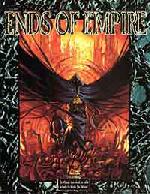
Review of Ends of Empire
 Goto [ Index ] |
On the other hand, I did get one damned packed book, covering everything from information on the Dark Kingdom of Jade to the Ferrymen to the Mnemoi, and an adventure tying it all together. The book compresses and flies over a metaplot that was intended to run another several years, but got snipped short. That gives the book a real feeling of being rushed at least in parts, but the official word (from Bruce Baugh himself) is that such is not the case, it just seems that way.
The content of the book itself, on the whole, is staggeringly superb. There is nothing boring or useless in the book, and the only sour spots in an otherwise beautiful book are the adventure (which didn't measure up to the rest of the book) and the Mnemoi section (which left me with a few questions and was a tad too short).
Erik fiction
The grand finale for the tale of Erik weaves itself through the book and is certainly damned good. While not my favorite Erik piece (that honor goes to the bit in the Player's Guide), it is certainly very nice and often serves to flesh out the details for things mentioned elsewhere, as well as fill in hole and provide information on the details that the rest of the book doesn't address, like the situation at Enoch.
The Last Hour of Jade
This section turns back to the Dark Kingdom of Jade, giving us a nice overview of the present situation in the gigantic bureaucracy of the East. In addition to descriptions of how the "china towns" of the Necropoli function and descriptions of the major power-players in the power jockeying in the Jade Empire, we also get an explanation of why the Jade Emperor feels that he has to invade Stygia, and how he convinced his citizens of the same thing.
The Empire's economy is based so solidly on relics and jade that when such supplies start to dry up (as they are now in an age where reverence for the dead is not what it once was), people have to look elsewhere to find the material, or supply it themselves. We also get a peek at a society with an increasing number of young and rebellious wraiths who do not really follow the centuries old traditions that have kept the Empire working for so long. In an attempt to gain more raw materials for the wraithly economy as well as to point the younger wraiths at some useful target and set them loose, the Jade Emperor devises are rather interesting plan to assault Stygia where it hurts - everywhere.
The Last Dansa Macabre
Warning: the following section on the adventure in the book contains a few spoilers. If you are really concerned about not knowing what happens in End of Empire, I recommend skipping this bit and just taking my summary. "It was okay, great in the beginning and iffy by the end."
This is the story that puts the characters at the heart of many of the major events of the end of Wraith, but it was a mixed bag overall. While there were many great and amazing scenes in it (especially in the beginning), the story became more and more rigid and focused as it went along, literally becoming a railroad ride later on.
The story starts in the London Necropolis with the invasion of the Jade troops. This section is beautifully written and I could base an entire chronicle just on this core idea. There is a brief but incredibly useful description of the Necropolis in general and then the adventure begins.
After the initial scenes of war, the wraiths are dragged by fate into dealing with the return of Charon firsthand, they are even charged with protecting him, as well as his power. The story is still good at this point, but it begins to sour slightly, not shining as brightly as the first "chapter."
The adventure follows a ride on the Midnight Express back to Stygia so that the characters can meet nearly everyone important in the Stygian government and watch Charon (nearly) return to his old power and save the day, at which point he turns over the city and the reigns of power to the characters (although the city is effectively razed at this point).
So why didn't I like the end of The Last Danse Macabre? Because it very much had a feel of "this is what is going to happen any damned way, no matter what the characters do." The railroading was apparent in the writing of the adventure, it wasn't even that no options were given for alternate character choices, it was simply that this is what is going to happen. While the characters are in the middle of the action (which, oddly enough, doesn't include ever finding out about Enoch or Xerxes Jones, the two causes of the Sixth Great Maelstrom), they are more spectators than participants.
The story isn't terrible, don't get me wrong, but as it went on, it more and more turned into something that I would at best take as loose inspiration for a game I run. I intend to run a long-spanning Wraith game from Wraith: the Great War all the way until the epic conclusion in Ends of Empire, but I don't think that I could really run The Last Danse Macabre anywhere near how it was written, and I'm usually very forgiving of published adventures.
On the whole, I think that in the space provided, the adventure would have been better structured in the much more free-form manner that the one in Rage Across the Heavens was done in. While the adventure does have a lot of optional scenes that can be added to subtracted as the Storyteller sees fit, as the adventure wears on, it seems to get more and more rigid and defined. The character's actions seem to grow less and less important, which makes little sense, unless there was a strong, focused attempt to show the "Fate will have its due" kind of idea, but there wasn't. There was a lot of ground that The Last Danse Macabre tried to cover and it didn't manage to get all of it equally well, mainly due to space concerns, I would imagine. As such, I think that detail should have been sacrificed for completeness.
By Charon's Oar: the History of the Ferrmen
This is easily the best part of the book and worth nearly the entire price tag itself. Providing us with a clear and blunt explanation of who the Ferrymen are, what they have been doing and what they want to do, this was a riveting and exciting section of the book.
Some of the revelations (other than more neat powers and artifacts) include the statement that the Pasiphae are indeed the removed Shadows of Ferrymen, and each is tied closely to the other. The Shemsu-heru, the undying mummies, are apparently the ones that made a pact with the Ferrymen so long ago to teach them how to remove their Shadows, and they call that favor due in Ends of Empire. Cross-over haters may dislike this, but I find it wonderful myself.
The chapter also contains a history of the Ferrymen full of both wisdom and folly, hubris and humility. The chapter gives us an organization of individuals with essentially human characters, capable both of great deeds and amazing mistakes. It is this kind of humanity that draws me to Trinity so much and it is nice to see it so strongly in another game.
Ends of Empire also contains detailed information on the culture (specifically the rituals) of the Ferrymen and their interactions with the Far Shores. This, by extension, also provides a surprising amount of information about the Far Shores and those who rule them. While other books gave the impression that nearly all of the Shores were lies serving only to enslave wraiths hoping for salvation, he get a better look at those Shores actually desperately trying to be some form of healing paradise. Some actually almost succeed. Furthermore, the city of Dis where the Ferrymen make their home is described, and it manages to be exciting and creepy in the few pages devoted to it. It is definitely something to have hints of when the characters are lost adrift in the Tempest.
The chapter also has a slew of detailed rules for the Ferrymen, both as NPCs and as PCs, if a chronicle travels in the direction. The rules are actually quite nice and make the Ferrymen damned powerful but not disgusting gods, which I like a lot. The chapter on the whole is superbly done, with human characters, thought-out histories, nice rules, and a wealth of information. This is definitely a must-have for anyone intended to use the Ferrymen extensively in their chronicles.
Prologue to Remembrance: Guildbook Mnemoi
This was another brilliant section of the book, but it had a few minor flaws as well. The opening fiction was terribly confusing to me, although it was a great story overall. After that rocky start, the chapter rockets into a wonderful exploration of the Mnemoi and their history.
As hinted in Wraith: the Great War, the Mnemoi are not quite the evil-evil bastards that the average citizen of Stygia believes them to be, they bear a much greater and nobler burden than anyone would have guessed.
My biggest problem with the chapter is that I wish it was longer. All of it is great, showing us a lean and desperate Charon and the persecution of those who chose duty over comfort, but I just wish that there was more time for the history section. I would have liked some more ups and downs throughout the Guild's long history.
My other problem with the book also ties in with Wraith: the Great War, but in a different way. The Mnemoi apparently use large artifacts to siphon the memories of the Insurrection and the Smiling Lord's treachery from apparently every wraith in the Shadowlands, and beyond. While this makes for some interesting déjà vu during The Last Danse Macabre as old scenes are replayed, any sort of wiping of everyone's memories tends to simply rub me the wrong way. While I understand why it was done and it was described nicely, it still leaves a bad taste in my mouth, it just feels cheesy.
The rest of the chapter deals not only with history, but also with culture and the details of Mnemoi powers. The Mnemoi are forced to be extremely selective about who they admit into the Guild and it makes for a small, tightly-knit group. Some Mnemoi wander around, trying to stay ahead of Stygian patrols while others take up hermitages or even turn around and infiltrate the Hierarchy, trading memories for safety. The information on the relations the Guild has with the other Guilds and organizations among the dead is surprisingly informative about those groups as well. The interspersing of short little memories throughout the chapter also works better than I had expected.
Furthermore, the chapter includes the systems for "memory palace" or a mental construction that Mnemoi build to hold all of the memories they take upon themselves (or force upon another) to lessen the risk of forgetting them, or worse, not realizing that the memories are foreign. A memory palace is like a large building with each room a different memory, a different moment. Handled nicely, this could add a lot to many Wraith games and it is an idea worth swiping for any other game with memory altering powers.
The merits, flaws and additional powers all are serviceable, some of them being really nice while others are simply work-horse. Why Perfect Memory (a 4 point merit) is so much more expensive than Eidetic Memory, I don't know since they seem to work in nearly the same manner, but the rest of the rules are really quite good.
The templates break White Wolf stereotype in not providing a character sheet of any sort, simply being character histories. This doesn't really bother or excite me, since I almost never use templates and they are generally wasted space, but it was a surprise. A few of the more famous Mnemoi finishes out the section and that is that for the Mnemoi, but I was left wanting more.
Appendix: Epilogues and Final Notes
These several pages are a quick guide to what "really happened" and what effects it had. It has a long roll-call of the more noted characters in Wraith describing briefly what they were doing at the time of Ends of Empire and how it affected them. Lots of wraiths die, I'll say that much, and many others are put through hell. The underworld certainly changes. There is a short mention of what the other Dark Kingdoms do after the events pan out, and while short, there is certainly a great deal of potential there, especially in a nice, long game set in Swar.
There is also a quick page on how to run a chronicle or adventure after the fall of Stygia, and it has some interesting ideas, some of which rely upon the adventure running in a certain way. A Storyteller planning on continuing their game after Ends of Empire is well-advised to read these ideas and think hard about what they want to happen afterward before they begin, so they know where to steer the game.
All in all
All in all, Ends of Empire was a damned nice book. It holds a wealth of great ideas crammed between two covers, but it doesn't manage to get through all of it evenly in the time allowed. Definitely of much more use for those who have been following Wraith for a while, the book definitely feels rushed and compacted. The ideas seem contracted and there are several editing errors and a slew of see page XXs scattered throughout the book. The art goes from excellent (Drew Tucker and Larry MacDougal) to really rather bad (Cobb and Clark), but most of it fits well enough, and I was truly amazed to see Cobb do a picture that I didn't hate. The writing is excellent, on par with Wraith standard or above, so this is definitely not a hard read.
It's really hard to explain my feelings about the book, it has some major flaws and is far from perfect, but it is also more than worth getting, reading and using. Highly recommended.
Style: 4 (Classy and well done)
Substance: 4 (Meaty)

