

 Search
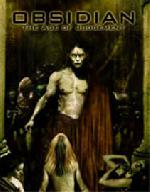
Review of Obsidian: The Age of Judgement
 Goto [ Index ] |
A great idea, I think, it has wonderful potential for a logically stable police-state and surreal living conditions, but it falls amazingly short of accomplishing anything except making me feel like a fool for blowing $28 dollars when I could have just read the back of the book and gotten most of the useful material from that.
Obsidian is one of maybe two or three books that I almost turned around and sold immediately after buying them. The only other ones that have reached this low are Ravenstar and Immortal, although Obsidian is the best of the bunch. The ideas of the setting, however, and some of the detail in the history and guns sections (oddly enough) have urged me to keep the book, but only for inspiration for setting another game there. I really want to run a one-shot in Obsidian, but the book fails to give me even enough information for that.
Maze
This story is better than much gaming fiction I have read, but not by much. More so, it tells you absolutely nothing about the setting, really. It gives almost no handle on what the game is about, other than that there are demons in the Wastelands outside of the Zone, the city where humanity huddles. It would have been much more useful to give us information about the Zone itself and how the Law interacts with people, how the varying Sectors inter-relate, especially considering how nearly-impossible it is to get into and out of the Wastelands. The fiction also seems to set the tone for the game, which leans much more towards the "Kewl!" side of gaming than I would like.
Chapter One: Obsidian Epoch
This is the history and setting chapter of the book, and its 20-something pages are extremely hit-and-miss. Opening with the first segment of the on-going fictional piece that begins each chapter in the book, the book quickly moves on the a look at history, and a very in-depth look indeed. Starting at several thousand years Before Christ, the book moves slowly through history, explaining how Hell (where God actually lives, Heaven is Hell and God had nothing to do with creating the universe) became tainted and corrupted by the sins of humanity. Apparently mankind's evil deed create a sort of energy which permeates the layers of hell, corrupting and twisting the deamons from happy-shiny lovers of peace to monstrous evil creatures. The daemons learn that they can gain power from this energy, and a feeding frenzy begins. Starting with the Circle of Avarice, daemons do all the can to tempt mankind and gain power, but it is a difficult procedure because opening a portal to Earth takes an amazing amount of energy. Eventually, every Circle does so and their minions spread taint far and wide, making Hell even worse and more powerful. The history reads like a school textbook at many times and basically sets up the feeling that everyone important was a Kultist serving daemons of one sort or another.
There are two unpolluted Circles of Hell, however, the Ninth Circle that no one knows anything about and the Circle of Azure Hyaline, the Circle of Hate, oddly enough. That Circle struggles to stay pure and wholesome, despite the deeds of the other daemons, and in that attempt, they open a portal in the womb of one mortal names Mary, loosing a daemon into the world who tries to unite the Earth under the auspices of peace, love and caring. A brilliant idea, I think, and one the twists the entire world upon its head and emphasizes how, in Obsidian, history is nothing but a thin film covering the Divinity Wars, the struggles between the various Kults. Sadly, nothing else is ever done with that.
This detailed history continues through the present day until 2026, when Hell gets enough power to simply open up the floodgates and send their hordes upon humanity. As I said before, nearly everyone dies and the last survivors, gifted with Mystic abilities granted them by the Divinity (who might live in the Ninth Circle), build the Zone. 15,000 feet high and 22 miles across, the Zone contains the last 60 million humans on Earth. Now they sit there, fearful of expanding outward but eating themselves alive within the Zone. Or at least, that is what they would be doing if the Apophis Consortium had taken five minutes to think about its setting.
One more annoying feature about the history is that apparently the company executed their layout designer, because there are several Sidenote... End Sidenote marks throughout the chapter, sadly.
The description of the Zone borders on the idiotic at times. What kind of brain-dead architect would think "Hey, if we just built normal cities and put a roof over them, and then stacked them on top of each other, that would be great!" Apparently the designers of the Zone were bereft of anything more than chimpanzees for writing blue-prints. Apparently, buildings are designed just like one in Boston or New York, but instead of a sky above them, they just have a really high ceiling with florescent lights mounted to provide lighting. There are also many wide roads for people to drive around their internal combustion engine cars. In a closed space. With fumes. Suuure. The entire Zone is divided into 80 Sectors, which are further divided into Sublevels, and traffic between Sectors is prohibited by law except under the most extreme cases. This is really intelligent. When daemons are still trying to get summoned into the Zone and crime runs rampant in the cramped conditions, closing off routes of travel is the only way to pretend to keep control. Sadly, however, apparently every Sector is exactly the same. Sublevels 1 are always rich, 2's are always middle-class, 3's are always poor and 4's are always life-support machinery and slums. Always. This is simple stupid and insane. It makes no sense for all Sublevels 4 to have problems with their lights, does it?
The societal information in Obsidian makes little sense as well. While the mentions of commerce are useful enough, ignoring references to sublevels, the laws in the Zone are insane. I love the idea of one Law, an organization that holds complete and total power over every citizen should they wish to exercise it. The Zone, understandably, lives in a state that is near perpetual martial law. However, anyone can also sign up to be an Assassin. Once again, this would have been a brilliant measure for an over-stretched Law to enact in an attempt to curb crime. Fight fire with fire, so to speak. That is not what the authors thought, however. The Assassin's Law was an attempt to curb violence in the Zone by allowing corporations and rich individuals the ability to take out contracts (publicly no less) on anyone they wanted to. They submit the name to the Law who can veto it if they like the person. Otherwise, the hired assassin is legally able to murder the victim, even if they have not committed any sort of crime. Nice way to curb the violence.
Also, in the Zone, science is apparently dead or near-dead. No one knows about physics or genetics anymore, but damn, they sure can pump out advanced technology and cyberware. The idea that science is dead but high technology is still pouring from labs makes no sense at all. Granted, pure science is dead since there are no resources available towards learning something "just because," but applied science (as in "kill them daemons dead") should be alive and kicking strongly. It seems that in the Zone, technology is churned out but no one really knows what they are doing. Another inconsistency.
In the Wastelands, the landscape itself begins to bend towards that of the various Circles of Hell, from the techno-horror vistas of the Circle of Torment (with the sin of Envy) to the jungle and monster-infested hellholes of the Circle of Carnivoria (the sin of Depravity). Scattered humans try and pretty much fail to survive and live well while daemons wander near and far, kept from the Zone by big outposts that have bigger guns.
And that is about all the setting information available.
Chapter Two: Elements of the Story
This chapter talks about such role-playing main-stays as mood and theme and character creation. Unfortunately, it was also written by those same drunken monkeys that apparently designed the Zone, because even after a few read-throughs, I was incapable of actually understanding how to create a character. That is a Bad Thing ((tm)), you should be able to understand character creation and the system in one simple skim-through. The only thing I could figure out is that the game relies on character classes of a minor sort and has no really interesting stats of any sort.
Chapter Three: Regulations
This is where the rules and traits are explained. The rules, nicely enough, take up all of a page in total to explain. Unfortunately, the monkeys from the previous chapter decided to leave out any mention of concrete rules effects of varying levels of success or failure, just qualitative descriptions.
The Skills are done well enough (although not all of them are skills as such, like Stamina and Immunity), but they are never well-enough described in the character creation section, so I don't know where a starting character should be. Immediately following that is the Combat rules. Glancing at the long lists and realizing that I hadn't understood anything up till now, I barely read this section at all, hoping to get to something good. Instead I was given 3 pages on diseases and radiation (in a section entitled Explanation of Terms oddly enough). After that amusing section (I could contract perculating worms, you know. "We've secretly replaced Bill's perculating worms with Folger's Crystals, let's see if he notices...") there is a long and confusing section on spirits. I came away from these four pages understanding nothing of spirits or the spirit world in Obsidian, unlike games like Tribe 8 and Werewolf: the Apocalypse, which are incredibly clear and concise about the Otherworlds.
After spirits come descriptions of the various portals to hell, and how they look and feel different. This would have made sense placed with the rules for creating and summon daemons and opening portals, but it appears that the monkeys still had control at this point. And they exercise their control too, there is an entire page devoted to the concerns of self-installation of cybernetics (!), vehicles and security systems. I'm not even going to bother wondering what the authors were thinking when they said "Hey! Wouldn't it be great if we talked about how to install stuff yourself when we don't need to! It would be cool if we just randomly placed it in the book!"
And then Chapter three ended and I was happy.
Chapter Four: Inhabiting
This chapter looks at the Mystics and the Kultists, daemons, and corporations and contacts. Another grab-bag chapter, I was saddened by the lack of depth, mystery and excitement throughout this chapter. The Kults are more limited and one-dimensional than any Vampire: the Masquerade or Changeling: the Dreaming splat at their worst and the Mystic paths are more vague and unreadable than whatever those monkeys from chapter two and three are yelling at me. None of the Mystic powers are really that cool at all, although some of the Kult Convokations are. The most interesting thing about the Kults however, is that all of their magic comes from one source, sacrificing people, whose spirits they store in their blades to use to power their magic. While only some of the Convokations were worth reading, all Kults have their own kind of Spirit Knife, and that aspect of the idea I found very interesting. The only Kult more than mildly interesting is the Box of Under, which serves the strangest Circle of Hell (a supposedly uninhabited one that governs the sin of Sacrifice - how that it a sin, I don't know). They manage capture the horror of Hellraiser while leaving the foolishness behind. The other Kults are pretty much all bland conglomerates of interesting and boring elements, although each has its own aspects and elements that keep them from being all the same. The Kult of the Machine irked me somewhat, however, because it follows the Circle of Torment and presides over the sin of Envy. The Kultists themselves become more and more machine-like as they serve their master, who is envious of humanity and their capacity for emotion. While handled nicely (although sparsely), the "machine that wants to become human" is an old an pretty much worn-out idea.
The daemons were boring as well. You need their Tome of Praemonen to summon them. The Tome is a book detailing everything known about them and how to summon them. Why all daemons are bound to these books to such a degree that destroying one will nearly destroy the daemon, I don't know. Why most of the daemon powers could be skimmed over with no loss, I don't know. I am beginning to suspect the monkeys have more influence than I had previously thought.
The section on corporations has no useful information like how they operate in the Zone or what the economy is like or even the major corporations in the world (that is in another chapter). Instead it is several pages on how build a corporation with points and how much it costs to be part of one. Boring and useless, I found nothing redeeming in these eight pages of text.
The contacts section, ending the chapter, is not interesting and compelling like the contacts from Shadowrun, instead they are short, quick, and limited. There is a selection as scatter-shot as the rest of the book, and the descriptions are as well done, if that says anything about them.
Chapter Five: Tools of Common
Here there be toys, lots of them. This chapter goes from costs of living to educational costs and basic systems (only skimming, sadly) to "unique services" like prostitution and assassination to equipment like weapon sheaths and tools. Some of the technology is interesting (although how it was created if science is dead, I don't know) but it has about as much variety as most character's equipment lists in RIFTS. There are weapons, weapons, more weapons and then some things that make weapons work better. I was amazed when I finally got the gun descriptions, however. Much of the book became clear. Obviously Obsidian was thought up by creative gun-bunny historians who were assaulted by drunken monkeys before they could finish the book. Somehow, the gun section has more detail and social dynamics than the entire chapters on characters and organizations combined. There is a massive amount of detail here, from economics and development to structure. If the rest of the book had been like this, then Obsidian would have had a place of honor on my shelf. Instead, this is the only thing that kept me from selling the book once I was done reading it. Sometimes the detail goes too far, however. When I play a role-playing game, I don't need and entire page devoted to the types of detonators I can purchase. That is no explosives but their detonators.
The vehicles and their options were, suffice to say, as interesting as much of the rest of the book. My eyes blurred and I moved on.
Cyberware, as with much of Obsidian was more complicated and less imaginative that it needed to be or should have been. It was as inspiring as the Security Systems and Devices section that followed it.
Strangely enough, the section on drugs rises almost to the level that the guns bits peaked to, and once again I found some reason not to leave the book beside the toilet in case of emergencies. I shouldn't have had to look for reasons like that in the first place though.
Chapter Six: Antagonists and Protagnists
Herein lies the histories, layouts and inhabitants of the Circles of Hell, as well as corporations of note as well as information on the Law and the Zone's government and some neat religions.
The Circles of Hell could not be called excellent with a straight face, but neither was it on the same level as much of the rest of the book. There was nothing that amazingly innovative, except for some off-hand mentions here and there, like in the description of the Circle of Azure Hyaline. There is little of use here, like a list of the order of the Circles or more detail on what ideas were actually nice.
The corporations, on the other hand, are lively, vibrant, and well-done. Unfortunately, they also lack some of the logical feel that they should have as businesses at what may very well be the end of history. The Law and the Zone's government is similarly, actually more so, sparse and useless. There is little detail and little thought it seems. I still do not know just how the Zone is governed. Democracy? Dictatorship? Anarchy with guys holding bigger guns?
The religions were actually very interesting as well, but they would have been better with some research into real-world religions. For example, the religion of Gladius Oblivii centers around a desire to cease all activity and life actions. This could have been a brilliant twisting of wu wei from Taoism into a bizarre psuedo-undead cult, but it falls short. Most of the religions focus more on structure (all are set up in an almost identical manner, disappointingly enough) than on belief, and structure is almost guaranteed to be more the more boring of the two.
The Appendix and miscellaneous
The Appendix closes the piece of running fiction throughout the book by killing nearly everyone off in a meaninglessly brutal and disappointing way and having evil triumph in the end... I think. The chapter contains more goodies, artifacts that are often incredibly useful as well as Arcane Rituals and Convokations. The Arcane powers are permanent and/or powerful and they are nicely detailed as to what is needed to enact them. Surprisingly enough, they are also well thought out and have that element of inspiration that so much of the book lacks. Too little too late, however.
The book finishes out with a pretty useless glossary of terms (in that I didn't find the words I wanted on it, so I ignored it early on), a reprint of some charts, ads, a character sheet, and many, many, many blank pages.
In Toto...
The book is poorly layed out and essentially empty. The only interesting information can be gleaned from skimming the history, guns and corporations sections as well as the Appendix (with a few exceptions, like the Box of Under). Despite the superb art of Christopher Shy, R.K. Post and Mike Sutfin (as well as someone who seems to sign their work "R Meyers" but I can't find in the credits), the book cannot be saved. There is a fair amount of okay to very poor art and the layout is pedestrian and unskilled. The content is sparse and the writing obtuse for the most part.
My recommendation? Don't but this book unless you really have money to burn and you decide that you wouldn't rather give it to some homeless person on the street.
If you liked the idea, pick up the book in the store, read the back, flip through it, and then put it back on the shelf. Go home and write your own setting because that is what you will have to do anyway, Obsidian doesn't provide you one.
What I think the title alludes to, a wall of nothingness forming at the edge of the world, is mentioned in one sentence in the middle of the section on the Wastelands. This game is about as well done as the anime Ninja Scroll, and as aptly named.
Style: 1 (Unintelligible)
Substance: 1 (I Wasted My Money)

