

 Search
Review Editing
Review of Unknown Armies First Edition
 Goto [ Index ] |
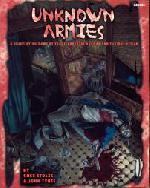
My initial reaction was one of half annoyance and half disgust. Just what we need, I thought. Another "conspiratorial horror" RPG to take its place alongside interesting but (IMO) flawed products like "Spookshow". A world that tries to combine the semi-nihilistic worldview of "Call of Cthulhu" with action inspired by "Hong Kong Action Theatre" and an overdose of "USA Up-All-Night" slasher flicks. Oh yeah, and let's toss in some "conspiracy" stuff to satisfy the X-Philes. Sigh. And the cover art, while intriguing, wasn't anything special.
But curious little gimp that I am, I picked it up and began flipping through it, trying to see what its gimmick was. I had relatively low expectations. In my opinion, the best modern horror game done was "Delta Green".
First off, I didn't recognize the author's names right off. If I had, I probably would have been more interested. Fortunately I'm a curious little gimp, and I flipped (like I always do with a new RPG) to the opening section to get their sales pitch. I was greeted with the following:
"This is a roleplaying game of transcendental horror, which is another way of saying we're going to explore the heights of human potential and find that everything isn't sweetness and light. We're going to see behind the mask of reality and examine the clockwork of existence, and find that everything isn't bearded gods and Thou Shalt Nots. We're going to look at what makes people tick, and find that our neuroses, obsessions, and fears define us just as strongly -- if not more so -- than our aspirations, ideals and conscience." (Unknown Armies -- pg 4)
"Ahah!" I think. "This is an attempt to cash in on the juvenile angst and pseudo-gothic culture that White Wolf has capitalised on so well. Too bad they don't realize that it's all been done to death -- even White Wolf has changed their tone recently."
But I was intrigued enough to continue reading, and a few paragraphs down I came across the first thing that made me realize just how different this product was from all the other "psychadelic (or what have you) horror" games out there. I qoute again from the book:
"It's worth noting a few of the design goals we had for this game, and some of the things that led us to create it, so that you know what you're in for and why we've made the choices we've made. We hope that you will adopt these as campaign goals as well -- these are goals we think you should aim for in the course of play." (Unknown Armies -- pg 4)
I can't recall ever coming across something like this in a game -- a statement right up front about the design goals for the game. You see them every so often in second edition books as "Notes from the developer" or some such crap, but here is a book where they say right up front "Here's what we're shooting for with this game. If this isn't what you're looking for, be warned."
I read some more, and I became confused. This game was different. It was well written. It seemed to be going for the mature, adult gamer rather than the adolescent "freakshow" fan. I flipped to the back cover to try and rationalize this dichotomy and saw the publisher's imprint. Atlas Games.
It all clicked into place -- Atlas has a wonderful reputation with me. After all, they own two of the most interesting games I've encountered in my decade-plus of gaming -- "Ars Magica" and "On the Edge". They are a wonderful publisher of "niche market" games. (I wished they had picked up Earthdawn last year when it got dropped by FASA -- it seemed right up their alley, but it was not to be... sigh. Anyway... enough of this parenthetical aside.)
I dropped the $25 on the book and took it home. I was floored. It is very well written, and clearly intended for the *mature* gamer. I don't think I can emphasize this enough. Thsi is not a game that should be made available for children -- I wouldn't put it in quite the same category as "Kult", but it reads like a darker "On the Edge".
All right, now to the important part of this review -- the game itself. Just what is the premise of this whole thing? Well, I'll try to briefly explain, but the best way to really get this is to track this book down and read it for yourself.
Karma and reincarnation work, but on a cosmic level, rather than a personal one. There exists a realm of existence above the mundane world that is inhabited by individuals collectively known as the "Invisible Clergy". The Clergy are people who have succeeded in embodying an archetype, and ascend to a higher realm of being where they can manipulate reality.
Still with me? Good. There are 333 positions available in the Clergy. When all are filled, they combine to form a single "Godhead" that recreates the world. The condition of the new world is based on the types of people that ascended to the Clergy -- if they were good people, then we get a better world. If they weren't so good... well you get the idea.
Anyhow, the action generally focuses on the "Occult Underground" -- that loose organization of folks who understand the nature of reality, and are trying to keep it hidden from the masses (usually for their own reasons). Naturally, the various cults and sects have differing ideas and goals, and conflict arises from them. The PCs have goals of their own (which don't necessarily have to be cosmic in scope), which they are expected to pursue.
But that capsule doesn't do it justice. Trust me, this game is something you need to absorb slowly and savor.
Character creation focuses on who a character is, rather than on what they can do. Personality, passions and goals are more important than a list of skills (in fact, there isn't a "master skill list" given anywhere. You can have any skill that fits, and can call it what you like). Number crunching is kept to a minimum. You distribute 220 points among four attributes -- Body, Speed, Mind and Soul. Each is rated from 1 to 100, with typical humans falling between 30 and 70. Skill points are then assigned accordingly, with the number of points given to an attribute determing how many skill points you get in that category.
Which brings us to the other part of the game -- the mechanics. They are incredibly simple (and elegant). It is basically a percentile system. The objective is to roll below your skill score on d100. To give you an idea of how simple the system is, the "mechanics" chapter is two pages long -- you heard me right, two pages out of over 200. Obviously, the combat section takes up a bit more space, but not really.
Here's how firearms work (to give you an idea of how fast the system is). You roll your attack. If you fail, you miss. If you suceed, you do damage equal to the roll. What this means is (basically) that the higher your skill with a weapon, the more damage you can potentially do. Attack success and damage with only one roll? I was astonished. Melee combat is just as intuitive -- except that you add the digits together to get the damage, rather than taking the number straight.
There are rules for handling madness and fear (always useful in a horror game). The way it is handled is basically if you behave like a sociopath (even unintentionally), then a sociopath you become. They are clear cut and easily understood. The reasoning behind them is also well explained, which is a plus.
The rules pretty much only take up about a third of the book total. The rest is setting -- and a rich, fascinating setting it is. I got ideas for dozens of potential stories just by skimming the "Supporting Cast" appendix at the back of the book. And there is a sample scenario that is sure to bend player's minds.
Look, I can go on and on here, but let me put it this way: If you're an experienced roleplayer looking for a game that is loaded with emotional realism, but still allows you to kick ass and take names, take a look at this game.
But remember my warning -- this is not a game for the weak. This kicks over the stones of the collective unconscious and looks at what's squirming beneath. THIS IS NOT A GAME FOR EVERYONE. All kinds of taboos are pushed and violated, but it is all handled in a mature, adult fashion, rather than the adolescent look-how-adult-and-shocking-we-can-be attitude that marks lines like White Wolf's Black Dog imprint (that's not to say that there aren't some great products in that line, but most of the stuff strikes me as juvenile gross-out rather than mature horror).
If, however, you are willing to take a chance, willing to go into the dark places in your own soul and face the demons within you, this game has a lot of potential. Give it a look. The system is so simple that it can be married to any other modern conspiracy/horror game with a minimum of effort. All in all, it receives an enthusiastic thumbs up for setting a wonderful standard for modern day occult horror and conspiracy.
Style: 5 (Excellent!)
Substance: 5 (Excellent!)

