Let's face it - I'm not the luckiest roleplayer in existence when it comes to the ol' random factor of gaming. Dice rolls, card draws - it doesn't matter yours truly can always be relied upon to fluff them.
However, this doesn't faze me anymore. It doesn't faze me because I have had the one motherlode of RPG luck, the one great landing-upon-feet that makes all the snakes-eyes seem trivial. Because (drum roll maestro please!) at Bifrost '99 I found Maelstrom, the holy grail of OOP roleplaying, on sale for all of one pound sterling.
I'm not sure if there really are degrees of out-of-printness, but if there are then Maelstrom can probably be rated as the most out-of-print RPG supplement ever. I'm reviewing it therefore, not only to inform people who may also roll 36 on 6d6 and find it for sale but to shed some light for those people who see Maelstrom mentioned on the forums but have no idea what on earth it was. Or is even.
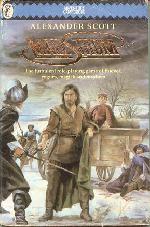
Back to the chase then - Maelstrom is an Elizabethean England role-playing game by Alexander Scott, published in 1984 by Penguin, publishers of the Steve Jackson (UK) and Ian Livingstone (Eidos) Fighting Fantasy series. Or rather, I assume it's an Elizabethean England RPG - the introduction makes vague allusions to the rules being usable for just about anything and much of the rules examples appear to be set in conquistador-era South America. A lot of the character classes, however, have suggestions that refer to these people's reason for travelling the roads of England (similar to the way that WFRP makes an effort to offer explanations of why a Rat Catcher or Tollhouse Keeper might find themselves becoming an adventurer) which somewhat implies that the author intended this to be the focus of a Maelstrom campaign. Possibly.
Rules
Well, you'll never use them, but for what's it worth...
Maelstrom is run purely off percentage dice and PCs have nine statistics, Attack Skill, Defence Skill, Endurance, Speed, Agility, Will, Persuasion, Knowledge and Perception all of which do pretty much what you would expect. All stats start at 30 and the player has 50 extra points to distribute amongst the nine. Simply roll percentage dice against the score and score equal or under to succeed.
Combat is also fairly predictable; roll under your Attack skill, hope your opponent doesn't roll under his Defence skill to parry the blow and then roll damage. Wounds inflicted are kept track of and once they exceed a characters Endurance stat then that character passes out. Death comes when a character suffers more than 100 wounds.
Unfortunately the damage rules just don't work at all. A week's rest in bed, or a months normal activity will cause the PC to recover the grand total of 1 wound point, which doesn't sound so bad until you realise that a sword blow will do between d10 and 5d6 damage on a hit, dependent upon the size and quality of the blade. Recovering from being KO'd in combat probably suggests you have taken 40-50 wounds and can therefore look at spending four to five years to get your health back unless you fancy spending a year in bed, John and Yoko-style.
This probably means that should your Maelstrom PC nick himself shaving then he will have to retire to bed for a fortnight in order to recover. I hate to think of the convalesence period required for a papercut or ingrowing toe-nail or similar.
Also it would appear that nobody ever gets killed in combat because they will pass out long before death is ever a danger. People are only killed therefore if someone attacks their comatose body, but I suppose the long convalesence time might mean a lot of suicides in mediaeval hospitals. I mean if it took me six months to recover from being punched in the stomach I'd probably give up on life too.
Characters
It's in the character class section that one starts to realise just how bloody much information is in this book. Characters can be Nobles, Professionals (clerk, doctor, architect, scrivener), Artisans (Armourers, Blacksmiths, Bladesmiths, Tanners, Wood-carvers), Traders (Butchers, Fishmonger, Fruiterers, Grocers, Mercers, Vintners), Labourers, Mercenaries, Thieves, Beggars (5 types!), Burglars, Assassins, Tricksters, Priests, Travelling Players, Mages and Herbalists. Phew! Interestingly the 'traditional' RPG archetypes such as the mercenary and assassin are actually less interesting than the ordinary people who are travelling as part and parcel of their jobs, such as the Fishmonger and Travelling Players who probably offer more interesting and hammy roleplaying opportunities. Top roleplaying potential probably goes to the Abraham Men, charlatan beggars who pretend to be insane to invoke charity, or maybe the Dummerars who pretend to be deaf and dumb but aren't in reality.
Basically this is the best guide to period character types for any period I have ever seen. If you want to play in this period then you need this book for this part alone.
Magic
The Maelstrom of the title refers to the somewhat sketchily described magical force in the universe. Mages can tap into this, but as this is witchcraft they have to do it on the sly to avoid the eyes of the church. Priests have the ability to exorcise demons. In a similar fashion to Ars Magica, there are no set spells, the difficulty of magic is rated from 1 to 5 once the desired effect is described by the player and a roll made accordingly. As Scott states the GM is free to completely ignore magic if he desires a more accurate period feel. I suppose the best way to treat it would be to tell your players that you are including it and then secretly don't. This would I think encourage a healthy degree of superstition amongst your PCs.
While on the subject of Priests I have to say it is a disappointment that Scott fails to mention the Protestant/Catholic schism in England at this time which would seem to be to be a vital part in the life of any clergyman in this time. The exact denomination of Priests is therefore never stated.
Background Information
A lot of the background information is included in a very unstructured manner, scattered throughout the book and amongst the character creation guidelines. For example there is just the one appendix which is an indepth look at, of all things, herbs and herbology. Don't be tempted to just skim over the character classes chapter as there is a lot of useful information there too.
The included scenario has no name (chapter heading - "An Adventure"), but is a road-trek from St. Albans to London, full of period detail. Interestingly there are differing motives for each PC and these plots are intertwined with the journey. It is assumed that the travellers band together for safety in numbers, nicely avoiding the "you all meet in a Spittalfields pub, looking for adventure" cliche. Reminds me a little of Canterbury Tales in this respect (and before anybody thinks to remind me I know that Chaucer's characters all met in an alehouse!).
To summarise - Maelstrom is a very, very singular RPG. The combat rules are so bent as to be useless but then nobody will ever use them anyway. It's best therefore to regard Maelstrom as a source book on Elizabethean England and patch in your favourite rules, but even that coverage is patchy as the book is a glorious mess of period trivia, surprisingly deep in some aspects such as the differing types of ruses tried by beggars yet shallow in others. There's a lot of detail in the available character classes, but very little direction on what campaigns might be expected to achieve. Adventurers wandering round Renaissance Europe? An ever changing assortment of ordinary people walking from town to town? Who knows? It seems like a great and highly original idea, but I'm still not 100% certain that was Scott's original intention. Even if you want to use this idea in a different setting then Maelstrom will still be useful as a good series of pointers on how to run such a campaign.
I think one of the reasons for Maelstrom being such a mess is that the people who published it obviously had no idea what it was and got it confused with Warlock of Firetop Mountain et al. I can just imagine the conversation at Penguin over the final manuscript vis:-
"I don't understand this. WTF is it!?"
"Some sort of Fighting Fantasy thing - you know, those kid's books that are earning us a fortune"
"Hell, let's publish it then."
And a final bit of trivia - no doubt he had the services of a good editor, but Scott researched and wrote this when he was still at school. Amazing.
Recommended if you ever see it available for a reasonable price, but don't pay silly money for it.
(Once again I don't see the relevance of Style and Substance ratings so I've left them at the defaults.)
Style: 3 (Average)
Substance: 3 (Average)