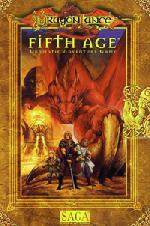
The game is packaged in a colorful little box (smaller than 8.5 x 11), painted up to look like a treasure chest, with a Velcro latch to hold it shut. On opening the box, you are greeted by the following items:
-Book One (128 pages, all the rules and statistics)
-Book Two (96 pages, details of Krynn up to the 5th Age)
-"Heroes of a New Age" (48 pages, introductory adventure)
-Fate Deck (82 cards with 8 suits of 9, and 1 suit of 10)
-Poster map of Ansalon (Dragonlance world, good wall hanging)
-Character Cards (18 pregenerated characters or Dragonlance heroes)
Book One is written mainly in black ink, with a pleasant brown color for section headings and important things. Pictures are rare, but this does not detract from the product, as there is that much more room for text.
The prologue describes the purpose of the game, common Dragonlance themes, and the roles that Players and the Narrator (DM is a term that wouldn't apply very well here) play. It is interesting to note that this is one of the few RPGs that does not open with a "What is an RPG?? It is a game similar to Snakes and Ladders, but without a board" chapter. This is good, as those chapters are generally wasted space - I mean, is it really that hard to figure out what an RPG is after reading the back of the book? Anyway, I normally skip over this chapter in any RPG, but after reading through it, I have to say it is well done and offers sound advice.
Chapter One gives you the process of Character Creation. Simply put, the Player draws 12 cards from the Fate Deck (these cards are used for everything in the game, instead of dice) assigns 8 of them to Abilities (such as Strength, Dexterity), 1 to Wealth (where your Character is on the social ladder - not used in the game, but useful for roleplaying purposes), 1 to Quests (how experienced your Character is, used to determine how large your hand is during the game), and 2 to Nature and Demeanor. These last two are also not used in the game, but instead serve as simple descriptors of your character's personality and attitude. After this, the book guides you through choosing equipment, race, age, and role (what your job is), among other things. I personally think that this system has the best character generation around (not including systems based around allocating points, as I consider those more Building than Generation).
The second chapter gives guidelines on running Adventures. This section is of importance mainly to the Narrator, and wisely leaves out any game rules, as they are discussed in later chapters. A sample adventure is given here, laid out Scene by Scene, to show beginning Narrators the ropes. The sample uses an "if the Players do this, go to 1, if they do this, go to 2" style, as is used in the Introductory Adventure included with the game.
Chapter Three details how Actions are performed. SAGA uses a system that is fairly common, and quite simple: Narrator gives a difficulty, Player plays a card and adds his appropriate Ability score - if Player's score is highest, then the Action succeeds. The book then goes on to discuss how various outcomes and card plays affect the Action, and finally a short list of example actions is given. I like this system, and especially the way they have applied it to a card-based game, using Trump cards and different suits. A simple system, and one that allows for extremely heroic (or suicidal) actions. I like it.
The fourth chapter is short, and gives the rules for Combat. This is basically a series of Actions, with a step in the middle to determine Player or Enemy wounds. Short, fast, and well written.
Chapter Five gives the rules for Magic, and this is where the system really shines. Instead of a pre-set spell list to choose from, or having to combine their magical talents (eg. Create + Fire), players make the spells up themselves. The Players determine Casting Time, Range, Area of Effect, Duration, Damage(if applicable) or other suitable Effect, and then consult a series of charts to find the Difficulty and Point Cost of the spell. Casting a spell is as simple as attempting an Action with a difficulty according to the spell. You then deduct the Point Cost from your Spell Points (determined by a couple of your ability scores). Boom!! You've just made a pool of lava appear under a house (yes, you can do that, it's not as hard as it sounds)!! If you record the stats for each spell as you cast it, pretty soon you'll be able to make them up in your head. This system is simple, flashy, and encourages dramatic effects. Very well done.
The sixth and final Chapter gives you statistics for around 50 different creatures, both animals and monsters, and details their various abilities. Dragons, being an integral part of Dragonlance (hence the name, silly) are given several pages. As they are huge and powerful beasts, they have lots of appropriately nasty and blood-chilling abilities. Throughout the chapter is a sidebar explaining the various creature abilities in terms of gameplay. This is the only part of the book that I felt was poorly laid out. The sidebar would be much more useful if it were confined to a single page, or re-printed as an Appendix. Another gripe, I felt that many of the monsters were given inadequate descriptions, few more than a paragraph, and many much less. Most of the creatures are common fantasy fare though, so this is not as bad as you might think.
An index follows, allowing easy access to every section in the book. No missing sections, no "page XX" errors.
The last few pages are Appendices, giving statistics for Weapons, Armor, the various Player Races, all of the Monsters, and a list of Actions.
Book Two gives us a complete history of Krynn up to the beginning of the Fifth Age. Interestingly though, there is no mention of the "Dawning of a New Age" trilogy, which would apparently take place less than a year after the book is set - there IS however, mention of all the major characters in the trilogy, and this makes no sense to me. Various Orders and Knighthoods are detailed, along with a one-page description of each major nation on the continent of Ansalon.
The last several pages, which can be very useful to new players, give a description for each of the 82 Dragonlance characters seen on the Fate cards.
Book Two is well written, given what it is, and is organized quite nicely. The only problem (and this might just be MY problem) is that the Dragonlance world has little room for adventures that are not "deal-with-the-huge-threat-to-everybody" adventures. This is partially caused by the huge amount of novels (over 70, last time I checked) set in the world of Krynn. Nearly every one of these is closely related to a) the War of the Lance, b) the Chaos War, c) the time of Huma, or d) Gnomes, and their hilarious exploits. This leaves very little detail (relative to other worlds such as Forgotten Realms or Planescape) that can be used for gaming. Oh, I'm sorry Mr. Narrator, but your party can't go on a quest for the Dragonlance, it's been found already. This problem is easy to deal with, thankfully, as there are many RPG worlds on the internet that are not based on a particular game system. I plan to use Khoras (http://www.khoras.net) in my campaign.
The Introductory Adventure is well written, well thought out, and provides an excellent way for Narrators to teach their players the basics. At 48 pages, it may seem rather short, but after reading it I feel that there is enough material for about 3 game sessions - conveniently, the adventure is divided up into 3 Acts.
The poster map that is included with Fifth Age is large, colorful, and very detailed. The map of Ansalon is bordered by paintings of the various Dragon Overlords. One thing I would have preferred would have been the inclusion of a map of Ansalon before the Chaos War, as the land was much different. This could be as simple as a map on the back side of the Fifth Age map, and would allow for more adventures in the Dragonlance world without running out of things to do.
The Fate Deck is colorful, attractive, and fun to use. Each card has a character's portrait, the card's suit and rank, and a pair of words describing the character - these words are used during Character Generation to give the character a personality. A very nice alternative to dice.
A reference sheet is also included with the game, one side containing various charts for Actions and Magic, the other side detailing a conversion process for those who wish to use AD&D (2nd Ed.) characters or monsters in SAGA. I haven't tried it, but it looks pretty simple and accurate.
Style: 4 (Classy and well done)
Substance: 5 (Excellent!)