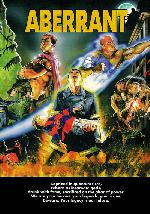
Aberrant is White Wolf's entry into the comic book RPG genre. Previously only known for their World of Darkness products and more recently the sci-fi Trinity, White Wolf now appears to be preparing a new line of products to succeed the WoD, since Aberrant is the prequel to the aforementioned Trinity.
The book is split into two sections, first Setting and then System. The setting has obviously been well thought-out and presents a deep world to play in (for example, WW theorizes quite logically that super-criminals are rare since a "nova," or superpowered human, can make a great deal of money from publicity and legitimate usage of their powers). For the most part, this section of the book presents the game universe very well, with a mish-mash of media and articles from the "OpNet." These articles range from specials on N!, a network focusing on novas, to rambling stories by Hunter S. Thompson-wannabe Dr. Duke Rollo.
Keeping in line with this vast array of information, the layout varies wildly, combining the traditional two-columns of text with the N! homepage, comics, and storyboards from TV shows. It's a little difficult to read at times (the comic sections are particularly badly laid out), and some of the material to me seems thrust in randomly (one page is a web page for satanists, the next jumps to a N! article, then we're off to an excerpt from a London magazine), but it all comes together for a surprisingly detailed overview of the world in Aberrant.
The setting itself is 2008, 20 years after the first Nova "erupted." The superhumans have formed a grand syndicate called Project Utopia which aims to fix the world's problems with help from Novas, and it has been largely successful (and profitable.) The environment has been cleaned up with genetically engineered bacteria, deserts have been terraformed, space is being conquered once again, and war has been eliminated in favor of deathmatches fought by hired Novas. Of course, this is a White Wolf product and so there have to be mysteries and enigmas that players will have to buy other books to understand, such as the shadow conspiracy within Project Utopia that will evolve into the protective Proteus in Trinity. I personally feel it's a little annoying that White Wolf refuses to concretely define anything in the setting, but I must admit being intrigued, and DMs without the money to purchase storyline updates will find plenty of hooks with which to run a setting.
One nice touch is the pseudo-scientific explanations for the irrational aspects of comic books. Super powers are the product of control of quantum energies, made possible by the "Mazarin-Rashoud node," a gland present in the brains of Novas. The costumes worn by superheroes that can be torn to shreds but still manage to keep the hero decent are made of Eufiber, a synthetic created by a shapeshifting Nova in South America (perhaps he became a giant silkworm). And so on. It might not hold up in a physics lab, but it's at least as good as some of the techno-babble used on Star Trek, which is widely regarded as the finest source of Science That Sounds Good anywhere.
The catalyst for the storyline is the death of "Slider," a member of the Team Tomorrow superhero group, who is rumored to have been killed by the Proteus conspiracy within Utopia. Intrigue surrounds her death, and a rival to Utopia (the Aberrants) has sprung up to expose its corruption. The most obvious storyline available is that the players can join the Aberrant movement, and there's plenty to support their crusade, but White Wolf intended this product to explore shades of grey in the setting, and it is entirely possible for characters to be Utopian, Proteus, or even members of the uber-terrorist Terragen.
The most obvious downside to all this is that this isn't Marvel anymore. Aberrant is not nearly as accessible as the typical comic-book setting because of the carefully logical universe. Campaign styles are limited using the Aberrant universe, and while a beat-em-up action-filled comic campaign is possible, Aberrant tends more towards the Graphic Novel tone and as such will seem too serious or grim for many players. For example, the setting lapses into more conspiracy theories than JFK and Elvis UFO abductions combined, and it forces characters to gain their power though a gland in their head instead of gamma rays or radioactive spiders or whatever. Aberrant is a little more realistic than Champions, certainly, but whether that's worth the cost of comic books' most loved quirks is debatable.
In short, the system is well-written and mostly presented in an attractive fashion, with plenty of meaty bits for a campaign to work with. On to the system section. The basic system is the standard Storyteller system, mainly concerned with pools of D10. In this aspect, there is not much difference from any other White Wolf game. The distinguishing factor of Aberrant's system is the set of rules concerning superpowers.
The most basic superpowers available are enhanced attributes, or Mega-Attributes. Characters can have up to five levels in a Mega-Attribute, which is considered separately from the regular attribute. A character with a Mega-Attribute automatically wins any contest against a normal character or a character with a lower Mega-Attribute level. Contests against other characters with the same level are as normal. Although this is a very fast and easy way of defining these superpowers, the automatic success is a little galling, and perhaps overpowering. Although it is unlikely that a normal human character could beat a Nova at arm-wrestling, it would be nice if the human had some kind of chance, no matter how slim, especially since Aberrant allows non-Nova player-characters.
The rest of the superpowers are detailed, varied, and inclusive. It is likely that just about any comic-book character could be built with this system. The only flaw with the powers is that some of them are represented by the special effect that they manifest as (magnetism, gravity control, time control, cyberkinesis) and others are grouped by game effect with the special effect defined by the player (force bolt, invisibility, elemental control). It's likely that this was done in an effort to make character creation a little more fluid, but it is a little inconsistent in design. Still, this is a nice step up from the sometimes cryptic and obtuse Champions-system powers, which were defined only in terms of game effect and made character creation a powerful but nightmarish experience.
The art for the book is of good quality, and there is a lot of it. This is not to say that it is all excellent, but it usually achieves the goal it sets (such as the bizarre ink drawings in Dr. Duke Rollo's articles that mimic the Ralph Steadman art usually found in Hunter S. Thompson's books, and the comic book panels scattered through the rules section). There are very, very few truly ugly pieces, a laudable achievement in any RPG, and probably 99% of the pieces that accompany each power description hit spot on. Art in the setting section is color, the rules have either black-and-white line art or shades of grey in various mediums. Layout is cluttered enough to be interesting but not enough to be unreadable. All in all, the book is pleasant to read and of highly professional quality, all which should be expected from White Wolf by now.
I have to admit that I like Aberrant. It's well-written, with rules that flow quickly and a setting that proves compelling. I do think that setting can be a bit of a straightjacket to players who merely want to play a superhero RPG, but if you're willing to accept the various concessions that such a detailed world brings with it at the expense of freedom and classic genre "feel," you'll find that this is a pretty good game. Even if the setting is too grim for you, the rules are good enough to be used in a straight Marvel/DC style game by a creative GM, since they're a little cleaner and simpler than Champions, but with almost as much versatility and breadth.
Aberrant. It's a good book.
Style: 4 (Classy and well done)
Substance: 4 (Meaty)