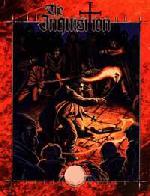
The Inquisition is active for seven hundred years now. It's been hunting witches and supernatural beings all that time, for they are Satan's Breed who walk upon this Earth, and must be battled before Christ's second arrival, also called Parousia.
The book is divided into several chapters and I will deal with each of them separately:
I - The Way of the Martyr
This chapter deals with the history of the Inquisition, it's structure nowadays, it's centers of operation around the world (called Cenacula) and in orders within the Roman Catholic Church. The history is well and concisely written and covers major events in the Inquisition history that defined its way of thinking and made it what it is today. The society's structure is rather thorough as well, including Inquisitorial hierarchy and ways of recruiting new Inquisitors. The other two parts, however, are lacking. The book mentions Western Europe and North America as places where the Inquisition is dominant, yet oddly enough; only a little more than one page was dedicated to describing those places. Of the many orders within the Church, only four were mentioned, and even those only received a short paragraph each. This chapter could have been expanded. Greatly expanded.
II - Catechism
This chapter deals with the beliefs of the Inquisitors. What books are important to them, what they think about all kinds of supernatural creatures residing in the World of Darkness, what orders exist within the Inquisition and finally, what supernatural creatures think of the Inquisition. Sounds like the most important chapter in the book? It sounded that way to me too. But the author must have though differently, for this oh so important chapter, the one that's supposed to show us how to ROLEPLAY an Inquisitor, is also the shortest chapter in the book.
III - Character Creation
Puzzlingly, this chapter got the biggest portion of the book. This chapter deals with subjects already taken care of in several other supplements. Both "The Hunters Hunted" and "The Vampire Players' Guide 2nd Edition" deal with the creation of mortal characters. The character creation process isn't different from those offered in the aforementioned books, and in some points, even refers the reader to those books in order to get more information. The book does expand on supernatural hunters, which weren't mentioned in those books (except for the Children of Osiris), but doesn't expand enough.
Among the new rules is a new Numina called Theurgy. Did I say "New Numina"? Not really. Theurgy is Hedge Magic, which was explained in former books. The only difference is the Inquisition's view of it, as a form of magic given to the Inquisitor by God, instead of the Infernal power that is Hedge Magic.
A bright spot in the book are the Faith rules. Sure, we had them on "The Hunters Hunted", but here, they are somewhat different, and greatly expanded. A job well done.
IV - Storyteller's Aids
The important issue in this chapter, the Inquisition Chronicle, is too short. It includes tips for games in which the players are Vampires battling the Inquisition and also for games in which the players are the Inquisitors. There are suggestions for games in other eras, but that's it.
From there, the chapter takes a turn toward game mechanics, as if we didn't have enough of that in the previous chapter. The new rules include torture, which is very amusing, and also very important to those people who need the rules to run the game and didn't know how to put torture into the game thus far. For those of you who don't use the rules, it could at least give some ideas. I for one didn't know many of the torture methods and devices mentioned in the book. The other rules in this chapter are for Holy Ground and Relics, two subjects important to a book so focused around religion, and they were well taken care of, the rules being short and not taking a great portion of the book.
V - Inquisitor Personalities
This chapter includes information usually divided into two episodes in White Wolf products. Character Templates and Who's who among the Inquisition. The templates are nothing to write home about. No brilliant ideas there (In fact, the templates are rarely brilliant in any White Wolf book I know). Unfortunately, the second part, usually much brighter than the first (Try reading Clanbook Malkavian), is also dull in this book. No really interesting characters, the only attempt to create something special (Balthazar Richter, and ex-inquisitor most probably embraced in the far east) isn't really interesting.
Style: 2 (Needs Work)
Substance: 3 (Average)