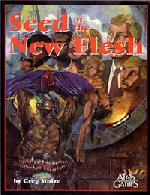
Good news, Comsumer! After almost four years, the Architects of the Flesh
supplement for Feng Shui has seen print. Many of us (like me) have been
waiting for this supplement for almost 3 years. But it may not be quite what
you expected.
What This Book Is Not
Let's be up-front, so that I can deal with any expectations you might have
without distracting you from the rest of the material: this is an old book.
That doesn't mean it's bad, just that it has sort of missed a lot while it was
sitting in Jose Garcia's lost vault gathering dust. In fact, the inside cover
says:
And a special note to all you old school Feng Shui fans: Untold thanks
for keeping the fires burning during the dark days of Feng Shui's
slumber. I'm sorry that I couldn't incorporate your disparate visions of the
grim Feng Future, but all the re-writing would have been a drag.
What does this mean to you? It means that a lot of cool stuff that showed up
in Shadowfist in its last years — the Purists and their Paradox Cubes, the
Lotus plot to infiltrate the Buro, the Dragon raid on the Arcanotower, and the
sinister designs of Homo Omega and the Vivisectors — aren't in here.
There's a lot of other cool stuff, but if that's what you're looking for (like I
was), you aren't going to find it in this book.
What This Book Is
Seed of the New Flesh is a soft-cover book of 128 pages, written by
Greg Stolze, who is the developer of Feng Shui at Atlas Games. It's
organized into six chapters with two appendices, each an adventure. More on
that in a minute.
Each chapter is prefaced by a bit of fiction. Yes, this is a staple of the
industry. Yes, this story is pretty well-written, especially for gaming fiction.
It follows the lives and ultimate fates of three characters in the 2056
juncture: a dissatisfied Consumer, a Jammer-esque speed freak, and a Guiding
Hand monk on a mission. But ultimately I thought that the space could have been
put to better use. Again, more on that later.
One of the first things that I noticed about the book was the art, which is
one of the most obvious casualties of Feng Shui's lost years, and the
move to Atlas. Some of the art is okay, and a couple pieces really shine. Some
is very appropriate (you have to love the cheesecake pinup of Desdemona
Deathangel, wearing only the Buro flag...), and some (like the frontispiece by
Andrew Bates) is just silly.
1. Welcome to 2056
This slim chapter starts off with 4 pages of general background on the world
of 2056. It's definitely in with your Orwell-class oppressive dictatorship
distopias, but the citizens do seem to have a better life than those of
1984. The big problem is that all of this equality and stability are paid
for with a terrible loss of freedom.
We briefly survey housing, transportation, and few other facts of life. The
change of currency to Hours (of work) is a nice touch, and makes bookkeeping a
little easier to boot. If anything, I really wish that this part of the book had
been expanded a little more to give a better feeling for day-to-day life in the
twenty-first.
The rest of the chapter is devoted to the six new archetypes, which are a
really mixed bag for me. They are:
- Free Sex Militant: this and its variants are meant to be
representative of the various underground resistance movements that exist
in 2056. Mechanically, they are cribbed from the Ex-Special Forces and
Martial Artist, with unique schticks to help them lead mooks, and sway
characters to their cause.
- The Drifter: One of my two favorites, this archetype is very
general, with free-form skill bonuses that really allow you to build
whatever sort of Drifter you want. Has a knack for showing up just at the
right moment.
- Consumer on the Edge: Sort of your typical high-strung
Falling Down type character. I really don't see the need for this
type, since the premise gets old really fast, and the whole concept seems
kind of silly for a PC.
- Criminal Mastermind: I'm really torn about this one, which
represents your typical comic-book or action movie baddie (think Doctor
Doom or Auric Goldfinger), with schticks to match (Mook Magnet and Slave
to the Cheese). Genre-appropriate, but I really don't think that they fit
well in the grimness of 2056. Moreover, I tend not to want these (or
Masked Avengers) anywhere near my game; like Scrappy Kids, they're just too
silly for me.
- Supersoldier: A useful and kind of cool archetype, conditioned to
the point where they can use Impairment as a bonus. But the intro
copy strays awfully close to parody, which is deadly for a game like this,
which is so over-the-top already.
- Über-kid: My other favorite character type. A tremendously
intelligent genetic experiment by the CDCA, now escaped. Sort of a
sardonic take on the Scrappy Kid. Maybe not very Hong Kong, but very good
Architects flavor, I think.
2. Us vs. Them
A brief 6 pages comparing and contrasting the good and bad points of the
1990s and the 2050s. Also has some good examination of the ways that a Buro
operative might find their way into TacOps, the elite Innerwalking Buro troops.
Good stuff, and especially useful for GMs running a Buro party, or for players
trying to write a history for their renegade operative (Cyborg, Monster Hunter,
etc.). This is another section that I really wish had been expanded.
3. Making History My-Story
This 10 page summary of the Buro's current efforts in the Secret War, and
some of their plans for the future was also excellent, and one of the meatier
parts of the book for GMs looking for information on how the Buro operates.
Combined with the briefing transcript in the Shadowfist Players' Guide,
I'd make this required reading for any GM hoping to get into the heads of the
Architect planners.
Also a great touch were the margin doodles, apparently by Johann Bonengel
himself... :-)
4. R & D
The single largest section of the book, this chapter is 26 pages of Buro
gadgets, and some new CDCA experiments straight from the lab. Stolze has been
very careful to delineate the parts that players should not read, and you
should believe him: there are no Big Secrets revealed, but the information may
well reduce your fun in running into these gadgets and figuring them out.
A lot of the items in this chapter are pretty standard "future" fare, and I
admit that none really made me sit up and say, "WOW!". But they are good, solid
bits of tech, and creative players and GMs will find all kinds of ways to make
use of them. The game notes jumpstart this process with some good stunt
suggestions. Oh, and the Disintegrator Ray from Back for Seconds is
reprinted here.
5. Casting Call
Here we have 10 pages of characters from 2056, with a mix of mooks (PubOrd
and BuroMil, as well as some base-model Abominations) and Big Names like
Boatman and Bonengel. Desdemona Deathangel is reprinted from Back for
Seconds.
My biggest quibbles with this section were that we didn't get many more Big
Names from Shadowfist (like Dr. April Mucosa or Prototype X), and that some of
the information seemed to conflict with other sources, particularly the
description of Curtis Boatman. In the history in the rulebook, we are led to
believe that Boatman had Dr. Dao removed and took over the CDCA, then found and
used Bonengel to take control of the world; in Seeds he is described as
having no real ambition. Riiiight.
It also would have been nice to see some characters from outside the
Buro/CDCA hierarchy. Maybe some notable subversives or agents of other
factions. Perhaps some of the Architects' non-TacOps Innerwalkers?
6. Blowing Up 2056
This 16 page section gives details of a number of widely varied backdrops
for futuristic set pieces, including the Sun Farm in Mesa, Arizona, a Flying
Fortress, and a museum of failed Abominations. The game notes are great, and a
creative GM could have a blast (quite literally) with these. Combat Shopping,
anyone?
There are a few places alluded to elsewhere, like the Texas Demilitarized
Zone, that I would have liked to see details on, but this leaves room for GM
imagination, and future supplements.
WARNING: minor scenario spoilers follow.
A. Cancer Factory
I swear that when I was reading the first page or so of this 9 page
adventure (aimed at low-level characters) I thought for a moment that I was
reading a Call of Cthulhu scenario. An out of the way town called Dunville,
wiped out by some strange agent? Living puddles of goo? Meddlesome scientists?
Sounds like Delta Green, or the CoC/Cyberpunk crossover. And the list of
reasons why the PCs might go there really could have been lifted right out of
the stereotypical CoC adventure.
There are some good ideas here, but the scenario is basically one long (and
sort of pointless) running gun battle. I think that this was sort of a weak
addition to the book.
B. Fist of Shiva
The second appendix is the second-longest part of the book: a 20 (!) page
scenario for "very powerful characters." The basic premise is that the
characters have to find a way to destroy the last (and very heavily-guarded)
link of a world-spanning chi funnel. The solution? Hijack a weather satellite!
This scenario has some great potential for creative GMs whose players enjoy
some of the intrigue and politics of the Secret War. No one faction is strong
enough to succeed alone, and none will trust the others to run the operation,
so a fairly neutral group like the PCs (assuming they're Dragons) will have to
take charge. A good chunk of the appendix is taken up describing the allies
that they will gain from the Lotus, Hand, Jammers, and Ascended.
The fight to steal a shuttle and get into orbit is good, but the events on
the satellite (the titular Fist of Shiva) seem sort of silly, and
uninteresting. "Safety bullets" aside, would BuroMil really arm soldiers on a
satellite with automatic rifles?
I can't help but think that the pages would have been better used elsewhere,
and this scenario either trimmed down, or moved to another book where it might
grow into a very cool campaign all its own.
Spoilers end.
Summary
When I was finished with this book, I couldn't help but feel a little
conflicted and let-down. I really liked what is in this book, with the possible
exceptions of the adventures at the end. But I felt that Seeds could have
been so much more. The Architects are one of my favorite factions, and the 2056
juncture is one of the least well-detailed (because, of course, it hasn't
happened yet, and there are fewer film references).
As I think more about it, I really wish that some of the pages spent on
adventures and stories and gadgets had been spent augmenting the background
sections. I find the fiction sort of superfluous, and shopping lists tedious:
I'm in it for the places and the characters, and there are so many not touched
on here: the Jammers and other revolutionaries, the organization of the Buro,
the research efforts of the CDCA, the Biomass Reprocessing Center, and other
Architects' efforts in the Netherworld. Essentially, I wished that this book had
been twice as big.
But what is here is good stuff. I suppose in some sense my
desire for more is a positive sign: it hooked me. This book does have solid
information and useful stuff to shoot and be shot at. It may not be enough to
live in 2056, but it is enough for a vacation. Hopefully we can convince Greg to
revisit the future of Feng Shui again, and spend some more time wandering
the streets.
Style: 3 (Average)
Substance: 4 (Meaty)