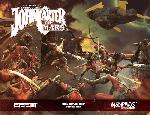
Review Summary: John Carter doesn't need to work that hard, but the GM does.
Blurb from the publisher: 'Conspiracies on the dying world of Barsoom!
Edgar Rice Burrough's John Carter of Mars: Phantoms of Mars provides you with a new, unique campaign for the John Carter of Mars: Adventures on the Dying World of Barsoom roleplaying game. Play through an epic story of swordplay and conspiracy, using the 2d20 system.
- Uncover the Eidolon conspiracy using your wits, brawn, and the help of your companions.
- Adventure to familiar locales and new locations, as the campaign takes you across the dying Red Planet.
- New rules and statistics for narrator characters are included for each adventure.
- New creatures are introduced, with their new rules and statistics explained.
- Narrator advice is included on how to insert the campaign into your ongoing game, or as a separate storyline.
- Rules for miniatures combat builds on the 2d20 system conflict mechanics, for a standalone skirmish wargame experience.
This campaign supplement requires the John Carter of Mars: Adventures on the Dying World of Barsoom core rulebook.'
What you get: Your EUR 27,99 or USD 31,99 or GBP 24,99 will buy you John Carter of Mars: Phantoms of Mars, a full colour, hardcover, 118-page adventure in landscape book format for use with the John Carter of Mars game line, along with its pdf edition. The book boasts an integrated red cloth bookmark.
The pdf version alone costs EUR 13,99 or USD 15,99 or GBP 12,49. It is comprised of three pdfs: the book proper in full colour, the book in black and white, and a page of errata (which, up to now, simply states the nature of the changes on the pdf).
Spoiler warning: As much as I am not going to describe, let alone detail the adventure (which the blurb from the publisher partially unveiled), parts of the scenario might be revealed while discussing the strong and less strong points of the book. If you intend to participate in this adventure as a player, stop reading now.
Contents: The adventure is broken down into four parts, each ranging from 11 to 16 pages. Parts are themselves broken to anything from four to eight scenes. Most of the scenes are covered in one to two pages. The adventure is written with 3 to 5 novice players in mind, even though it can be adjusted so that even the named protagonists of the setting like John Carter and his allies can tackle it. Expect an average of two sessions per part, depending on your playing style and the immersion you are trying to create.
In The Shadows of Korvas the heroes will become aware of the Eidolon, a secret conspiracy within Barsoom, which seeks to use ancient science to dominate those in power and rule through them. Traitors and Fugitives will see the heroes being accused and hunted down as members of that conspiracy. To prevail, they will need to gather evidence and allies to clear their names, and unite the other cities against the real Eidolon threat. Raiders of Kaol further expands on the conspiracy and the heroes' interaction against it, while in Specters of the Mind, the adventure's finale, the heroes must save Barsoom from the terrible fate that awaits it.
The book however does not contain only the adventure; it also contains the 2d20 Skirmish Rules. The chapter is comprised of the rules themselves, seven types of scenarios, and Fall of the Eidolon, a six-part campaign that works as a loose wargaming sequel to Phantoms of Mars. The skirmish rules can be used as a substitute to combat encounters, or as a way of setting up John Carter miniatures games without the need for a role-playing element. Units may consist of a model or a squad of five models. Units generate momentum, which in turn is used to fuel actions. Two actions per activation are free, yet momentum can be paid in order to purchase a third action. There are six actions in the game (movement, charge, attack, special ability, claim objective and call for reinforcements). All fighting (i.e. both melee and ranged) is based on opposed rolls. In melee a player can counterstrike through spending momentum. Expect rules like morale, routing, commanding distance, having multiple leaders etc. Victory conditions are specific to each scenario. The Arena is a fight to the death, as is Last Thark Standing. In other scenario types however a player might be trying for his units to leave the board, survive a number of turns etc.
The strong points: Pulp and romance do not need a lot to get going, and that is the premise Phantoms of Mars bases itself on. The adventure is very close to the original subject matter, never bothering itself with trivialities or the drudge work. There is betrayal, conspiracies, ruins, incredible science, fantastic monsters, impossible feats, false accusations, daring escapes, and many more, before the final confrontation. The action is tight, even though some of the scenes are less active than others in order for the adventure to breathe. The system proves its worth once again; I enjoy how, with the same basic set, I can have games as cinematic as the present one, or as crunchy as Mutant Chronicles. Narrative control is given to players for a reason. Use it cleverly in order to bring about the nigh-on-impossible feats that the game requires for an entertaining completion of the plot.
I have been very positively surprised by the amount of attention that the NPCs have gotten. There are real histories waiting to reach the surface and be experienced by the heroes. Reading through them it will be easy for the GM to truly understand them and play them accordingly. Honestly, take the time in order to bring this material forth; it will be a pity for it to die an ignominious death as GM-eyes knowledge only because you fumbled through it.
I enjoyed the skirmish rules. They might not be the next big thing in gaming, they are however light and cinematic, meshing well with the subject matter. They will have no problem accommodating a John Carter type of game, seeing how there is no scenario that uses more than four units per side. Clearly, these are not rules to base more involved scenarios on. The seven types of scenarios are what one would expect to see, while the wargaming campaign, although derivative, can provide a lot of entertainment. Using the same terminology as 2d20 (e.g. momentum generation) is a clever trick to increase brand awareness.
The production values are very high. The books of this line are landscape oriented, and this one couldn't have been an exception. The visuals are bright and imprint themselves on your eyes. The layout is well-done and the volume is overall easy to read. I will never tire of applauding integrated bookmarks; they really make a difference. The cover art is a surprise; it shows a rather violent scene with an unexpected amount of blood for this game's genre, yet I am not complaining, at least not for that.
The pdf is well done. I like how Modiphius produces two versions in order to facilitate those who wish to print their own, black and white version. The bookmarks go three levels down. There is no index, and the table of contents is not hyperlinked, yet this is an adventure so I don't mind that much.
The line is very well supported. I am not only talking about the RPG materials, but also about the accessories like dice, miniatures and tiles. These skirmish rules are not an one-off; you can put them to good use.
The weak points: Phantoms of Mars is a pulp adventure, which comes out as almost abstracted at times. The characters might be storming through a city without the GM having a prior idea of how the city looks like. Ambushes will be set without any meaningful description of the surrounding area. Important dialogues are brushed off, with the book simply stating what kind of info the players will obtain and what they need to roll for it, but not much more. Scenes might or might not feel disjointed, depending on how a gamemaster transitions from one to the other. There are no visual portraits of the NPCs, even though they are all described in detail. Funnily enough, for a game of such frantic action, it is not always obvious how this information will get to see the light of day. I understand the John Carter premise, the adventure however should have contained more immediately transmittable information overall. If I don't have that info I am very likely to create it on my own, both wasting time and potentially trampling over what the authors created in the first place.
No complaints about the style of the adventure. No matter the turning points and revelations, the scenes are rather formulaic in nature. There is some railroading (which the book warns about in advance, and explains it in the wider John Carter literary context), if you don't like that however why are you playing romantic, pulp style adventures in the first place?
I am not convinced about the skirmish rules being attached to an adventure, any adventure. They had to be somewhere, sure, yet in my opinion this should have been a rulebook or a sourcebook. If the space taken up by the rules was used to further expand the adventure, the final result would have been even more memorable with far less work from the GM's side.
One of Iron Maiden's biggest aesthetic failures was the cover of Dance of Death. The revelers depicted on its cover were rough, computerized sketches, without the textures that a computer generated image of a human requires. The humans and Martians in Phantoms of Mars might not be as bad, yet they still don't look good enough. There are weird angles here and there, bland characteristics, and an overall feeling that the job wasn't properly finished. Not all pieces are disappointing, many however are. I wish something gets done about this in future releases.
There are typos in the book. In fact, there are typos even in titles. This shouldn't have happened. At some point I would have also enjoyed Modiphius to shorten the margins and provide part of the additional content I am talking about. It wouldn't be that much, but having even 10% more material in such a book would have made my life easier.
I know I am nitpicking, but I really dislike how adventures nowadays are called campaigns. Where I come from, Phantoms of Mars is not a campaign, no matter how many things the heroes might come to accomplish.
Conclusion: The Phantoms of Mars Campaign Guide might not be strictly speaking a campaign, it is however an entertaining adventure that remains faithful to the subject matter, seeing how the heroes get to save the world in the first full adventure of the line already. That having been said, this won't be a walk in the park for the GM who will need to do some heavy duty weightlifting. The skirmish rules are solid, even though they aren't the most obvious fit for an adventure book. If it were up to me, all those pages would have been used to alleviate the GM's burden.
For more info on the John Carter of Mars: Phantoms of Mars Campaign Guide and the John Carter of Mars game line overall, visit the Modiphius Entertainment website at http://www.modiphius.com.
Shameless plug: for more gaming news and content (including, for example, pictures of the John Carter of Mars: Phantoms of Mars Campaign Guide that I am unfortunately not able to upload on RPG.net for the time being) and to better keep track of my reviews, subscribe to my Antonios S facebook and twitter page.