Volt: Robot Battle Arena (2014), by Emerson Matsuuchi, is a game of battlin' robots published by Nazca Games.
Players: 2-4
Playing Time: 30-45 minutes
Summary of the Components
Volt comes with: a pair of battle boards; a plastic robot, player board, and player screen for each player; dice; and lots of cardboard bits.
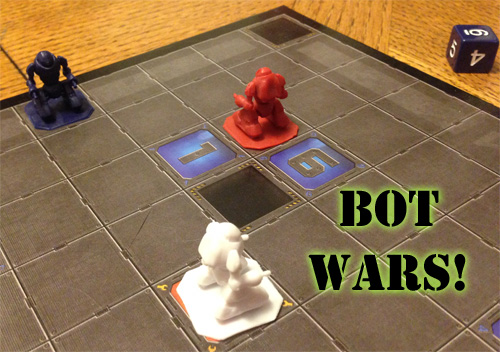
Quality: All of the cardboard is thick and linen-textured, though the player boards are just a tad flimsier than I'd like. The plastic robot figures are also nice molds. 5 out of 5.
Beauty: There's not a lot of artwork in the game, but the player screens are very good looking, as are the plastic robots. 4 out of 5.
Usability: Volt helpfully uses the inside of the screen to remind you of the main sequence of events in the games. The player boards are also pretty easy to use, though the symbols for movement and attack are less visible than I'd like. 4 out of 5.
Theming: You have robots, and they battle. It's a pretty simple theme, but it comes across well enough. 3+ out of 5.
Overall, Volt is a good production, with especially high-quality components. I've given it a "4" out of "5" for Style.
Summary of the Gameplay
The object of Volt is to destroy other robots and to take control of certain strategic locations on the board.
The Battle Board: The game is played out on a 9x9 battle board, which contains several pits and several spaces that could become worth points over the course of play. (There are actually four battle boards total to choose from in the game.)
Robots will enter the battle board from their individual edges.
Programming a Turn: A player prepares a turn by laying his three dice down on his individual player board. Dice are each laid down either to move in one of four directions or to fire in one of eight directions. Two restrictions keep things interesting: no more than one dice may be placed on each move or firing direction; and no more than two moves can be made each turn.
The dice are three different colors (red, white, and blue), which determines their order. They can also be set to a value from 1-6 which determines distance moved (for a movement order) or how damaging the shot is (for a firing order).
Taking a Turn: After everyone has programmed their moves, the dice are then revealed and moves go in order: first red dice, then white dice, then blue dice; with the lowest number on each die going first.
Seeing the Results: Clearly, players want to move their robots onto the victory-point spaces and to shoot each other. However, amusing things can also happen as a result of robot interactions.
First, robots can push each other, which can mess up moves, or result in robots ending up in pits!
Second, when they shoot each other, robots can disrupt their opponents' moves and gunshots … if they set their damage to be high enough.
Third, robots can get blown up if they're shot enough. They'll regenerate at the start of the next turn!
Ending the Game: The game ends when a player has earned enough victory points through sitting on victory-point spaces, delivering the killing blow to opponent robots, and pushing robots into pits.
Relationship to Other Games
Players will instantly compare this game to Richard Garfield's RoboRally (1994). They're certainly in the same category of "program your moves and insanity follows", but Volt is shorter, simpler, and shallower.
The Game Design
Volt is a fun game primarily for its clever programming. There is just enough complexity to make things interesting. You have to decide not just how to outthink your opponents, but also how to get your stuff done done before them (by using lower numbered moves and attacks) or after them (by using high numbers). The result is a fun combination of double-thinking and risking everything.
As with most programmed-move games of this sort, a lot of the excitement comes through the roll out of everyones' interrelated moves. When another player shoots you and messes up your commands, or when someone trundles into you to push you right into a pit … it's a great laugh, both when you see the cascading events coming in advance, and when they finally happen.
With all that said, the game is a bit shallow as well. The board is very small and the terrain on the board is pretty simplistic. As such, you don't have the magnificent complexity of a RoboRally. Instead, each round of play turns into a simple tactical puzzle, as you figure out the best way to manage the interrelations between you, your opponents, and the scant locations on the board. This can get old … but fortunately Volt is a short enough game that that probably won't happen before your game is done.
Overall, Volt is a nicely clean and simple game that has a lot of surprise and excitement in it. I've given it a "4" out of "5" for Substance.
Conclusion
If you're looking for a super simplified version of RoboRally, this is it. Volt is a simple game of programmed moves that's easy to learn, quick to play, and fun to enjoy.
