For the sake of transparency, this review is written from a PDF copy of the final version of the Vow of Honor Roleplaying Game given to me by its author/designer, Ben Dutter. I did not back the Kickstarter and have no relation to the author or its other contributors.
Layout
The book clocks in around 255 pages, and is written in a single column layout on a "central tablet" on each page, making excellent use of contrast and readability on tablets and electronic devices. In a printed form, it would probably suffer from having such a large font and only the one column, unnecessarily padding out dead-tree format. That said, the final version of the game is offered in not just PDF, but also EPUB and MOBI formats for book reader devices, which means that the formatting is clearly optimized in that direction.
Art
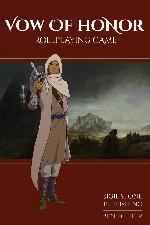
The cover features a unique style that is prevalent throughout much of the interior as well: "anime"-style characters inspired by a sort of contemplative, warrior-monk aesthetic, against a backdrop of ancient, forlorn ruins and post-apocalyptic expanses of various natural vistas. Ancient temples, religious ceremony, and hints of the otherworldly nature of the setting continuously crop up, making for a gorgeous and thematically strong presentation of the alien world featured in Vow of Honor. The cover is credited to Markus Lovadina and Lee Che, and the interior work to Winston Lew, Stephen Garrett Rusk, and Lee Che (again), and they certianly deserve praise for the consistent and gorgeous style throughout.
Every page has a repeated image in one corner: odd pages depict an Arbiter (the type of character the players will be playing in the game) and even pages a demonic, beast-like humanoid known as an Adabhuta, which are one (of many) antagonists in the setting. Additional artwork is sporadic, but is usually tied to the text that each image is positioned near in order to illustrate a character, monster, or locale. The alien world of Sasara has a very specific look, and the artists capture this well. For instance, the primary setting of the game notes that the horizon line slopes up, and while it does so gradually and extends away to great distances, this effect is captured in much of the artwork of landscapes and cities.
Content
Vow of Honor is a fairly focused game in that it is designed from the ground up for the player characters to portray Arbiters, warrior-monk lawmen and councilors that travel to the various settlements (Enclaves) to carry out the duties of the Order of Fasann, an ancient organization dedicated to bringing enlightenment to the people of the alien world of Sasara. "Enlightenment" involves defeating bandits and beastly Adabhuta, weeding out corruption -- which has physical effects on the world in this setting -- and uncovering artifacts that provide clues to the origins of the people of Sasara. The Tenets of Honor are followed by the Arbiters, making them sort of like the ideal samurai warrior, but this doesn't mean the players need follow them to the letter.
In point of fact, much of the game consists of the moral issues the Arbiters will face, and therefore corruption, willful or not, is central to the gameplay mechanics and world building.
All of that said, there are additional rules (provided at the end of the book) to play non-Arbiters, and little is lost in doing so, or in playing a mixed group of characters (Arbiters and non-Arbiters).
As an aside, every major section of the rulebook -- whether it's about setting details or gameplay mechanics -- ends with a "Recap" summary. It sums up each section in a handful (sometimes more, sometimes less) of 1-2 sentence bullet points. The succinct nature of these recaps, and the clear call-out text box formatting of them throughout the book make them excellent fodder not just as reminders as to what the game is really about it, but also as potential handout information to players to bring them up to speed on the setting or gameplay. This is incredibly important for a game presenting an alien fantasy world such as Sasara, and it is a powerful tool not only for the reader, but for the gamers sitting at the table and playing it.
Setting
Due to the focus on particular characters and how moral quandaries affect the mechanics of the game, the setting is necessarily detailed in such a way as to promote conflict through situations, organizations, allegiances, and the investigation of mysteries. While there is no detailed gazeteer of the world of Sasara, there is a fair amount of text devoted to what the world "feels" and looks like, and who the various players are in the world, while leaving several bits and pieces unanswered so that each campaign can develop its own direction and "solutions" to various mysteries.
Thus, we are left with broadstrokes yet highly "gameable" information, with a sample Enclave (city) detailed fairly loosely. The subject matter of the setting touches on everything you'd use in a campaign -- thus "gameable" -- including a broad description of the world (a man-made one, wilderness of ancient ruins and violent weather dotted with Enclaves and bandit settlements), technology, food, everyday life, society, etc. More detail is given the Order of Fasann, religions that are related to or opposed to it, corrupted members, governments, syndicates, slavers, and more. Though it is an alien world, and the artifacts of its original inhabitants (the Forebears) litter it, enough real-world explanation makes it easy to picture this fantasy world...and as mentioned earlier, the art goes a long way in helping this.
Rules and Gameplay
Vow of Honor is recommended for 2-6 players (one of whom is the Gamemaster), and requires six-sided dice. The rulebook includes character sheets as well as a short Quick Start Rules appendix, which gives everyone at the table the ability to reference only a handful of pages to get the entirety of the game mechanics (in shorthand form, notably).
Because of the nature of Arbiter characters -- and the world of Sasara in general -- ample space is given to discussion about what type of game is being played, in terms of tone, character types, antagonists, and general maturity level. This serves as excellent advice in general, but reinforces the fact that this is a focused roleplaying game, as opposed to a "generic" or all-encompassing genre game. The Tenets of Honor reinforce this, and are described simply and succinctly in order to help establish what the game does. The Tenets of Honor are Compassion, Commitment, Purity, Righteousness, and Understanding.
Ultimately, we arrive at the Rules section, which state the basic mechanical aspects of gameplay. Simply put, players roll all the dice -- never more than 10 six-siders at a time -- and the GM interprets the results bassed on the enemies or tasks the characters face. Every roll has at least 1 die (the Base Die), and a pool of other dice can be added to it...but these dice aren't always available, some don't regenerate once spent in an encounter, and some can be gained or lost depending on how the actions the character is taking relate to the Tenets of Honor.
Players accrue a pool of Honor Dice that can be spent throughout an encounter (called a Scene), but don't regenerate until the encounter is over. Honor dice are gained or lost based on the moral and ethical implications of an Arbiter's actions.
Advantage Dice come from equipment, environment, and other situational modifiers.
The dice in a pool, once rolled, are compared to an appopriate Skill to see if they count as successes. If the number of successes matches or exceeds the Difficulty of the roll -- which might be a trait of an enemy or the complexity of a task in an unopposed situation -- then it's all good. If not, bummer.
Character Creation
Generating a character comes next, and describes how an Arbiter is created (remember, non-Arbiter characters are discussed -- with full character creation rules -- at the back of the book). They are pretty much a bundle of Skills (this is the target number of the d6s you roll to perform actions), Talents (descriptive traits that improve your dice pools, like Smooth Talker), and Oaths to two of the Tenets, which provides you with ways to get Honor Dice more quickly, as well as low-level supernatural abilities like a healing touch. During play, excessive abuse or corruption of any of the Tenets can lead to Stains, which have a palpable, visible affect on the character and world around them.
Further Mechanics
The Gameplay section continues through the majority of the rest of the book (some 60 pages), which might sound like a lot, but is mostly taken up by permutations of the basic mechanics and copious examples, illustrating these permutations in multiple ways for clarity.
Among these permutations are how to handle Scenes and complex tasks in the same manner as monsters/adversaries to determine Difficulty ratings, how injury and Consequences work on failed rolls (Consequences are a lot like Complications in Cortex Plus games, which in turn are similar to Fate games and others of that ilk, providing narrative and mechanical heft to every failed task), how the Tenets affect dice rolling (and how acting against a Tenet gains Stain, as well as Dishonor Bonuses. Yep, you read that right: it pays to act against the Tenets...but do it too much, and you'll be advertising via Stains. Combat itself takes up only about 8 or 9 pages of this.
The Game Mastering section goes over how to build campaigns, short adventures, and encounters, and discusses in detail the ebb and flow of Honor Dice rewards (and penalties), setting Difficulty, creating adversaries and settlements that directly drive action and intrigue (for example, each settlement receives a Dishonor stating what needs "healing" by Arbiters that visit the settlement, as well as a Source of this Dishonor that they have to deal with).
Factions round out the main rules text, describing organizations in game terms that provide motivations, actions, and "scale" rules for factions of different sizes (such as a bandit fort against an Enclave's military) acting against one another.
Additional Rules & Info
Vow of Honor ends with several appendices of additional information, including Playing Non-Arbiters, random idea generators for Forebear Artifacts and plot seeds, Sasaran Creatures (not all antagonistic), a Character Sheet, and the Quick Start Rules, which are suitable for printing out and having players (or the GM) reference on the fly.
Conclusion
Ben Dutter did a great job designing and writing Vow of Honor, creating a focused RPG experience where morality, honor, and the consequences of having to sacrifice these things -- or forsake them entirely -- has concrete mechanical effects as well as visibile effects on the setting. In many ways, it harkens to several "indie" games for its strong narrative theming and relatively simple mechanics, but there's enough permutations and expansions in the rules to place it closer to a rules-medium game, perhaps close to the level of some Cortex Plus games (Leverage or Firefly) or Fate Core (as opposed to Accelerated). It doesn't rely on too many esoteric traits or "weird dice tricks," though, so it's all about managing a character's relation to the Tenets in order to build up more dice. That the GM doesn't have to roll dice is, however, a very telling aspect of the game (likely inspired by the various Powered by the Apocalypse games like Apocalypse World and Dungeon World), and provides the GM plenty of space ot manage Consequences of failed actions and develop the narrative of what successful tasks and moral quandaries mean.
It's a strong game, greatly focused, and backed up by evocative artwork. The simplistic layout and the lack of even more art are the only things I can hold against the game, and that ain't saying much. Consider Vow of Honor highly recommended!