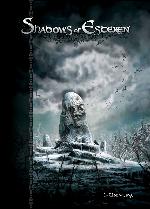
"Shadows of Esteren" is the brain child of one Nelyhann, a French gamer who raised funds to get it published using the Kickstarter website. It attempts to introduce an element of horror into fantasy roleplaying but much of this depends on whether you like the background of the world as the mechanics of the system are a complete mess.
Book 1 itself is a large hardback filled with some really stunning full colour artwork. The first 173 pages are filled with background information written in a similar style to White Wolf games with stories and letters being used to describe the setting and mood of the game. Unfortunately though the quality of the prose is very poor, if it had been written as a novel it would never have been published. The world it describes is similar to the late middle ages but with an uncomfortable mix of celtic influences and steampunk thrown in. There are numerous made up fantasy names for different aspects of this world which to me at least just ended up sounding lame. When Tolkien created Middle Earth he spent years developing the different languages so they sounded right, here they sound like they were made up in about five minutes.
The adversaries of Shadows of Esteren are creatures called Feondas (again, not the most intimidating of names). These creatures are never fully described in Book 1 though and the impression you are left with is that the name covers any monsters the GM cares to come up with. No statistics are provided for any adversaries in Book 1, and it is not until you buy Book 3 that you find out the true story behind them. As a result Book 1 is in effect a Players Manual for the game and you soon realise that to play the game properly you will need to pay out for Book 2 and 3 at the very least.
The game system is clearly not the focus of the game, but it is so defective as to make the game unplayable. It focuses mainly on describing a characters personality in place of the traditional attributes that describe strength, intelligence, etc. Unfortunately though it then relies on these personality traits when making physical skill tests, so you may find your characters fighting, climbing mountains or hiding based on force of personality alone. There are several character classes available in the game but there is little to decide between them except the selection of skills they receive (there are no special abilities except for those with access to spells). Skill tests are a matter of rolling 1D10 + a skill + a Way (one of your personality scores). The only physical attributes you can choose are picked using a system of Advantages and Disadvantages at character generation and these give a flat bonus to skill tests (rather than a scale).
Combat is similarly messy with a system that allows an attack score partly based on Fighting skill (and can therefore be increased) against a defence score that is based on personality alone (and therefore can't be increased). Everyone seems to have the same number of Hit Points in Shadows of Esteren and combat seems mainly to be a matter of grinding down those Hit Points until one or other combatants is dead. For a game that proposes to be more realistic than other fantasy RPG's this is a rather uninspired system and without any special abilities to liven combat up its going to be hard to make it very exciting.
The magic system in Shadows of Esteren does show a lot of promise as it allows some freedom on the part of players to create their own spells based on the guidelines provided. There are three possible types of magic, which amount to druidic magic, clerical magic and the technology based steampunk magic of magientists. Unfortunately though the system has again given little thought as to balance as it is entirely left to individual GM's to decide how many spells characters start with and how many they gain during play.
Finally the last section of the rules deals with the special psychology rules. This is a tricky system to introduce into the game as even in D&D Ravenloft characters in fantasy games are used to being able to do whatever they want without worrying about fear and sanity rules. The player of a grizzled veteren warrior does not want some game rule telling him that his character wets his pants and runs off when a werewolf attacks him. Players want control of their own characters and while these rules are well handled it is a difficult match to play D&D style characters with Call of Cthulhu style sanity rules.
Overall therefore I was sadly dissapointed by Shadows of Esteren. It is clearly a labour of love by the author but it allows little room for the individual GM to make it his own. If you don't like the game world which is described (and I didn't) there is not much left to take from the system. The game mechanics seem like an afterthought, and are deeply flawed, meaning more work is required to make these balanced. At the same time if you do want to play you have to realise that a substantial investment is required to buy further books even just to provide some adversaries for your characters to fight. While I love the original idea of making a dark, gritty fantasy horror game this just doesn't quite do the job. Despite its impressive appearance and obviously high production values Shadows of Esteren just fails to live up to expectations.