Five Tribes: The Djinns of Naqala is a gamer's game by Bruno Cathala, published by Days of Wonder.
Players: 2-4
Playing Time: 60-90 minutes
Summary of the Components
Five Tribes is packed to the brim with great components including: piles of wooden tribesmen, palaces, trees, and camels; cardboards tiles that make up the board as well as cardboard coins and a few other bits; and lots of cards for both resources and djinn.
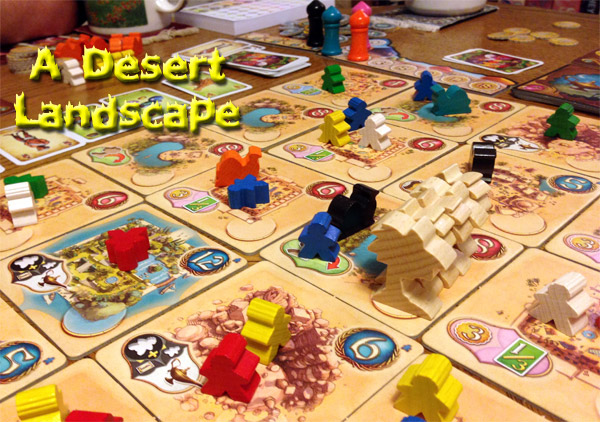
Quality: Everything is very well produced. The cardboard is thick and linen-textured; the wood is all quite stout; and the cards are thick and linen-textured too. 5 out of 5.
Beauty: Five Tribes is generally quite attractive, especially the box cover, the rules, and the player aid sheets. Though the location tiles and the resource cards were a bit more plain, the djinn cards make up for that with 22 beautiful full-color drawings. 5 out of 5.
Usability: I was fairly surprised to discover that ease of use wasn't well supported by the game. The rulebook was somewhat troublesome because it was overly sparse. There were a lot of things which were taught by inference or were outright omitted rather than being explicitly addressed (like how to play a 2-player game; or how many points tiles score; or what to do if you can't afford to pay for turn order). Though each player gets a player aid card, they weren't great for quickly reminding you how to play a game. They omitted some crucial rules (like the fact that elders score points at end game) and misrepresented others (like how viziers score). Overall, the game would have been better served by a simpler player aid that showed quick iconic representations of what tribes and locations did, and how everything scored at the end, instead of the text-heavy aid we got. None of these usability issues actively makes Five Tribes hard to play, but the point of great usability in a game is to make a game easier to play, and that was in shorter supply than I would have liked. 3 out of 5.
Theming: This is a game of 1001 Nights, and that's somewhat apparent through the core gameplay, which involves viziers, elders, builders, merchants, and assassins. The theme comes across more strongly through the djinn, who are beautiful and evocative, but they're just a part of the game.
Some players are uncomfortable that the game includes slaves as a vital part of the economy. (I'll admit, I was one of them.) However, if anything that adds to the theme of the game. 4 out of 5.
As is the case with the entire Days of Wonder family of games, this is a beautiful, well-produced game. If the theme is a lightly lighter than most, that's because of the game's abstractness. Unfortunately, not enough attention has been spent on the game's usability, which could have made it easier to play. Overall, I've given it a rating of "4" out of "5" for Style.
Summary of the Gameplay
Five Tribes is a game of cleverly collecting tribes members to earn points, primarily through the capture of valuable tiles and valuable djinns and through the purchase of valuable resources.
Setup: The 30 location tiles are randomly arranged into a 5x6 game board, then a random selection of 3 tribes members are put on each tile. Each tribesman can come from one of five tribes: assassins, builders, elders, merchants, or viziers.
Bidding for Turn Order: Each round starts out with an innovative turn order mechanism: each player decides how much to pay for their turn. There's a bit of brinksmanship here, as players have to decide how much it's worth playing to go earlier in the turn order — without knowing how much later players will pay.
Taking a Turn Order: During a turn, a player: collects tribesmen, takes a tribe action, and takes a location action. He also might claim a location.
Collecting the Tribes. This is the abstract heart of the game. The active player picks up all the meeples sitting on a location, then drops them down one at a time in a linked line of adjacent spaces. When he drops the last meeple it must be put in a location that already has at least one meeple of that color.
Take a Tribe Action. The player then picks up all of the meeples of that color on the last location and takes an action with them:
- Assassins: Kill a nearby meeple. This action can be improved through the use of slave cards.
- Builders: Give coins, which can be used to bid on turn order, but are also worth points at the end of the game. This action can also be improved through the use of slave cards.
- Elders: Used to buy and activate djinn. Alternatively, worth points at the end of the game.
- Merchants: Acquire resources (or slaves) from a face-up row.
- Viziers: Worth points at the end of the game.
In all cases, these actions improve if you pick up more tribes people of the same color. You'll always get two but more can give dramatically better results!
Take a Location Action. Specific locations allow you to: place oasis, place palaces, buy resource cards, or buy djinn.
Claim the Location. If a location was emptied of meeples at the end of the turn (though the collection of tribesmen or an assassination), the active player gets to claim the location with one of his camels.
Merchandise & Djinns: The main purpose of acquiring merchandise is to earn points. A set of unlike cards earns an increasing number of points based on how many cards are in the set. These sets can also be sold during the game for coins, if need be.
Slaves are mixed in with the merchandise and can be used to improve assassins, to improve builders, to purchase djinns, and to activate djinns.
The djinn themselves have a variety of special powers, which help to form your strategy. Many can be activated during the game using elders and slaves, while some are just worth points at the end of the game.
Cleaning Up: Merchandise and djinns for sale are only refreshed at the end of each round of play — which is one of the reasons that it's important to bid enough to go early in a round.
Ending the Game: At the end of a game, a player earns points for: coins; locations (including palm trees and palaces built on the location); djinns; sets of resources; viziers (including a pseudo-majority-contest); and elders. If it sounds like there are several paths to victory, there are!
Relationships to Other Games
The core mechanic of Five Tribes is a Mancala-like move. The way that pieces are put down in multiple adjacent spaces also reminds me of one of Rüdiger Dorn's favorite mechanics, which shows up in games like The Traders of Genoa and Goa.
Some folks have called Five Tribes a "worker placement" game, but I find it pretty far removed from that core mechanic. Instead, it's a pretty unique style of game that's all its own.
The Game Design
Overall, Five Tribes is a thoughtful analytical game that plays well. The core mechanism is quite innovative and allows for very tactical play as you try to figure out a move that allows for the tribe action and the location action that you want, and that also (maybe) empties out a space for you to grab. It's a carefully arranged puzzle and you usually have to settle for just one or two of those options, but it's still great fun figuring them out.
Despite its tactical basis, there's some interesting strategy in Five Tribes too. Most of this focuses on the collection of the djinn cards, which can define how you play — but collecting resources is also ultimately strategic.
As with any good resource game, you never have enough of anything in Five Tribes. In particular, you often don't have enough elders or slaves to activate your djinn, and so you sometimes have to spend multiple rounds trying to get what you need.
Finally, as noted earlier, there are a lot of paths to victory, so you can concentrate on what seems best for you in each game, and hope to outcompete your opponents.
I have some caveats for Five Tribes too. Most importantly, it's the exact sort of thoughtful, tactical game that can be prone to Analysis Paralysis (AP) and "Best Move" syndrome, where players keep searching and searching, hope for a better option than what they have. This is made worse by the fact that the board changes so quickly that you can't easily plan out a move before your turn. Individual players will know whether their group is prone to AP or not, but if it is, player beware.
Overall, Five Tribes is an interesting and innovative game that should appear to exactly the gamers that it was made for. It's a solid new release from Days of Wonder, and it's nice to see them venture out into more complex gamer grounds.
Conclusion
Five Tribes is an abstract euro that's likely to appeal to serious gamers. It's got an interesting and innovative core mechanic for play that creates tactical puzzles that the players must solve. Groups prone to AP won't like it, but others probably will.
