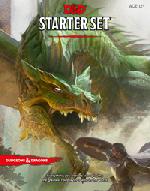
The D&D Starter Set (for Fifth Edition) is an entertaining but flawed product. It begs the question, "What should a starter set do?" If its job is to whet one's appetite for the main product, then it did its job. If it is supposed to explain the main concepts of the new set, then it needs some more work.
Physically, the starter set is a nice product, but I would have paid a few dollars more for some more stuff, or a little less for a smaller box. It comes in large box (2.5 x 9 x 11.5 inches), but much of that is air. What you get is two books and dice. The Starter Set Rulebook is 32 pages and does indeed contain most of the rules. The other book is the adventure book, The Lost Mine of Phandelver, which comes in at 64 pages, and contains the adventure (a mini-campaign, really), magic items, and monsters. Rounding out the contents are five pre-generated character sheets (well, I got six, but one was a duplicate of the halfling rogue), and some disappointing dice.
The rules themselves are mostly clear, but there are some parts that are just plain confusing. Old players will be confused about the subtle differences. For instance, there are no flanking rules, two-weapon fighting is easy to achieve, armor mostly doesn't affect movement, wizards now memorize spell lists but not their actual spells, which they use spell slots to cast, as sorcerers did in 3rd edition. A sheet with a list of major changes or a link to page with those changes would have been nice (I spent half an hour looking for rules about armor and movement, thinking I must have missed something, since every edition of D&D has had heavy armor reduce movement).
Both old and new players could have benefited from a greater discussion of inspiration and advantage. I found that the basic rules that Wizards of the Coast provided online were very helpful in that regard, but since these are major ideas in the game, they should have been included in full detail in the Starter Set. This is what the Starter Set says about advantage and disadvantage:
"Sometimes a special ability or spell tells you that you have advantage or disadvantage on a d20 roll" (5).
Compare that to the Basic Rules:
"Sometimes an ability check, attack roll or saving throw is modified by special situations called advantage and disadvantage" (4).
The Starter Set does go on to refer to "situations" that grant advantage and disadvantage, but, rules-as-written, those situations it refers to are multiple uses of special abilities and spells, not characters doing something clever or being stuck in a tight spot. This contradiction between the Starter Set and the Basic Rules (and I expect that the Players Handbook will follow the Basic Rules in this situation) will cause unnecessary confusion.
Another missed opportunity is that there is no discussion at all of inspiration. "Inspiration," as explained in the Basic Rules (35-36) is an award that a player receives when his or her character demonstrates that trait. Since Fifth Edition includes a lot of roleplaying elements directly in the rules such as Ideals, Bonds (to the game world), and Flaws, it is both easy and fun to gain inspiration. If a player gains that award, he or she can use it to gain advantage on any roll, or even to give his or her inspiration to another player. Since the Starter Set pregenerated characters had all those character elements, a few paragraphs on inspiration would have allowed them to use those elements for more than just flavor.
What does work about the Starter Set is the adventure, which is really a mini-campaign. The pregenerated characters each have links to different parts of the campaign. For instance, the cleric has a personal goal of "teaching the Redbrands a Lesson," which the cleric gets a chance to do in the town portion of the campaign. My players enjoyed those personal goals, and they had a fun time balancing them with the actual quest.
In addition to connecting the characters to the campaign, each part of the campaign highlights a different part of the rules set. Players get to explore classic dungeons as well as wilderness, and they get to negotiate with townsfolk as well as untrustworthy villains. Smart players will also investigate where they are going and what they need to do.
I'm of two minds about the Starter Set. I was interested in Fifth Edition already. I keep up with the news, I participated in the playtest, so I was in a good position to use the Starter Set. It was fun for me. But what about a new player, or an old one who isn't as well informed as I am? I don't think it should be mandatory to look up the rules for a game online if one has paid good money for the box. I also think a starter set should not contradict the main rules or ignore important rules such as inspiration. Ultimately, I recommend this product with the reservations I discussed above.
[SPOILERS FOLLOW]
HOW I HACKED THE STARTER SET
I did run the adventure in the starter set, so this is my actual play / actual prep report. I hope it is of some use to you.
I read the adventure several times, and I was struck by the town of Phandalin, and the way that it reminded me of towns in Dogs in the Vineyard (an rpg about religious law officers in a fantastic-but-historical Old West). The PCs in Dogs in the Vineyard are concerned with sin and demons. Phandalin is a frontier town gone to seed, with the promise of the rediscovery of the mine that once fueled its growth. It is tormented by a gang of ruffians ruled by a wizard (what DitV would call a sorcerer) who communes with a demon.
So I made the PCs religious law officers, "Watchdogs of the Gods," in service to the main pantheon of gods (you'll have to make one up yourself or borrow from D&D past). The main tenet of my pantheon was that the ideals of all of the non-evil alignments were all important, as long as they were balanced, and that evil thoughts and actions drew evil beings such as demons, and vice versa.
As religious law officers, the PCs had a lot of authority. They could arrest people, confiscate contraband, accuse others of conspiring with demons (or undead or such). There was also a traveling circuit judge, an NPC who could discern truth from falsehood.
The PCs were sent to Phandalin, then, ostensibly to help the Rockseeker brothers, but really to uncover the sins of the town, and it had plenty.
As in DitV, I went through the NPCs and I listed their sins and I made up a few of my own. The biggest thing I added was a journal that the mage Iarno Albrek (aka Glasstaff) kept of the sins of the town. I wondered why the town, which had the odd retired adventurer or two in it, didn't simply stand up to Albrek's ruffians, especially after they had murdered and kidnapped people. I decided that too many of them were scared of having their secrets exposed. What helped this interpretation was that the demon that Albrek had struck a deal with was a Nothic, which has the ability to discern people's secrets. So I imagined that the Nothic had fed Albrek all this information.
Thus when the PCs showed up to town, some townsfolk begged them to help, plied them with food and praise, and others, particularly the mayor (um...Townmaster), did what they could to stop them or slow them down without seeming to actually hinder them, since getting in the way of Watchdogs is a good way to be charged with some kind of crime. I cut out the factions since the PCs already belonged to a faction, but I kept the Zhentarim agent as a spy (which Albrek and the Nothic knew about).
I also decided to give the Drow in the adventure a demonic, mad makeover--Cthulhu elves, basically. I am sad that I never got to use them since the evening ended before the PCs got to the actual mine, but I was able to foreshadow them. After the PCs defeated the mage and his ruffians, the PCs find a letter that Albrek has received from the Drow. I decided that the letter would be an actual part of the Demonweb from the Abyss, and that rather than tell in words what the Drow wanted, it would send an astral spider into the reader's mind, and the reader would KNOW what was expected as this spider etched it in its mortal brain.
In actual game play, the players started by messing around, which almost got the cleric killed in the first encounter. They let the poor guy investigate the very obvious ambush by himself. After that, they got serious. They interrogated townsfolk, followed up on leads, and their best move was to investigate the old manor, the hideout of the wizard and his gang of ruffians, before charging in.
Charging in would likely have gotten them killed. Instead, the PCs came up with a plan. One of them used explosives and a wagon at the front of the manor to draw out the ruffians. That, some spells, and a bit of roleplaying ("You have been judged, and found wanting!") scared a whole bunch of them into surrendering. The others went in through a hidden entrance protected by the demon. The demon offered to let the PCs through without a fuss if they would step on a symbol of their pantheon, but they proceeded to smite the demon instead, with righteousness and critical hits.
And now I feel a bit like a hypocrite. I know I complained about the lack of inspiration rules in the Starter Set, and I had every intention of using them from the Basic Rules, but in play, I did not. However, my players did point out that rather than give them a small bonus for "inspiration," I rewarded their intelligent and creative play. I did award advantage liberally, and when a PC positioned himself just right to kill the next thing that walked through the door (a bugbear, as it turns out), I simply let him do it.
I also adapted something fun from Dungeon World, a great rpg in its own right. Dungeon World (and Apocalypse World before it) have success and failure, like most games, but they also have a midground, success with a cost. Since low-level PCs in D&D tend to technically fail a lot, I allowed them to succeed with a cost if they rolled within 5 of what they needed to succeed. In one fight, for example, I gave the fighter with the great axe the option of hitting his opponent by throwing his axe, thus losing his main weapon. He took that option.
Perhaps the thing that I enjoyed most about the Starter Set and D&D Fifth Edition (as expressed by the Basic Rules) is that I was able to treat the PCs as the heroes of the game. I could challenge them of course, but I found it simple to reward them too. The simplicity of the advantage / disadvantage system and the simple action economy of Fifth Edition allows me as a DM to quickly estimate what is an appropriate reward and to tweak the game (by adding that midpoint between success and failure, for example), without breaking it.