Bremerhaven is a game of auctioning and contract fulfillment by Robert Auerochs. It was published by Lookout Games and is distributed in the US by Mayfair Games.
Players: 1-4
Playing Time: 1-2 hours
Summary of the Components
 Bremerhaven comes with many cardstock boards, many cardboard strips, many cards, lots of cardboard tokens, and a few other bits.
Quality: The cardboard bits are all linen-textured, while the cards are medium weight and glossy. Though the player boards are cardstock, they're a good, sturdy cardstock. The coolest component in the game is doubtless the newspaper card holder, which is a little wooden stand. Overall, everything is great quality. 5 out of 5.
Beauty: The overall style of the components is clearly meant to evoke Le Havre (2008), and that's not a bad thing, as Le Havre is itself an attractive game. Despite the high number of cards, almost every card in Bremerhaven has unique art on it that's good quality. The only artwork that was somewhat plain was the player board art … but there's only so much you can do with an empty space for playing cards. Especially given the huge quantity of art in this game, I've given its beauty a top rating. 5 out of 5.
Usability: The auction boards are full of icons, and though I found them somewhat befuddling at first, they became easy to read by the end of the game. There's also good use of icons on many of the cards, though they also took a bit of work to figure out. The one usability failure is in the pricing cards, which require you to go through a stack of cards to try and correlate goods with prices; there should have been a better way to do this. 4 out of 5.
Theming: This is a game of carefully timed shipments from boats to the countryside. Some of the players found some of the thematic aspects a little funky (like the fact that completed contracts remain unfulfilled until their time was up), but such is true in most eurogames. Overall, Bremerhaven was well-themed as a game of resource movement. 4 out of 5.
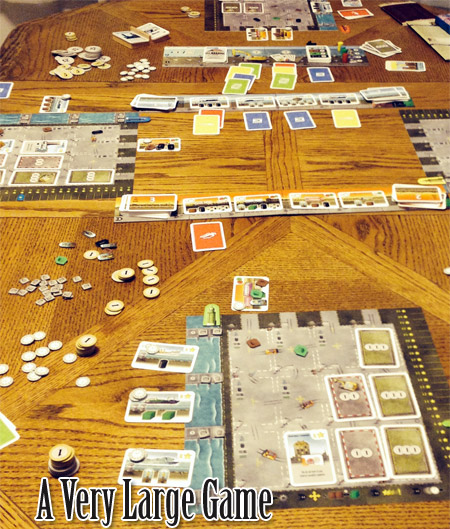
On the whole, Bremerhaven is a beautiful, well-produced game that earns a full "5" out of "5" for Style. My only real complaint about the components is that they take up too much space; my usual gaming table, with the leaf in it, was still tight. I think that cutting down the size of the player boards would have been a big plus that wouldn't have harmed the game … but so it goes.
Summary of the Gameplay
The object of Bremerhaven is to earn the most money through the shipment of goods while simultaneously earning prestige by building a great, well-used harbor.
Setup: Each player gets his own harbor board, which shows three docks and a parking lot that can be used to hold goods or building cards. He also gets a hand of influence cards, numbered 1-5, a random rank (playing order), and some starting money. Some initial buildings, ships, and contracts are placed out for purchase.
The game is then played out over several rounds, each of which has three major phases.
The Bidding Phase: During the first phase of each round, players bid their influence to acquire items available for purchase. The do so by playing their influence cards one at a time, face-down to the game board. Players will thus have the opportunity to react to other players' interest in individual items. In the end, the player with the highest total bid on each item wins it (except in a few cases where all players can pay the highest bidder's price).
Some of the items available for bid are the sort of structural things that can improve your overall game:
- Buildings. These cards can be built in a player's harbor. They offer special powers and increase prestige.
- Building Permits. These are necessary to actually build buildings! They can alternatively be used to clear more space in a harbor or to increase the size of docks.
- Influence. A player can increase his influence (and thus ability to bid) here; the winner will throw out his lowest influence card and take a higher one.
- Pricing. The winner here gets to set the prices for the four goods, which affects any contracts completed this turn.
- Ranking. This winner increases his rank, going earlier and earning more money in future rounds.
The players also get to bid on
ships and
contracts, which are really the heart of the game.
Ships. Ships carry goods to a harbor. Each one requires the docks to be a specific size and each also has a time that it will stay (locking up the dock in the process). Goods can be left on a ship or moved into a harbor for storage. Ships also have prestige values, which can increase the prestige of your harbor.
Contracts. These are the flip-side of ships. They require certain goods and they must be done in a certain amount of time. They usually generate money if successful and cost if they fail.
Individual Actions: After the results of all of the auctions have been determined, players now get to take actions in their individual harbors. For the most part this means producing, moving, and converting goods — with the ultimate goal of transferring them from ships to contracts.
Players also recalculate their prestige each turn by counting up the prestige value of their built buildings and the ships in harbor. If the total is higher than it was in previous rounds, then the player increases their prestige to the new total.
Finally, players remove time counters from all ships and contracts — advancing ships toward leaving and contracts toward being completed.
Clean-Up Phase: Each round of play ends with a newspaper event occurring, a game timer advancing, and new stuff being put out for auction for the next round.
Ending the Gaming: At the end of the game, each player counts up his prestige and money and multiplies them together. The player with the highest total wins.
Relationships to Other Games
Bremerhaven is an economic game with a blind auction that focuses on contract fulfillment. The progressive bid of cards (where you put them down one at a time) is one of my favorite mechanisms for a blind auction, and not one that I've seen very often. I think it was also used to strong effect in Bruno Faidutti's Corruption (2000). The contract fulfillment is a bit more commonplace, but used to good effect here. I recently reviewed another game in the same category: Global Mogul (2013).
The Game Design
I've been very pleased to see Mayfair bringing the Lookout Games into the US, because they generally have strong designs but they hadn't previously gotten as much attention in the US. Though Bremerhaven isn't by Lookout star Uwe Rosenberg, it's still a top game.
As I already said, the auction system is a strong one. Though blind bidding has a certain amount of randomness and uncertainty, that's largely offset by the fact that you can see how many cards each player puts out. This creates a very nice balance — allowing some bluffing and guessing on the one hand, but allowing some solid tactics on the other. There are also some nice variations within the auctions — like the couple of spaces where the high bidder controls price, creating some prisoner's-dilemma-like tactics.
The actual collection and shipment of goods would be commonplace if not for the timing mechanisms associated with the ships and contracts. Not only do they create a new resource for players to tactically manage, but they also have a real affect on the auctions: they create an interesting, orthogonal attribute that players have to think about when bidding and they also allow clever players to get out-of-sync with the rest of their opponents to their benefit, allowing them to bid on ships and contracts when other people can't.
Overall, there is a lot of opportunity for different strategies in Bremerhaven: you can increase your influence, you can bank on special powers from buildings, or you can increase the size of your docks. More generally, you can focus on money or prestige (though ultimately you'll need some balance).
My only complaint with the game is that the development feels a little incomplete. This is the most obvious in the individual-actions phase where you move things around the harbor. It's clear that this system was much more complex in early versions of the game, but now it's mostly vestigial: you don't really have to think much about moving things around, but nonetheless the game requires you to do so. I think there's also some opportunity for players to play spoiler in some of the bidding spots (particularly the building permit action), to the deficit of the whole game.
Despite those complaints, Bremerhaven is a strong, dense, thoughtful economic game that should appeal to serious gamers. I've let it eke in a "5" out of "5" for Substance as one of the best of the last year.
Conclusion
Bremerhaven is a strong economic game that puts together several elements to good effect, among them: continuing semi-blind auctions; a contracted goods system; and a simple harbor building system. The result is a great, serious game.
