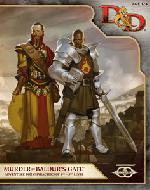
First things first: as I'm sure many of you readers already suspect, at $34.95 MSRP Murder in Baldur's Gate is grossly overpriced, almost regardless of the quality of its content. The physical components and packaging do not even come close to justifying the price tag, and on that count alone there is no good reason to purchase this product except at a steep discount. However, this does not mean that the adventure itself, or the supporting materials that accompany it, are without value, and those of you who have the opportunity to obtain it cheaply may actually consider it worth your while to do so.
Wizards of the Coast has designed Murder in Baldur's Gate (henceforth MiBG) with a few goals in mind. First of all, it provides the material for the next season of Wizards' public-play program D&D Encounters. Second, it aims to promote the latest overhaul of Ed Greenwood's Forgotten Realms, an event termed (in classic DC/Marvel Event Series style) "The Sundering." And third, by providing game statistics for editions 3.5, 4, and Next,* it encourages groups to give the still-in-development Next playtest rules a spin while offering backups formatted for two widely-played editions of D&D.
Unfortunately, the physical package that MiBG presents undercuts all of those aims. The outer packaging consists of a single sheet of heavy, glossy paper, wrapped around the module components and sealed with one of those circular mailer seals. Mine has already begun to tear at the corners, and I've owned it less than a week.
The components themselves are only slightly less uninspiring. The outermost is a laminated, landscape-oriented GM's screen featuring maps of Baldur's Gate (detailed on the inside, less so on the outside), some reference material, and tables for random encounters, NPC names and shops (yes, random shops). Attractive, and fairly sturdy (certainly sturdier than the wrapper), but hardly a must-have.
Tucked within the main fold of the screen lies the meat of the module: two saddle-stitched booklets printed in color on heavy, slick stock. These are professionally designed and illustrated, using attractive layouts and well-chosen, highly legible fonts. The larger is a 64-page campaign guide to Baldur's Gate; the smaller is the adventure text itself, weighing in at 32 pages. Both booklets, I should note at this point, lack any game stats for NPCs or other encounters. These must be downloaded from WotC's website for "The Sundering." The 24-page PDF contains stat blocks for 3.5e, 4e, and D&D Next. if you want them on paper, however, you'll have to print them yourself.
Let's review for a moment: Your thirty-five dollars buys one laminated-cardstock GM's screen, one 64-page setting booklet without a proper cover, one 32-page adventure book in the same format, and a slick-paper wrapper to hold the whole thing together and protect it from harm. Oh, and a half-page flyer advertising other D&D products. No monster or NPC statblocks until you go download the appropriate PDF-which is freely available whether you've purchased the module or not, so it's not something you're paying for. To compare, in April 2012 Wizards released the 4th-edition adventure book Halls of Undermountain, which wrapped its 96 pages of text in hard covers, provided a pair of double-sided perforated maps to boot, and included all relevant game stats for encounters--for five dollars less. It's hard not to feel insulted.
Having argued, I hope persuasively, that MiBG is not worth buying at the listed price, I would like to turn to the question, "But it it worth playing?" In other words, pricing aside, is the adventure any good?
To answer that question, I'll start with the campaign book. This is a 64-page guide to Baldur's Gate, covering its history, geography, economy and politics in the era of the Sundering. The chronology is reset to the year 1479--the same year in which the widely-reviled 4e version of the Forgotten Realms kicked off--and there is no sign of any of the changes associated with the 4e Realms. The locations and NPCs discussed in the most detail are, unsurprisingly, those playing a significant role in the adventure, but the guide is still a good overview for GMs who might wish to use Baldur's Gate in another game. And for the GM who plans to run the adventure itself, it will be important to get a solid handle on the Campaign Guide's contents, because Murder in Baldur's Gate is designed to give players a lot of room to maneuver.
The 32-page adventure book focuses pretty tightly on the structure of the adventure. The designers have attempted to combine sandbox freedom of decision making with a plotted storyline by throwing the characters into a tide of events that is simply too big for them to stem completely, so that they can shape events but never really change their overall direction until the climax of the adventure. That tide begins with a shocking public death that has both obvious and inobvious supernatural dimensions; this event leads to a ratcheting-up of the city's existing social tensions as three of its most powerful figures push to fill the ensuing vacuum.
Assuming that the players take the initial bait and deal with the obvious supernatural menace at the beginning, they will find their characters recruited by each of these three power brokers to support their strategies. Whether the players choose a side, try to play their would-be patrons off against each other, or attempt to avoid commitment altogether, so long as they remain in Baldur's Gate they will be affected by the unfolding of these three schemes that threaten to tear the city apart.
The sequence of events is divided into "Stages," each of which would seem to cover one Encounters session (about 1-2 hours of play). In each of these stages (apart from the introduction and climax) each of the three power brokers attempts to implement one part of his or her strategy. The PCs will have opportunities to assist or oppose these schemes, but will almost certainly lack the resources to exert a decisive influence on all of them. And as each stage is played out, the DM will be keeping score for the power brokers, because the most successful of the three will play a central role in the adventure's finale.
This structure is fairly clever; it gives players a reasonably wide scope of action and decision-making and allows them to have a visible influence on the course of events while keeping the range of possible outcomes manageable from the designers' perspective. To some, perhaps even to many readers, this sort of overdetermination is going to seem like railroading. It may even be so, but if so it's a lot more flexible (and fair) than most types of railroading--the players' choices (and luck) have consequences within he limited range of possible outcomes, and it seems unlikely to me that a player who hasn't read the adventure will feel artificially constrained while playing it--except to the extent that "too many fires and not enough buckets" feels like an artificial constraint. It may feel unfair, because many players are used to being set challenges that lie within their characters' capabilities, and given that aspect it might be useful for DMs to make that aspect of the adventure clear up front. But the players will still have a lot of freedom to act and to make decisions (indeed, they'll have to choose, because they can't do everything.)
This freedom for players is going to require considerable flexibility from the DM. The designers have given DMs some tools--random encounter and shop-name tables, maps, and of course the information in the Campaign Guide--but MiBG is not a tightly-scripted adventure, nor does it provide a lot of guidance for handling players' wilder or less plot-relevant plans. There will be a lot of winging it, and a DM running this adventure will have to be ready for that. And while in many ways this flexibility is an admirable feature of MiBG's design, it does call into question the adventure's suitability for a public program like Encounters, where time is constrained and play groups can vary considerably from week to week.
As an aside, it seems to me that the particular storyline is an odd fit for beginning characters. The Realms are notorious for their population of high-level NPCs, yet a small band of relatively inexperienced adventurers is placed in a position to exert decisive influence on the course of what could turn out to be a revolution in one of Faerun's most important cities. And the three power-brokers around whom the adventure revolves--including a commander of the feared Flaming Fist mercenary company--top out at fifth or sixth level. (This aspect would actually bother me a lot less if MiBG weren't set in the Forgotten Realms; it's an irritant rather than an issue, and it should be easy enough to ignore in play.)
To sum everything up, Murder in Baldur's Gate seems to be a pretty good adventure crippled by a ludicrous price tag for its unremarkable (not to say incomplete) physical format. I can see no sound reason that even a lower MSRP should have prevented the inclusion of a physical stat booklet rather than a downloadable PDF. As released, though, I would advise thinking twice before spending as much as twenty dollars on this product. If you can find it cheap, however, or have the opportunity to play without buying it, I expect it would be worth giving this adventure a spin.
*Well, for a certain definition of "providing," as we shall see.