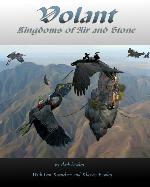
Volant – Kingdoms of Air and Stone
By Better Mouse Trap Games, Flying Mice Games Imprint. Written by Clash Bowley with Levi Kornelson and Klaxon Bowley.
The pdf is currently available at Precis Intermedia (http://www.pigames.net/store/product_info.php?products_id=738) and Drivethru RPG (http://rpg.drivethrustuff.com/product/112903/Volant---Kingdoms-of-Air-and-Stone) ($12.00), and print-on-demand will soon be available at LuLu.
Volant is a new fantasy RPG from the publishers of other such games as In Harm’s Way and StarCluster 3. Volant occurs in a post-magic apocalypse setting, many years after the tragedy. In an ancient war between wizards, horrible monsters were set loose on the surface of the world. In a last stand, the opposing wizards pulled every bit of magic from every living thing to rip mountains loose into the air, creating the Skylands as a last refuge. Humanity, in a more primitive form, maintains a tenuous foothold on the dangerous surface world. Most of civilization has migrated to the Skylands – floating rock islands that vary greatly in size. Monsters continue to enter the surface world through magical rifts that still linger from the apocalypse.
And giant birds. Lots of giant birds.
Humanity uses the birds as mounts. Martial forces of the Skylands patrol the skies mounted on birds bred for speed, endurance and maneuverability. Whether guarding against the few flying monsters from the surface, or against another Skyland, the giant birds are a common site in the air.
Volant is a complete RPG with game mechanics and setting. Volant is a StarCluster 3 rules game, offering the same multi-option task resolution systems. The rulebook offers four alternate task resolution methods: StarPool; StarNova, StarZero; and StarWorm. These options allow Volant to support a range of gameplay styles. Systems used vary the grittiness of play, so this should be discussed among the group prior to play. For example, StarPool is designed to support cinematic play while StarNova is meant to be gritty. The book provides plenty of explanations of how the four different task resolution systems work, including examples of how to use systems with Attribute modifiers and how to use each die system with examples. This is a nice touch to allow players to select style of game, resolution mechanics, or just the die type the like to roll.
Volant uses the standard six Attributes with which fans of StarCluster 3 are familiar: Strength, Coordination, Agility, Endurance, Charisma and Intelligence. For those that are not familiar with StarCluster 3, characters are built from Attributes, Skills, Traits, Maneuvers, and Edges. Players distribute 45 points among the six Attributes, and then select a starting age for their character. Character generation recognizes differences in age, allowing a range from wet-behind-the-ears youngster to aging wise-one. This is a throwback to some of the games systems from the ‘80’s, but is less tedious to apply. The starting age dictates how many points the character has to spend on purchasing Templates (similar to classes) and Maneuvers allowed. The older the character the more points to reflect their increased experience and capability. However, there is also the loss of physical attribute points with increased age.
Templates function as ‘classes.’ The game provides more than 80 Templates and advanced Templates. They provide Attribute bonuses and Skill modifiers appropriate to the archetype selected. For example, Avian Knights (bird riding soldiers) get Ride +1. Templates are purchased and followed as trees. The more points spent at the start of play, the further along a Template tree a character can advance, allowing more Skills, advancement to higher levels, and gaining Edges. Templates provide for a wide range of character type possibilities, including the typical warrior, priest and thief but also Alchemist, Artisan, Entertainer, Merchant, Miner, and Street Rat.
Skills are tied directly to one of the Attributes. For every five Skill levels, one level of Mastery is achieved. Mastery allows a reroll if a task attempt fails (and one additional attempt per level of Mastery). This is the usual nice touch in game design from Flying Mice.
Traits are aspects of the character’s personality that define them, be they cultural or moral, positive or negative. Each character receives seven Trait points to divide up among at least three Traits. The stronger the Trait, the more points put into it. The Trait level may then be called into use as a bonus in any situation where it is applicable.
Maneuvers are special attacks that are able to produce interesting results. Each maneuver is tied to a specific weapon. Multiple advantages are provided for each and includes melee, ranged and unarmed styles.
Edges are a powerful bonus that characters gain. Edges may be triggered when conditions (environmental conditions that are agreed upon between GM and player in advance) are appropriate, such as weather or lighting. An Edge is a bonus to a skill check; however, the benefit is that it can be used after the task roll. So a failure can be turned into a success, damage can be increased, the quality of a success raised, etc. These make Edges powerful, as the effect of their expenditure can be maximized at opportune points in the story.
The main attraction of Volant is the setting. It is unique, providing a new world to adventure in while still retaining a familiar feel and style of fantasy role playing. The geography of the setting also provides for various encounter and adventure types. Aerial combat in the skies, urban adventures on the Skylands, hex crawl on the world’s surface, or a dungeon crawl through the ruins of once magnificent cities.
At the start of a campaign prior to the beginning of play, the players form an Association. This is the agreed upon type of campaign the group wants to play, and sets the framework for the tone. When the Association is created at the beginning of play, the players let the GM know what their preferred style and purpose of gaming is through their selections. The group can determine exactly what they want or they can randomly roll on the provided tables. Exploration, spying, warfare and trade are all possible focal points of storylines. The players can then further this agenda by designing a home base and staffing it with specialists and materials that they feel necessary to accomplish their goals. For example, a castle can be constructed with a library and a small avian knight contingent. But beware, these resources must be maintained. Plenty of ideas are provided in the random generation tables for those that want to put less thought into the Association.
The technological level in Volant is best described as equivalent as pre-Renaissance. This provides a playground for different styles of games, such as dabblers and creators who want to impact the world. Magic no longer exists other than in the form of alchemy. Potions are the only ‘magic.’ Mechanically, alchemy works as in a prescribed manor, using up to a five step process to achieve the desired potion effects. Each step lasts an entire day, so there is not an instantaneous use, and the results vary based on the number of steps completed. In typical fashion, the rules provide a robust list of material components, their respective effects, and the Edge each provides.
Technology is beginning to emerge in the more civilized and advanced Skylands. Artifice could easily be ‘magic,’ the same as how Volant uses alchemy, for those that want a little more arcane feel. However, the sensibilities of the setting (i.e., fantasy) are preserved by not including the intrusion of black powder (though this could be easily added).
Volant is also a role playing game for those GMs and players that like to create what they play. Guidelines for creation of Skylands, ships and birds are provided. Quick roll tables for just about everything a GM needs to determine are provided. Designing these aspects of play is simple and quick, yet the tables provide for a level of detail that makes each new feature individual. Need a new Skyland – you can have the basics in five minutes, and then flesh out the details how you see them afterwards. There are nearly endless possibilities by combining the various elements of the tables. Creation of Skylands goes down to the level of dominant religion, geography, climate and the animal, vegetable, and mineral resources that drive the economy. Use or not use as you like. Personally, I like this, as it can be determined quickly and is not overbearing. It provides just enough basis to give GMs window dressing that makes the environment interesting and memorable but not domineering of play.
Monsters in Volant are the result of the effects of the wizards ley line magic that nearly destroyed the world are still occasionally spitting them out on the surface. The ruins of the surface world are overrun by monsters, and like everything else about this game, designing new monsters is well supported. Again, guidance and tables are provided to allow creation of unique denizens to combat.
Creation rules for birds as mounts are, of course, provided and detailed. They allow quick generation of new varieties based on speed, aggression and special abilities (as Edges) among other statistics. Appearance is also presented in detail, again giving the feeling of unique creations for each character’s ride. Aerial combat is also a significant part of Volant, given the Skylands and birds as mounts, and in typical Flying Mice fashion there are extensive rules for this. Explanations right down to variations in maneuvers relative to bird size and speed are provided.
What I like most about this setting is that despite being fantasy, the how’s and why’s are very plausible and ‘real’ feeling. The setting ‘makes sense’ is maybe the best way to put it. It is not a world so much recovering from a magical apocalypse, but a mature world that long ago learned to live with its new conditions. Life has adapted to this set of circumstances, and it is once again about to flourish. It is a game of life – commerce, warfare, and politics play important roles.
Volant is definitely a game of resource management if played strictly by the rules that come between the covers. Management of Associations, ships and Skylands is an attraction for players who like a game with robust character story development potential. For those who just want to role play more casually, this aspect is easily bypassed, since Volant is such a great sandbox. The design participations are not mandatory, though doing at least the Association is a good idea to establish the type of adventures and encounters the group wants.
The negatives are few. It would be useful to have a better explanation of the basic rules provided in the game for players not already familiar with StarCluster 3, but it is not a major detriment. The rules are fairly intuitive. The use of the Template trees needs to be better explained, but the templates as is allow for career planning for those players who like grow their characters toward a goal. Players familiar with StarCluster 3 will be comfortable with the template use. A basic bestiary to start play with and/or for the lazy GM would also be helpful in what is essentially a complete RPG.
Production wise, the PDF could use some editing (such as removal of blank and half used pages), but again, no glaring problems. The PDF is adequately bookmarked, which is a must for books of this size. Layout of the game is not as tight and efficient as most current RPGs, but this is a minor point for the pdf product and the increasing popularity of electronic tablets at the game table. This may be more of a concern for the forthcoming hard copy, requiring more pages of print than necessary. However, all the game info is there rather than sacrificing to meet a page limit.
The artwork is original, stylized and evocative of the world. It appears as chapter covers, and is generally consistent and supportive of the feel of the setting with a few exceptions. The cover of the Skylands chapter, depicting a lancer on his bird, is particularly representative of the world.