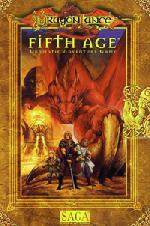
The Saga rules system were TSR's attempt to revitalise the Dragonlance setting in the advent of the fifth age. I don't think that the product has been too commercially successful, which in my humble opinion is a bit of a shame. It is also a bit of a shame, in a way, that they felt compelled to launch a good rules system which is restricted to one setting like Dragonlance.
They have since tried to remedy this with Marvel Super Heroes, which uses the same system. I have not yet had a chance to try it...
The saga rules come in two different packages. You can buy them complete as a beautiful boxed set, styled as an old tome, including an A5 booklet about Ansalon (the setting), a 128 page A5 rulebook, a thinnish A5 adventure, a deck of 82 coloured cards and a small poster map of ansalon. The other way of buying them is as a saga fate deck which is literally a cut down version of the rules together with a deck of cards.
The game itself hinges around the cards which have a character name (from the world of Dragonlance), one or two adjectives describing that character, a value and a suit. Success of each character's action is determined by which card they play from their hand. Even character generation depends on the cards.
To generate a character, twelve cards are dealt. The player then assigns a card to each of the eight abilities; Agility, Reason, Dexterity, Perception, Endurance, Spirit, Strength and Presence. These abilities are fairly self-explanatory and each card has a suit. All actions played using the right card are cosidered trumps. Of the remaining four cards, one is chosen for wealth, and one is chosen for quests. The value of the card chosen for quests is looked up on a table to see how many cards make up that character's hand.
The really neat feature is that the remaining two cards define the character's demeanor and nature. Demeanor is a single adjective which describes how the character appears to other people, and nature is what the character is really like on the inside. So you could have a character which seems pleasant enough on the surface, but underneath, he could be a real swine. Very simple, but it all seems a bit more three dimensional than the alignment system of AD&D.
Rolling up NPCs quickly is as easy as pie.
Whenever a character wishes to perform any kind of action, the referee secretly assigns a difficulty for that action ranging from easy (4) up to impossible (24). If the action is opposed, for example in an arm-wrestling contest, an opposition attribute is added to this figure. The player then chooses a card from their hand to add to their character's relevant attribute - in the arm wrestling example it would be strength. If the total that the character reaches is greater than the referee's total, the action would succeed. If the total was less, the action fails. If it fails, and the card plyed was a dragon, it indicates a botch of some sort.
Combat feels a little bit awkward, coming down to a couple of actions each round, but the damage system is quite novel. If a hero is wounded, they have to throw away cards totalling the damage they have sustained.
The magic system is quite clever. I would even go as far to say that it is second only to Ars Magica. The players design their own spells, and then work out the cost of casting those spells. Having said that, the booklet only comes with a couple of fairly basic sample spells to get you going. A list of pre-prepared spells would have been particularly handy for creating NPCs
The game really does promote creativity. If you've got a high trump card in your hand, then you might as well try something utterly heroic... If you've got rubbish cards in your hand, you're forced to try and think of things to do to try and burn the cards up.
On the whole, I quite like this game, but you do have to be the kind of GM who can improvise and make things up on the fly. There's no huge list of equipment and prices... there's no huge list of weapons... as I mentioned before, there are no big lists of pre-prepared spells.
Style: 4 (Classy and well done)
Substance: 4 (Meaty)