

 Search
Review of Player's Handbook
 Goto [ Index ] |
With the longest lineage in roleplaying games, the Dungeons & Dragons Player's Handbook, 5th edition, is now ten years old, with an initial publication of August 2014. Despite engaging in fairly heavy use as a player shortly after release, I do confess that prior to writing this review, I didn't really take the deep dive that the product deserves. This review is the first of three reviews of the core publications, along with the Monster Manual (September 2014), and the Dungeon Master's Guide (December 2014), all following a traditional three-book system that has been consistent with AD&D 1st and 2nd edition, D&D 3rd edition, and D&D 4th edition.
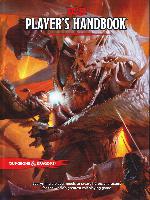
Physically, the book is quite weighty at 320 pages and is appropriately well-bound and sturdy. The two-column print is easy to read, albeit the page numbers and chapter references have insufficient contrast with the yellowed background. There are three parts to the book: effectively Characters: Adventuring, and Spell, and a set of appendices. There is a good single-page table of contents and an extensive index. The writing style is easy to read throughout and starts with a gentle introduction to the game and the core mechanics. There are various illustrative references to the literature of Dungeons & Dragons throughout the text (e.g., Weis and Hickman's description of Elves from "Dragons of Autumn Twilight"), which is quite charming. The artwork throughout, including the cover, is competent and colourful (the product is full-colour throughout), but not particularly evocative or creative.
Characters
Character creation is laid out in step-by-step instructions: choose a race, choose a class, determine ability score (random or point-buy), describe the character, and choose equipment, with class and proficiency bonuses gained at each level determined by the number of experience points. All character races have traits; abilities score bonuses, age, common alignment (a return to the law-neutral-chaos, good-neutral-evil axes), languages (including "racial" languages), size, speed and with variations with subraces. A new inclusion is the use of "inspiration", invoking the character's personality in a stressful situation to create an advantage. Races include Dwarf, Elf, Halfling, Human, Dragonborn, Gnome, Half-Elf, Half-Orc and Tiefling and ability bonuses stack, rather than replace, for subraces (e.g., mountain dwarves receive +2 Strength and +2 Constitution).
There are twelve standard classes, each with a specified hit die to determine hit points (e.g., d12 for Barbarians, d6 for Wizards), primary abilities (e.g., Strength and Charisma for Paladins), Saving Throw Proficiencies (e.g., e.g., Strength and Dexterity for Rangers), and weapon and armour proficiencies. The twelve classes are Barbarian, Bard, Cleric, Druid, Fighter, Monk, Paladin, Ranger, Rogue, Sorcerer, Warlock and Wizard. Classes have standard class features and gain additional features with level gains. As with races, classes have specialisations which come with bonus proficiencies. Multiclassing, with prerequisites, is also allowed with the distinction between total level and class level clearly explained. In addition, characters also have backgrounds which provide past history and character features, such as personality traits, ideals, bonds, and flaws. Various equipment (weapons, armour, adventuring gear, transport, etc) also receives its own chapter.
Actions
The second part of the book consists of three chapters that deal with abilities, adventuring, and combat. Abilities and ability checks are really the core resolution method of the game, with saving throws and skills both based directly as variants of ability checks. Skills, in particular, are notably reduced in quantity and descriptive scope compared to previous editions. The core mechanic in the game is a d20 check versus a target number, plus modifiers, plus an advantage or disadvantage die. The latter is a significant simplification of previous editions where modifiers could become an exercise in arithmetic, but it has a great deal of coarseness and randomness to it. Simply put, if a character is at an advantage, they can roll 2 d20s and pick the highest, and if they are at a disadvantage, they pick the lowest.
The Adventuring chapter is quite short but quite dense in its brevity, covering time and movement, environmental challenges, including food and water requirements, drowning and falling (no game is complete without it), social interactions and, finally, rest and recovery. A main activity in D&D has always been combat and this edition is no exception with order, movement and position, actions, damage, and unusual environments discussed. At its core, it comes down to initiative (Dexterity checks), attack rolls (d20 versus armour class as a target) with various colours (e.g., opportunity attacks, two-weapon melee), and damage rolls against hit points, with negative values requiring saving rolls for survival, unless massive damage applies.
Magic and Appendices
Spells are differentiated by spell level (0 for cantrips, up to 9 for powerful spells like "Wish"). For spell-casters, there is a distinction between "known" spells and "prepared" spells, the latter selected from the former. The number of spells that are castable without rest to replenish is determined by spell slots, a number of spells based on spell level. A small selection of spells can also be cast in rituals that take up ten times the normal casting time. Casting time is a significant change with some spells as reactions and multiple spells can be cast in a round if a bonus action is available. In addition to casting time, spells have variable range, area of effect, duration, and components (verbal, somatic, and material). Many spells may be resisted with a saving throw and some also require an attack roll. Spells of different names can combine in their effects.
Spell-casting classes in the game consist of Bards, Clerics, Druids, Paladins, Rangers, Sorcerers, and Wizards. Their available spells are listed according to class but then are described in detail in alphabetical order. The spells are pretty much a well-known D&D staple, simultaneously the most interesting and complex part of the game, with many moving parts and detailed variations. One particular change of note is the many more spells in this edition vary in power according to the caster's level.
The appendices provide a useful glossary of conditions and their in-game effects (e.g., "blinded"), a summary of gameworld deities, domains, and alignments, and a description of the planes of existence. In addition, a limited creature statistics section provides a brief introduction to the Monster Manual.
Concluding Remarks
In many ways, the D&D 5th edition Player's Handbook presents a game that is a rules-light version of the 3rd edition, plus some of the innovative ideas of the 4th edition (without being a radically different game), and adds a few new ideas of its own. On the positive, this is probably the game that makes the most effort in encouraging character background in D&D and providing in-game mechanics to support this. Many contemporary players will like the stripped-down version of the rules; personally, I think it's too stripped down, but I don't mind a bit of extra crunch. The advantage/disadvantage die is also something that will appeal to many, but again, I find the coarseness and randomness not to my taste. As another positive, some effort has been made to include a lot into the book in terms of "can the game be played with these rules alone?" However, by the same token, the game is quite verbose, even if clearly written.
Ultimately, whilst it certainly satisfies the D&D historical lineage and is designed in such a manner to encourage ease of play, the biggest problem with the product is that it is unfortunately quite dull. Admittedly, this is difficult to pinpoint and is quite subjective, but it was a strong and consistent evaluation across the different design vectors: the artwork, the writing, the game system as a whole, and perhaps most importantly, it becomes part of what is a very limited scope of the game; this is pretty much only a game about beating up monsters and stealing their stuff. Maybe that's playing to the game's strength in terms of design, but it doesn't speak highly for more flexible and imaginative applications.
Style: 1 + .7 (layout) + .5 (art) + .4 (coolness) + .8 (readability) + .7 (product) = 4.1
Substance: 1 + .5 (content) + .4 (text) + .4 (fun) + .4 (workmanship) + .3 (system) = 3.0

