

 Search
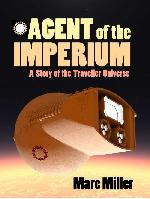
Review of Agent of the Imperium
 Goto [ Index ] |
by Marc Miller
- genre: SF, Space Opera, game supplement
- Form: epistolary, police procedural
- Data: Baen Publishing Enterprises, 2021, 352pp
- ISBN: 1-9821-2507-1
Front Matter:
- Galaxial Map
- Map of Charted Space
- Imperial Calendar
- Capital Planetary Profile,
- Universal Personality Profile
- Traveller5 rules summary:
- Table of Ranks (287-292)
- World Remarks (293-298)
- Chronology of Interstellar Travel (299-304)
- Identifying Ships (305-308)
- History of the Third Imperium (309-314)
- Glossary of Game Terms (315-330)
- The Archives (Library Data) (331-334)
- Sophonts (335-336)
- Races of the Imperium (335-350)
- Introduction toTraveller5 (351-352)
- Rulers of the Third Imperium
Back Matter
Plot:
Jonathon Bland, a former Naval soldier, is brought back to life using his recorded personal profile data and skill-enhancing disks called "wafer jacks" to police charted space in search of dangerous "red zones" and Ancient artifacts and sites. Continued service brings him into contact with admirals and royal officials. Shortly before his death, Bland prepares a "recorded personality" file stored on a small disk. Bland uses "wafer jacks" to train his new body with skills useful to special agent working on behalf of the Imperial government.
Form and setting
An epistolary novel following the "Police Procedural" format For a game supplement, this is very good. For a novel, it is rather clumsy and dull. An epistolary novel requires the presence of "things implied but not seen." The book sacrifices story in favor of gamespeak, character stats and complex game situations.Review
General readers will need to have a copy of the Traveller core rulebooks in order to understand the game terms used throughout the book. Characters are not presented as individual but rather as their character type and abilities. Planets and locations are described in conventional Traveller terms. We never see the personalities and struggles involved in living on a red zone planet. Apart from Bland's notes and statistics, we don't learn about people or cultures. The earliest epistolary novels (Richarsdon's Clarissa and Boswell's Journal of a Tour of of the Northern Isles of Scotlan) transmit feelings, tragedies and joy through the form of letters. Even in deathBland does not display the human story. Perhaps this is the effect of being continually re-animated into identical copies of himself.
Style
A series of log entries written by the main character between the Imperial years 109-350 thru 109-737 (Wednesday April 18, 4868 thru Monday April 19, 5255)The concept of a "quarantine crew" working inside the Imperial Navy could spawn all sorts of situations. However, This idea is mentioned once, dropped and never revisited. There is no lack of good ideas in this volume, but the author failed to maintain one single idea and develop it into a theme. This is an unfortunate trait of first-time authors. Miller has struggled with this objective.
As Bland's re-animated body gains experience, he is promoted to higher and higher levels of responsibility (social standing) in the Empire. Bland's re-animated life consists solely in traveling to various systems aboard identical but differently-named ships declaring "red zones" (forbidden planets) and planets that need to be "scrubbed" or destroyed entirely. Jonathon is not changed by his experiences nor does his character experience life-changing conflict. His re-animated body has no "character arc or transformation. In the book's apotheosis, Jonathon begins yet another re-animated life with yet another body.The epistolary style (Bland's notes and log entries) can be executed well in the hands of a trained writer. That doesn't seem to be the case here. Bland travels to hundreds of nearly identical planets going through the same activities on each along with more and more game terms, acronyms and personality and planetary code numbers. There is no conflict and no character development. The "personal data file" seems to prevent the character from doing the same things over and over. The log entries are generally identical save for the change in date and ship name. There is no pay-off for all the activities (and continual flipping back and forth to the index in the back of the book). It is a disappointment.
Bland's first body was wracked with terminal cancer and pain. That could have been the source of some real character development but it is mentioned once and dropped immediately in favor of the re-animation trope. The book dies at the same time that Bland does (page 51). Sadly there are 200 pages of log entries yet to read before embarking on the pages and pages of glossaries and explanations of terms which could have been illustrated through action and conflict rather than of rules and glosses.
I could not recommend this book to anyone wanting to read a pleasant or fulfilling bit of fiction. It is a retelling of ages-old SF tropes placed in the cryptic language of a roleplaying game. The central character is not affected by his surroundings nor by the dangers he faces as an agent. Supporting characters are described in terms of a game rather than as living, breathing people who interact with their environment and are changed by it. More space is devoted to an explanation of game terminology than is spent telling the "story." Perhaps game fans would enjoy this but it is not fit for fans of Science Fiction or fiction in general.
The second edition of this book has been helped by the addition of neary 100 pages of glossaries and game reference material. The first edition started at page 51 (the end of Bland's first life) and ends before Bland's third re-animated life.
Mr. Miller is to be congratulated for a very complex story writtren in a very complex and challenging epistolary form. Was the book written in a single weekend? Ultimately, the book is just not ready for the fiction consuming public. A society of endlessly re-animated citizens (undead entities) could be quite dystopian but we don't get to see that. We get a narrative retelling of a set of very complex game rules. The log entries, locations, planets and characters are identical. The result is heavy, laborious and slogging with many ideas dropped as soon as they're mentioned.

