

 Search
Review of Exalted Second Edition
 Goto [ Index ] |
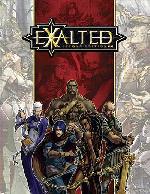
The Exalted RPG is a high-powered highfantasy game by White Wolf Publishing. The physical product is an hefty hardback book, around 400 pages, and well-bound, although insufficiently so for the size and weight of the book. The cover and fullcolour interior art is fantasyanime which befits the setting and style, but is only vaguely contextual and best, and average in terms of creativity and technique. The inside covers have a twopage map of the setting which is fairly attractive but lacks detail.
The major chapter breaks are separated by a short comic which makes a nice change of pace. There's an inexcusably sparse table of contents (chapter headings only) and a more detailed (3 page) index. Pages are differentiated with page numbers and chapter titles in the bottom margin, and less than useful "oriental-styled" differentiating script in side margin. The text is presented in a twocolumn justified serif font with a decent amount of whitespace. It's pretty heavy going however; Exalted is the sort of game which incorporates a large level of fluff and crunch and when the two are combined you get a long and wordy text which uncomfortably switches between the formal and informal.
Exalted is a game that claims to be inspired by various world mythologies and fantasy anime, all of which are combined into a complex gameworld sufficiently complex that a 3.5 page setting lexicon is provided in the opening chapter. A core difference between Exalted and other fantasy RPGs is the starting power; PCs are former mortals who are of epic power levels (hence "Exalted") and will be engaging in worldchanging activities. Following a lengthy introduction, the chapters are "Setting", "Character Creation", "Traits", "Drama and Systems", "Charms, Combos, and Sorcery", "Storytelling", "Antagonists", and "Panopoly".
Setting
The first chapter, "Setting", goes into some detail about this situation, starting from a Wyld of Essence, from which came Primordials and the antagonistic Fair Folk. The former established Creation with elements, and then created the major gods, whom they toyed with. The Gods, led by the Solars, created the Exalted, successfully rebelled against the Primordials, and imprisoned them. The Solars themselves were poor rules, and were subject to rebellion by the Sidereals and the Dragonblooded, which led to the Immaculate Order, followed by a great plague unleashed by the Deathlords (ghosts of the dead Primordials and Solars wearing grumpy pants), an invasion by the Fair Folk, and the destruction of the latter by the one of the Dragonblooded who then declared herself the Scarlet Empress (and ruler of the world, naturally). The Empress has, however, disappeared, the Solar Exalted have returned, and civil war is now brewing.
Frankly, this is just an awful and infantile backstory, and is regrettably hard to avoid. This said, the rest of the setting isn't so bad. The world is quite acceptable and its reasonably clever in having Elemental Poles based on geographical locations (centre is Earth, north is Air and cold, south is Fire, East is Wood, and west is Water). A lunar calendar is used and seasons match the elements. There is a Solar system (pun intended) of the Sun, Mercury, Venus, Mars, Jupiter, Saturn, and of course Gaia. Theres is extensive descriptions of locations and daily life, social classes (patricians, citizens, peasants, slaves, disenfranchised), and various orders, military and religious and so forth. It is actually quite a good syncretic combination of Oriental, Occidential, and Semitic influences of antiquity, with even hints of the Americas (to the wooded east) all of which is a little weird given the poor the historic and mythic backstory is.
Character Creation and Traits
Characters are mortals that have recently become Exalted, with an assumed default of Solar Exalted. It begins with a character concept of a few sentences which elaborates on their human past. The first major ingame choice however is the selection of Caste which roughly equates with character class in other systems. The titles are solarbased, Dawn (Warriors), Zenith (Priests), Night (Rogues), Twilight (Wizards) and Eclipse (Leaders). NonExalted characters, i.e., ordinary humans, have no Caste. Players must select an epic motivation for their characters. The motivation answers the question: "Why will the character become a legend?".
Characters are also defined by their Attributes and Abilities. Attributes are rated 1 to 5, whereas Abilities are rated from 0 to 5.Physical Attributes are Strength, Dexterity, and Stamina, Mental are Intelligence, Wits and Perception, and Social are Charisma, Manipulation and Appearance. Players allocate points according to the Attributes for their characters with 8, 6, or 4 points across each group. Abilities represent training in skills and knowledges and are categorised by Caste; players can select an additional 5 abilities outside the character's Caste Abilities. These are the character's Favoured Abilities. Caste and Favoured abilities are assigned 10 points to Caste and Favoured Abilities. Favoured Abilities must receive at least 1 point. They then can assign 18 points to any Ability (including Caste and Favoured), however no Ability may be rated more than 3. Specialities in Abilities can be purchased with bonus or experience points.
To further flesh out the character, 7 points are received to distribute among the 11 Backgrounds. The Backgrounds are: Allies, Artifacts, Backing (by an organisation), Contacts, Cult, (Anima) Familiar, Followers, Influence, Manse (pure items of an element Essense), Mentor, and Resources. In addition there is also receive 10 points of Charms, of which 5 must be from Caste or Favoured abilities. For want of a better word, Charms are like magical feats. Five points may be added to the four Virtues (Compassion, Conviction, Temperance, and Valour). No Virtue may start at above 4 without spending bonus points. Choose one Virtue as the root of the character's Virtue Flaw; this must be a Virtue rated 3 or more. Virtues both add when acting with the virtue, and one must fail a roll to act against that virtue. To finish off character creation, a character's Willpower equals their two highest Virtue ratings. Temporary expenditure of a Willpower point can create an automatic success. Characters start with a number of Intimacies (proper, collective, or abstract nouns) equal to their Compassion. An Exalted character's Essence starts at 2 and may be increased with bonus points. Their Personal Essence pool is equal to their (Essence*3)+Willpower and their Peripheral Essence (Essence*7)+Willpower+Virtues. Characters also start with 15 bonus points. An increase in Attribute costs 4 points, an Ability 2 (or 1 if Caste or Favoured), a Background is 1, or 2 if already 3+, a speciality costs 1 (or 2 per 1 if Caste or Favoured), a Virtue costs 3, Willpower costs 2, Intimacies 3 to increase to Willpower + Compassion, Essence costs 7, and Charms cost 5 (4 if Favoured or Caste).
Game System
The core system is pretty contemporary Storyteller system. Success in tasks are acheived by a test against an attribute plus an ability, plus bonuses, which provide a dice pool of d10s; with 7+ required for a success and with a 10 counting as two successes. A number of successes is neeced equal to the difficulty of the task to suceed ('1' being standard, '5+' being legendary), and the number over that (or below) represents a degree of success or failure. In any division, Exalted characters always round up, whereas Mortals round down. A "botch", or critical failure, occurs if the character rolls no successes and has at least one "1"; additional "1" results make the botch worse (with the curious result that the larger the pool, the greater the opportunity for very bad botches). For repeat checks a penalty of 1 success is usually applied.
Characters may use a point of temporary Willpower for an automatic success, or activate a Virtue for an extra die (limited by the Virtue rating per story). As the character's Willpower declines they become increasingly under control of their Virtues, rather than the player's direction. Characters will find that certain circumstances challenge their Virtues, requiring a check. Each Virtue Flaw also has specific limit condition that, when met, forces the character to roll that Virtue and gain limit equal to that amount. Suppressing successes on the Virtue to engage in a preferred course of action adds to Limit Break. When this value reaches 10, the character becomes dominated by their Flaw in a selfdestructive course of action.
In addition to the basic tasks there are rules for extended rolls for ongoing tasks, resisted rolls for contests, combining actions, reflexive actions, teamwork, and Stunts where bonuses are added for descriptive flourish. In addition there is detailed rules on various noncombat tasks (climbing, disguise, holding breath, academic knowledge, evaluating goods, treat wounds, thaumaturgy, etc), both Attributebased and the standard AttributeplusAbility combination. Combat situations are also described. Exalted uses onesecond combat rounds with most characters engaging in an action every three to six seconds ("ticks") or so, with precise and flowing checks required by the Storyteller.
Combat
Surprise is determined by a contested skill of Dexterity+Stealith vs Wits+Awareness. Under such conditions Dodge and Parry have a defensive value (DB) of 0. A Join Battle (Wits+Awareness) check is required for initial initiative. The character with the highest count goes first on second 0, and everyone else starts after that based on the difference on their roll and the highest count (with a maximum of 6). When a character's 'tick' is reached, they must choose an action. Speed is a tick counter; after a character's action, they must wait a number of ticks equal to the Speed of their action before they can act again. The Defence Penalty is a penalty applied to your defences for taking the action. The penalty lasts until their next action. Actions include aim, attack, dash, flurry, guard, and move.
To attack, a character rolls their Accuracy pool; Dexterity + Relevant Ability + Weapon's Accuracy. A Defense Value is subracted from the number of attack successes. Defense is typically either Dodge or Parry; dodge DV is equal to half the character's Dexterity + Dodge Armour Mobility Penalty. Parry DV is equal to half of the character's Dexterity + Ability + their weapon's Defence. Shields and cover provide a DV bonus. Receiving multiple attacks on the same tick reduces DV. There are special rules for grappling, called shots, and mass combat. If there are more attack successes than defense value, a hit has been scored. Damage is equal to the Damage rating of the weapon + character's Strength + excess successes. Damage is differentiated between "bashing" (blunt trauma), "lethal" (edged, piercing), and "aggravated" (supernatural). "Lethal" is the most common. If a character received more base damage than their Stamina + Resistance, they may suffer Knockdown, requiring a reflexive (Dexterity or Stamina) + (Athletics or Resistance) check with a difficulty 2.
The base damage is compared to the defending character's Soak value of the same type. Soak is based on the character's Stamina and Armour against the different damage types; mere mortals cannot Soak lethal damage with their stamina, Exalted can. Armour has an aggravated Soak equal to its lethal soak. A relatively common weapon bonus, armour piercing, halves the Soak of armour. The minimum damage caused is the Permanent Essence of the attacker (typically 2 for stating Exalted or 1 for Mortals), or the minimum damage rating of the weapon, whichever is higher. The final damage value is rolled with a number of successes (ignoring botches and 10s) equal to a number of wounds, marked on the character sheet as /, X, or * (to represent bashing, lethal, and aggravated wounds). Wound penalties apply on the degree of damage. A character who suffers more health levels of damage in a blow than their Stamina may be stunned. Mortals also suffer the joy that if they received 4 or more wounds in a single blow, they have suffered a disabling wound.
There are also rules for social combat, which follow a very similar approach, including "surprise social attacks", guards, social flurries, etc. If a character is struck by a Social attack they may either accept the results, or pay a Willpower to avoid them. If it goes against the character's motivation, they must spend the Willpower. Additional successes of the attack have no effect on the Willpower required. Social charms have a variety of effects such as building or eroding intimacies, compelling behaviour, etc. There are also rules for social attacks between units of organisation (applied through the leader).
Charms and Sorcery
Charms are the basic magic tricks; all Exalted and supernatural creatures have Charms. Each Charm requires Essence to be channelled. Charms generally supplement an action, and cost Motes, derived from the Essence score or Willpower. Usually only one can be used per action. Notably, some Charms can be used as mental or social influence (e.g., compulsions, illusions, servitude etc). Every Ability has three Charms known as Excellencies (thus, Archery Charms, Intergity Charms, Craft Charms, Athletic Charms, Bureaucracy Charms etc). Characters may one, two, or three of these Charms for each Ability. However there is not an equal distribution of Charms; Melee, for example, has 19, while Stealth has only 4. In addition Exalted have two Charms to to enhance their Excellencies.
Charms, like weapons and actions, have a Speed rating. Unless otherwise noted they have a Speed of 6 and a DV of 1. Charms have a cost on Motes; small units of Essence. Each Exalt three Mote pools; personal Motes are easily spent without inviting unwanted attention, peripheral Motes are those the use of which flares the Exalted anima. Finally, there are committed motes. Whenever a mote is spent on an ongoing effect, move motes from one of the other two pools to the Committed pool. Motes cannot be regained whilst Committed. Spending Motes from the peripheral Essence pool cause the Anima of an Exalted to appear. Peripheral Essence is regained by rest, through an attuned Manse, by a Hearthstone, or with an active Cult. A Charm is limited in the bonus it can give to a dice pool by the relevant Attribute plus Ability, or half that for static ratings. Only one Charm may be used per action, however "Combos" may be used which compound Charm effects with the expenditure of Willpower; these are timeconsuming and difficult to learn.
Whilst Charms are available to all Exalted, Sorcery is somewhat more difficult to learn, "more transcendentally powerful and difficult" as the rulebook says. It involves a fivepart initiation trial based on virtues (humility, tutelage, journey, courage, sacrifice), and requires in gameterms, learning the sorcery Charms. Each spell must be individually learned as well, and the spells are separated into different circles (terrestial, celestial, solar). All this said, only a handful of sorcery spells are provided in the core rules. Sorcery spells tend to take a while to cast compared to Charms (ten combat rounds) and are expensive in Motes.
Storytelling, Antagonists, and Panopoly
The last three chapters are sufficiently ruleslight to be dealt with quick sequence. The first, Storytelling, is a mere 18 pages, which describes the formation of a group, rule changes, gaming styles, setting locations (including detailed travel times and modifiers), character connections, developing a story series, running sessions, and awarding experience. In complete contradiction to the rest of the game, this is one chapter which really required more elaboration, especially for various techniques for speeding up the resolution, combat, the mountain of charm choices etc.
In comparison the Antagonists chapter is quite, lengthy, almost 80 pages. It starts with a range of mortals, including ordinary citizens, seasoned soldiers, heroes (on a mortal scale), elders, and "godbloods" (halfdeities). Like other antagonists in the chapter these are provided a pretty comprehensive set of gamerelevant statistics. Along with the longsuffering mortals, there is also beastmen, creatures of the wyld (a chaotic environment, and so populated) and the terrifying Fair Folk, Spirits, and various folk Gods (mainly integrated in the game system for summonings and divine powers). Samples of the latter two are given with the Dog of the Unbroken Earth, a forest spirit, and GriFel, God of the Imperial City, and Sikunare Storm Mother. In addition there are truly mighty elementals, numerous demons and undead, Deathlords, and other Exalted from other sources (terrestrial, lunar, sidereal, abyssal etc), including their anima manifestations and charms. The section follows mundane and fantastic "beasts of creation", only moderately described at best, then the curious diseases, which are virtue based.
The final chapter is a detailed summary of the use of money and resources in the game with variation in coinage and equipment, including weapons and armour. There is also a description of various magic items, gems, etc. The "Jade Standard" is presented as a regular coinage and script, with silver coins used elsewhere & etc. There is too much discussion on the currency system and the finance system, but not enough on basic economics and trade. Still, for characters there is an abstract method that makes use of the Resources value and various personal items of equipment, and a few items of larger property. In addition there are several pages weapons and armour in tabular form, providing the essential game characteristics, along with various magic items differentiated as "everyday wonders" (potions, salves, herbs), "lesser wonders", "hearthstones", and "greater wonders", "earthshaking wonders" etc.
Evaluation
Stylistically there is nothing in Exalted that even rates as average. The layout is difficult to work with, the art is largely uninspiring, it oversells the importance of the key themes, it's a turgid read to get through, and the physical product is below standard. None of these, one hastens to add, are especially bad (with perhaps the exception of the general readibility). It's just the entire book could be attacked with a red pen to make it shorter (which would help the product's physical strength), more legible, easier to use and so forth. On the other hand, the game does better in terms of substance. The content provides above average coverage, although the signal to noise ratio could be improved. It is difficult to actually run with far too much die rolling, which sucks a lot of the fun out of what could be an otherwise workable system that is shows fairly good scope.
All this said however, Exalted does what it says on the tin, insofar it does provide a high-powered anime-fantasy system, a detailed setting, that is in a period of crisis. A Storyteller determined to run this game should develop a series of optional rules to reduce the steps involved in conflict resolution for example, although there are some parts of the game the mighty collection of Charms for example which would be a little more difficult to simplify. Overall, it's a somewhat frustrating trip, but a determined group will be able make a workable game out of it. Most of the problems are not in what is provided but rather how it is provided.
Style: 1 + .4 (layout) + .4 (art) + .4 (coolness) + .3 (readbility) + .4 (product) = 2.9
Substance: 1 + .7 (content) + .3 (text) + .4 (fun) + .5 (workmanship) + .7 (system) = 3.7

