

 Search
Review of The Shadow over Providence
 Goto [ Index ] |
Blurb from the publisher: 'August 25th, 1928: Providence, Rhode Island.
The Milton Hotel cordially invites you to view the fantastical traveling exhibition "The Kingdom of Fire—Egypt's 18th Dynasty." All the way from the British Museum, London, England, come see these wonders of ancient Egypt, rare and priceless items from a time long ago. Learn about their history from Dr. Caitlin Bronson, the exhibition's curator, who will be on hand to answer all of your questions. Marvel at the treasures of Tutankhamun and Hatshepsut, along with the star of the exhibition, the mysterious canopic jar of Ibnhotep the Mad! Tickets are limited and going fast—and you don't want to miss out on what promises to be the most talked about exhibition of the year!
With an invitation like that, how could your investigators possibly refuse? Be they historians and scholars, or even those who ply the blackmarket trade in illicit antiquities, this is a rare opportunity to learn the secrets of the distant past outside of a museum. And what possible danger could there be in going to see the mortal remains of someone called "Ibnhotep the Mad"?
The Shadow over Providence is a new Call of Cthulhu scenario set in a venue that may seem strangely familiar to anyone who has visited Providence's iconic Biltmore Hotel. The adventure was written by Jon Hook of the Miskatonic University Podcast, and developed and published by Chaosium, to celebrate NecronomiCon 2019.'
What you get: Your USD 9,99 will buy you The Shadow Over Providence, a 36-page softcover, black and white adventure for Call of Cthulhu 7th edition, along with its pdf version.
The electronic version is a single, 38-page black and white pdf document that can be bought for only USD 3,99.
Spoiler warning: As much as I am not going to describe, let alone detail the adventure, parts of the scenarios might be revealed while discussing its strong and less strong points. If you intend to enjoy it as a player, stop reading now.
Contents: The fonts of The Shadow over Providence are small, while margins are of a medium size. The adventure takes place on the 25th of August 1928, mostly inside the Milton Hotel in Providence, Rhode Island. The location is the Mythos equivalent of the Biltmore Hotel where NecronomiCon 2019 was hosted, since renamed to Graduate Providence. I know for a fact that the 2019 convention took place in the exact same day of the year, yet I do not know whether games were run in the evening at the exact same time the adventure transpires. If they did, cool! I am certain that those who participated in those renditions of the adventure had a very different vibe than the one of those that buy and play the product in any other time and location.
The adventure proper is 13-pages long and can be concluded in a single, medium-length session; it is supposed to be convention-oriented after all. The rest of the volume is taken by the adventure's supporting material: one page of handouts, two pages of maps, and eighteen pages of ready-to-play PCs (three pages devoted to each). The adventure follows the surprise-investigation-action format, even though only the final part of the adventure is expected to be outright deadly. The adversary is a brand-new former non-Mythos entity which became a Mythos beast.
The adventure is small and is not accompanied by an index or table of contents.
The strong points: There is always a market for short, contained Call of Cthulhu one-offs, and even more so for games that you can start playing immediately; that's what The Shadow over Providence aspires to be. In contrast however to scenarios were tension is slowly built through investigation, in this one the players start with an explosive burst of action: a failed heist with disastrous supernatural consequences. The investigators are not in real danger, yet if you play this right as a Keeper they will feel that they barely survived. From then on, investigation is mixed with shorts bursts of action. An enemy that can enter even the most confined of spaces, who appears to be everywhere, and which, until you learn how to hurt, looks invincible: that's almost Alien in Call of Cthulhu, even though nobody gets impregnated with undesirable extraterrestrial entities. I like the vibe. The culmination is a boss fight which the adventure leaves open when it comes to style and aesthetics. One can go for a dark, gory last stand inside the bowels of the hotel, an extremely public confrontation in the ballroom, an equally public slaughter in the hotel lobby (in my opinion the best course of action, following an unexpected twist), and anything else in-between. Yet, the Keeper will have to craft all that; keep on reading.
I am a big fan of adventures incorporating elements from real locations. In this case, a hotel is imported as is in the Cthulhu-plagued world of the Mythos. What's the difference between that and a fictional hotel? The hundreds of photos, articles, and videos that you can find on the net about it. If you play the adventure as a one-off, you can inundate the session with visuals that cannot be found in the book. If you make it a part of the campaign, all this real-world information will anchor everything in place for a more vibrant and convincing experience.
The pdf is of the usual Chaosium standards, even though the few images are not extractable. Since there is no table of contents and no index, there are no links.
The price is a steal, for either the pdf or the pdf/physical product combo. Granted, it is a small adventure and the Keeper will have to work on its deficiencies before he runs it. On the other hand, it costs as much as a coffee. Just because it is not a masterpiece does not mean that it cannot turn out to be enjoyable.
The weak points: Convention-oriented adventures are supposed to provide tight, well-crafted pregenerated characters that suit the adventure at hand, have been balanced against its challenges, and fit thematically without ifs and buts.
The Shadow Over Providence fails spectacularly on every count.
Starting from the crunch, I counted at least three to five occasions where the adventure requires a skill that nobody (or only one investigator out of six) possesses, or a profession that nobody practices. There is this weird instance which allegedly promotes roleplaying in the lines of 'admire the scenery, read all the cards on the exhibits, roll EDU, and gain 1% of Archaeology'. Sounds great, until you realize that every single pregen has a 1% in Archaeology; what is the point in doubling that? Even worse, when does the adventure ask for an Archaeology skill? Never. Insert facepalm here.
Things are far worse when it comes to the pregens' thematic fit. Do you remember the 'an Englishman, an American, and a German enter a bar' jokes? Here it is the Sikh, the Muslim, the Protestant, the Catholic, the agnostic and the atheist trying their luck as investigators. The adventure takes all the time in the world on fluff that is unusable in a one-off, yet it does nothing, absolutely nothing, to tie the PCs to one another. Thus, you get your scars, your mostly irrelevant personal possessions, and the name of some relatives, but you have to invent the group's dynamic from scratch. Two of the PCs work at the hotel where the action takes place, yet there are zero words devoted to their professional relationship, or the other NPCs they know at their workplace, something that will be needed numerous times later on during the game. A couple of the pregens are linked to tertiary characters in the adventure that the players are unlikely to meaningfully interact with, and that's just it. There is zero reason for the four hotel guests to be interested in the heist (supernatural intervention is confirmed later), or even to cooperate, taking their clashing religious beliefs into account, yet that's what they have to do for the adventure to progress. To add insult to injury, the adventure states 'it is recommended that the investigators are known to one another (have an existing relationship) before the scenario begins'. I am furious. A one-off, a scenario specifically made for fast convention play, does not do what it is supposed to, and demands that the Keeper does it, while it actively sabotages him in the process. I get how the game tries to appeal to a wide variety of audiences with different ethnicity, skin colour, and beliefs, and doesn't mind bending a few historical facts about the 1920s in order to promote diversity. This, however, should be done elegantly, respecting at least part of the social contract and the feeling of the time. Deputizing exotic, conspicuous outsiders that don't even know each other in a city with a population of 230.000 in 1920 kills any semblance of immersion.
The NPCs aren't any better. Should any of the pregens perish, some of the NPCs can be used as substitutes, allegedly with only minor tinkering. Yet as PCs they break the game's rules, with properties whose origins are dubious, to say the least. One of them has a gambling problem, which translates as a penalty die whenever he rolls luck (!) no matter the prompt (but only as a PC, not as an NPC). The other gains a bonus die on particular rolls (again, only as a PC, not as an NPC), and so on and so forth. Where does this pointless rules-bending nonsense come from? And more importantly, why? Such liberties are also taken about how skills work. I was quite intrigued to learn that, depending on whether you are part of law enforcement or not (none of the pregens is, yet the adventure wastes a few lines to explicitly state this), the Psychology skill works differently. And by 'intrigued' I mean 'how did that stuff pass muster?'.
Structurally, the adventure is unsound. The only way the players will learn more about the heist that went wrong is through the revelation of a woman that participated in it. The woman posed as a hotel guest all night long before the heist, while in reality she was planted in order to help her partners in crime. When the shit hits the fan one would expect her to leave the crime scene like there is no tomorrow. What does she do instead? She willingly lingers... for hours. As a witness. After everything went wrong, and she herself is likely to get caught. Convenient, hey? How pathetically stupid were the criminals in Providence back in the day? At another point in the adventure, the investigators will accompany the local police to the morgue. I already discussed how disastrously unthematic a deputized, out-of-town, turban-wearing Sikh and a gypsy-like dressed Muslim woman feel for the era. The fact is that the Keeper does not know how to pace this meeting, nor do the Investigators have a way of finding out about it. Once again, it falls upon the Keeper to not simply fine-tune, but actively craft the adventure. This is not the only time the adventure stumbles when it comes to finding its rhythm. The transition from one place of the hotel to the next, the availability of witnesses, some more practical investigating ('where do these airducts meet?'), and many more, are somewhere in the ether. Don't you dare ask anything brainy, like how many people the hotel employs, so that they coordinate in order to locate the bad guy's physical manifestation; your Keeper will suffer a stroke. The adventure hangs him out to dry, and doesn't provide facts, answers and reactions for even the most obvious investigative courses of action.
The ending is not particularly linked to what the heroes do. It basically falls upon the Keeper to trigger it whenever he sees fit, probably when he wants to wrap things up because the session is running out of time. Until then the investigators are pestered by small-sized protoplasmic forms, what they will stumble upon however is a deadly shoggoth lord, even though he is not at full strength. A potentially interesting Keeper-triggered resolution (the monster trying to leave in human form, potentially masquerading as an NPC that the investigators happen to be talking to at that exact same time), is my suggestion for you, and, as expected, you will not find it in the book. It is only partially insinuated upon, buried inside stats and other irrelevant noise, without any additional meat whatsoever. Damn it, it's the conclusion. If you want to leave things open, give the Keeper three well-defined options to work with with four to five lines of facts and fluff for each.
The adventure doesn't get any better when it comes to details. There is one thumb-sized map of the hotel's ballroom, yet no images. Are we expected to google the real deal? If yes, I'll bite: Lo and behold, and wow, isn't that glorious? Now, is any of this in the adventure? Any description of the opulence, the feeling, the atmosphere? None. Those who attended NecronomiCon 2019 only needed to look around without the Keeper describing the scenery. Yet, everybody else needs words, words and descriptions that are nowhere to be found. In any event. Notice the windows; the thumb-sized map accurately depicts them the way they are in reality. The adventure starts on the 25th of August, somewhere between 19:00 and 20:15, on the hotel's 17th floor ballroom. How bright would such a 17th floor ballroom be at that day and time of the year, counting both outdoor light, and with the lights on? Yet, conveniently, 'the lights go out and the ballroom is plunged into darkness' as soon as the adventure begins. Okkkkkk. Let's assume for a moment that the hotel manager is a blithering idiot and closes the ballroom's curtains, depriving the paying customers from one of the ballroom's traits: the 17th floor's light and view. Is this a 'if I take one step I will kill myself' darkness, or does it feel like the great outdoors under a starlit sky? I am neither ironic nor nitpicking, mind you. This darkness and panic is supposed to last for 15 full minutes (your read that right: fifteen), and greatly influences, if not outright dictates, the heroes' options. That's the adventure's opening scene, and if you lose your players there already, you lost them for real. If it is the former, they probably can't even leave the floor, not unless they want to break their necks falling down the hotel's staircase (the elevator shouldn't be working since the lights are out). Yet, then, nor should any of the dozens of people on the floor, not until the lights start working again. Needless to say, the adventure doesn't bother with crucial details about alternative sources of light. Were smokers carrying matches in the 1920s, or were lighters common? Would such a luxury hotel's ballroom have gas lamps around, just in case the lights went off, or would there be flashlights available? If the curtains were closed, can one simply slide them open, and make the place as bright as day again? That's the kind of stuff any involved player will suggest. The Keeper has nothing but 'Errrr... hmmm... aaah' and his wits for an answer.
The maps are an afterthought, seeing how they are both too small, irrelevant in many ways, and all crammed in a single page. The player and the Keeper versions have only two differences between them, and only one of them is of some importance to the adventure. The maps have no legend; my google search is actually more helpful towards figuring out how big the ballroom and the guest rooms are. And let me not forget the 'the exhibition is very well attended this evening. Lots of people have come to see it' nonsense. What is that supposed to mean? Do participants have personal space, or Is it the London tube at rush hour? 'Well-attended' applies to both, yet such crowds would behave very differently if panic stroke. Even more so, it makes a difference if eight thugs are in a crowd of 50 people instead of 300 people. I hate it when designers opt for platitudes. Keepers need facts to build descriptions (and platitudes, if need be) around them; never vice versa.
The handouts' presentation is equally ill-conceived: typed messages for what are effectively handwritten notes, and a wooden manner of exposing information that would make even pulp writers despair. Dispense of them and take two minutes to write your own. Make them urgent and impactful while you are at it.
Serious horror adventures and cringe-worthy pastiche names do not work well together, and unless I miss something about how this came to be, Ibnhotep is a dreadful choice. Ibn, or 'son of', is Arabic. Hotep, 'be at peace', a suffix found in many pre-Islamic Egyptian names including that of famous Imhotep, is ancient Egyptian. As a derisory caricature of contemporary Egyptians the name works great.
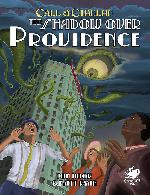
The only piece of art, and excluding the images of the pregens and the photos of the NPCs, is the one in the cover. Admittedly I am not plused, even though I will not complain about the adventure's literal lack of colour. If you don't have imagery, it'd be stupid to increase the product's price for no reason whatsoever.
There are a handful typos in the adventure, both in the printed version as well as the pdf. With everything else that troubles it, they are the least of your worries.
Conclusion: The Shadow over Providence is by far the weakest adventure to come out of Chaosium since 2015. It is not tight, faces structural issues while making dubious assumptions, and lacks attention to detail. Ultimately, it disregards the needs of convention-oriented adventures with pregens that are inappropriate both crunch- and fluff-wise. Yet, with a couple of hours of dedicated Keeper work, even this messy, rhythmless affair can be turned into a decent, entertaining plot. Seeing how Chaosium reworks, expands and republishes its Call of Cthulhu adventures, I am curious to see The Shadow's much better version a few years down the line.
To find out more about The Shadow over Providence, Call of Cthulhu and Chaosium take a look at http://www.chaosium.com.
Shameless plug: for more gaming news and content (including, for example, pictures of The Shadow over Providence that I am unfortunately not able to upload on RPG.net for the time being), and to better keep track of my reviews, subscribe to my Antonios S facebook and twitter page.

