

 Search
Review of A Night at the Opera
 Goto [ Index ] |
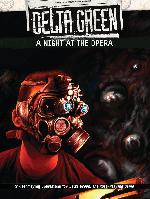
To start with, the book is very well produced, with the same style of artwork as the parent rules, and apparently more or less concurrent with them. Perhaps that quality level is Minimum Viable Product in modern game publishing, but it's still worth commenting on. All of the scenarios are set in modern America, true to the core game's setting, although "The Star Chamber" plays out primarily in Myanmar because of its after-action premise. This isn't the scenario book to go for if you want to expand your Delta Green horizons to other countries and settings. It also keeps a pretty tight focus on investigative horror. If you're coming to Delta Green hoping for an Apache-gunships-against-Cthulhu vibe, then this isn't the book for you, but then if you are, you're arguably missing the point. The creeping dread (sometimes creeping literally) and the sense of helplessness is palpable throughout.
For anyone who has the original Delta Green: Countdown supplement, the first scenario, "Reverberations," will be familiar territory from its "Tiger Transit," section, down to its choice of gateway drug and monster. It's also a good way to play out the new take on the Mythos, though, including the new take on an old nemesis. "Viscid" uses a rather more novel take on canonical Delta Green lore, especially the fallout from the collapse of the power blocs in the original versions of the setting. Human ties will kill you is a very Delta Green theme, and this adventure rationalizes and articulates it perfectly, and gruesomely. At the same time, it allows players to run up against one of the major figures from the Delta Green history, and to play out familiar scenes of deception and gunplay.
"Music from a Darkened Room" is probably familiar to many readers as it's been around for a long time as a freebie. It's also an epitome of Dennis Detwiller's "style of scenario creation," which is now practically proverbial. "I receive a lot of email about my gaming methods in Call of Cthulhu," Detwiller has said. "I'm known as a heartless killing machine when it comes to Keeperdom; and I take it as a compliment." As an investigative horror take on the classic/cliche haunted house trope, it works appallingly well. As a rehash of the familiar setting for the new Delta Green rules, it fits seamlessly, and there's clearly been a lot of effort put into adapting the new system's innovations like Willpower Points to the pacing of the scenario. "Fear and danger are what has moved Call of Cthulhu off the shelves for thirty-three years, not success," says Detwiller. You can guess how this scenario will play out, and how much chance characters will have of surviving it.
The fourth scenario, "Extremophilia," is the least satisfying for me, because it's the second appearance of a contaminating unnatural substance in the book, and it feels rather too much like a Mythos rehash of "Close Encounters of the Third Kind." Aside from the issues with the premise and the scenario spine, though, it will play out as another appropriately modern and dark slice of investigative horror, with plenty of technochiller beats.
Greg Stolze's "The Star Chamber," though, is a brilliantly thought-out evocation of core Delta Green themes and atmosphere. An after-action investigation of a failed Delta Green op, structured around interrogations and survivors' testimony, could play out as the dullest most static deskbound adventure imaginable. Instead, it's a disorienting opportunity to explore fractured perspectives, sub-optimal outcomes, and the disintegration of personality and intent in the face of the unknowable, and a chance for the players to play out the actual events of the investigation through flashbacks. "It's Rashomon with anti-gods and automatic weapons," as the text declares. Plus, it's a superb packaging and presentation of the fundamental Delta Green premise that there is no final victory, no happy ending, and only more or less bad choices. It's up to the players to work out the least worst, and they're sure to be unsure that they chose right. Thanks to its structure, it'll probably provide a very memorable one-shot - if it's the kind they even want to remember.
Finally, Shane Ivey's "Observer Effect" dives into modern weird science for its slice of the Unnatural, with a premise that transposes the psychological horror and subjective disintegration of "The Star Chamber" into a more objective, cosmic frame. The Olympian Holobeam Array has gone online and triggered a series of increasingly ferocious time loops that are going to wind all the way down to annihilation, unless the agents succeed in penetrating the facility and overcoming its assaults on their sanity, and on the structure of spacetime itself. There are plenty of bad actors in play, human and non-human, to keep things interesting - besides the imminent destruction of the universe triggered by human hubris.
How does the book hang together as a whole? Obviously, given that some of its best materials are available separately, buyers should take a careful look at what they're getting, and make sure they haven't already got the scenarios in different guises. Players who don't know these investigations, however, are almost guaranteed to be shocked, horrified, challenged, surprised, disoriented, and above all, entertained. Delta Green arguably won its spurs in the RPG universe and secured its all-time classic status by fixing two abiding problems with Call of Cthulhu: It provided an evocative framework to explain exactly why PCs should come together to investigate ineffable monstrosities; and it moved squarely away from a Lovecraftian bestiary whose properties had become all too predictable, and whose stats and game characteristics were no longer scary, but just sniggery in-jokes. Delta Green: A Night at the Opera lives up to that pedigree in spades. Players who don't know the scenarios already won't be able to anticipate the threats and types of risk at all, even if they know the core rules backwards. The Lovecraftian or legacy Delta Green elements in the scenarios are touched on very lightly, enough to keep the investigations in the same broad shared universe, but never enough to leave a bad taste of rehashed Yog-Sothothery. Individually, the scenarios are well worked out, often ferocious, and very satisfying. Together in Delta Green: A Night at the Opera, they confirm the new game's place as successor to the old and a benchmark in horror gaming.
Style: Excellent production values married to detailed content and sustained effort put into adapting material to the new system where necessary.
Substance: Some occasional dips in inspiration and some content familiar from elsewhere shouldn't detract from a really marvellous collection of deeply scary stories.

