

 Search
Review of Vehicle Handbook
 Goto [ Index ] |
Blurb from the publisher: 'Universes of science fiction are filled with vehicles ranging from the mundane to the exotic. A starport on a world far beyond the frontier may see a mix of pedal-powered rickshaws, horse-drawn wagons and anti-grav skimmers. A high-tech centralised and industrial world will have skies filled with the anti-grav equivalent of cars, trucks and buses, while its military will be able to deploy armoured tanks who can withstand bombardment from spacecraft in orbit above them. All of these, and many more, can be created with the Vehicle Handbook.
The Vehicle Handbook has been designed to be quick and easy to use, whether your Travellers are looking to quickly upgrade or modify their humble air/raft, or construct a massive battle-ready walker armed with city-crushing weaponry from scratch. Even a large, multi-turreted super-heavy battle tank will not take much longer than five minutes' work.
The Vehicle Handbook comes complete with an immense catalogue filled with vehicles built using this system, allowing you to dive straight in and begin populating your worlds with vehicles the Travellers can ride, purchase and fight against.'
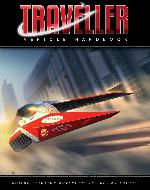
What you get: Your USD 49,99 or GBP 36,99 buys you the 150-page, hardcover, full-colour Traveller Vehicle Handbook, a supplement for Mongoose Publishing's 2nd edition of Traveller, along with its pdf iteration.
The pdf version of the present book can be purchased alone for GBP 20.
Contents: The Vehicle Handbook's obvious goal is to enlighten the Traveller players on how to move about once they have reached their destination. There are only two pages of new rules (namely about maintenance, sensors and particular vehicle traits), make however no mistake: this is primarily a book about vehicle design.
Vehicle Design is a seven step process whereupon the designer chooses a thing at a time. Starting from the chassis, and continuing with some basic characteristics like Agility Speed, Range, Hull, and Cost, the vehicle designer may also choose weapons and armour, apply customisations, determine the crew and passengers, allocate cargo space and finalise his design. If it sounds complicated, it is not, at least in theory. The whole premise lies on 'spaces' and how much a ship costs. The latter is rather easy to fathom; either you have the money or you don't. The former is an abstraction about what the overall ship's performance will be about, what one may cram into a ship if you wish. Even though the relationship is not linear, it is a safe thing to say that the more spaces on uses, the more the price of a vehicle will rise. The tech levels that are covered are anything from 4 to 11+. As to the types of vehicles, anything goes. There are land vehicles, sea vehicles (boats, ships etc), submersibles, all sorts of sky vehicles (jets, aeroplanes, helicopters etc), not to mention hovercrafts and walkers. Even drones get their own two-page chapter.
Once a design and its details have been picked, choices abound on pretty much every aspect. There are different types of armour, all sorts of weapons, and dozens of customization options. This may include anything from performance variables like speed or fuel capacity, to power systems, electronics, environmental customization and many more.
Biotech is a separate chapter; the book does not take for granted that the Referee will wish to see self-reparing technology become abundantly available, nor is every campaign set at TL 10 or higher. If however one wishes to go for this option, all sorts of new vistas open up.
At almost 80 pages the book's second and biggest part is Jayne's Guide to Vehicles of Charted Space. The 74 entries are ranked by Tech Level and relate to any type of vehicle. Thus, it is no coincidence that galleons and land yachts are amongst the first ones to be encountered. Each entry provides ample information on the vehicle, including its armour, range, crew, passengers, hull, shipping and cost in credits, amongst others.
The more one progresses the more interesting things get with ironclads, steam cars, biplanes, dirigibles etc. In advanced Tech Levels the designs become outright jaw-dropping, with vehicles like advanced walkers, subterranean assault capsules that cut through rock (!), supercars etc.
The book closes with a two-page index.
The strong points: Like with many other Traveller staples, the Vehicle Handbook is in reality a game within a game. Even though most of its space is taken by ready-made ships, these function as points of reference for the busy Referee. In reality everybody would like to dabble into designs of Frankenstein proportions and create mechanical wonders the world has never before seen.
The design process is rather easy, even though it needs a pen and a paper, as the book warns from the beginning. The arithmetical skills that are needed are trivial, to say the least. If you can handle division and you are good in min-maxing you are probably good to go. The process of the mini game is fun as a collective experience (even though it can stall for reasons that we will see shortly), and the end result is robust when it comes to the designs. The imagery is there to aid, to be honest however it is not particularly binding. If it were, the book would have needed a million types of chassis instead of the twenty it now has in order to cover every vehicle design possible in every tech level possible. In short, the abstraction works very well and there is a sense of fulfillment when you look at your mechanical offspring, even when you don't have a degree in engineering.
The book does not have much art, at least not in the form of drawings. The few it does have are rather entertaining in that they are commercials of allegedly existing products. On the other hand, it has tons of computer-generated 3D images, with designs that are pleasing, if not a bit old-school. The vehicles look plausible and diverse at the same time, something that matters a lot in a hard sci-fi RPG.
I appreciated how the book makes direct references to the Traveller 2nd edition Core Rulebook as well as High Guard and the Central Supply Catalogue. Cross-referencing information is always the trickiest thing around design, and this after all is a book about designing vehicles.
The weak points: The obvious thing first. Traveller is a dry system. Anybody who thinks that vehicle design can be approached very lightly has it wrong. This, of course, is not Traveller's fault; it is its nature.
A number of typos have escaped into the product. Oh well.
Not getting any sort of reference support starts getting very tiring. After the Traveller Core Rulebook as well as High Guard, the most basic table of contents mentions chapters only without any sub-chapters, summary tables, or anything of that kind. There is no header or footer anywhere in site, making page-flipping a drag. There are no indexes or all-encompassing lists for anything, be it options during vehicle creation or the vehicles themselves on the last chapter. Add the typos and you have the full picture. This problem is not simply systemic, it's persistent, and it doesn't appear to be resolved. I can accept any excuse, the most obvious being 'printing considerations don't allow us to insert indexes without a disproportionate cost increase'. That's fair. What considerations however prohibit the publisher for putting the indexes on the pdf, or as free, additional pdfs on the product's page? Vehicle design is a fun mini-game, especially for the more dedicated Referees who enjoy taking a crack at things. It shouldn't turn into an exercise in frustration for either them or the players. With so little support (see: no support), it unfortunately does. Good luck finding a vehicle, any vehicle, in the last chapter at a moment's notice, or, heavens forbid, trying to compare similar vehicles to one another. The learning curve is high in the beginning, and it mitigated only by the fact that some of the design steps are covered in a small number of pages. You first few vehicles aren't going to be constructed fast, that's for sure.
If one is expecting different vehicles of the same type like one would see, say, in a publication like 'Armoured Vehicles of WWII', he is in for a bitter disappointment. I don't need to remind you that the Traveller rulebooks are setting agnostic. Even more so, minor differences or changes in aesthetics could not possibly find their way into a book that creates a design system that can tackle any possible type of vehicle. It is a matter of perspective.
I am not an engineer, I can see however how existing, contemporary technologies (even at an experimental level) have not found their way in the book. I can actually live with that. First, I do not take it for granted that the writers are engineers themselves, or that they should be at the technological forefront of vehicle (any vehicle, on land, the sea and the air!) design. Second, even if they were, there are all sorts of things that can mess up an abstracted system that prioritizes usability over numbers. The bottom line is that if one complains about these vehicles not being crunchy enough, I wouldn't be sympathetic. If I wanted to design more complex vehicles, I'd get a degree in engineering and go for the real thing.
When it comes to bookmarking, the pdf is as good (or bad) as the physical product is. Only the 10 chapters and the index are bookmarked. To make things worse, the index does not provide live links. Uffff.
The price of the Vehicle Handbook is undeniably high. Compare it with High Guard for quantity and weep: the two books share the exact same price, yet the other one is some 74 pages longer. Something is wrong here, really. Maybe the present book should have been a softcover; maybe it should have been black and white. Whatever the solution however, it should have been much, much cheaper than it is.
Conclusion: The Vehicle Handbook is a peculiar product. It is definitely entertaining as a mini-game, and the results it brings to the table will satisfy the engaged Traveller player. On the other hand, it provides practically zero support to the reader for something that is in effect a design engine, while at the same time it comes of as an outright expensive product, even in its pdf iteration. Were the price to permanently and substantially drop, I would have been much happier with it. Now, one needs to think twice about whether the Core Rulebook (and his imagination) covers his needs vehicle-wise.
For more info on the Vehicle Handbook and Mongoose Publishing, visit its website at www.mongoosepublishing.com.
Shameless plug: for more gaming news and content (including, for example, pictures of the Vehicle Handbook that I am unfortunately not able to upload on RPG.net for the time being) and to better keep track of my reviews, subscribe to my Antonios S facebook and twitter page.

