

 Search
Review Editing
Review of Red Markets
 Goto [ Index ] |
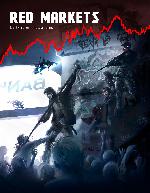
Players who like "fluff" will find a lot of it in the Red Markets book, which does a great job narrating a history of the Crash, the Blight (the zombie plague) and what passes for life in the Loss (the casualty-infested wasteland west of the Mississippi) and in the Recession (what passes as "normal" American society after the Crash). There's way too much of that background for me to summarize it here. Stokes has created a rich game world that casts the players as "Takers," small business owners five years into the apocalypse trying to keep themselves and their dependents alive and relatively sane in the horrors of the Loss. Hell, Takers may even be able cash out one day and retire. But this game doesn't give you anything for free. As Stokes puts it: "Red Markets is basically a poverty simulator that uses zombies to keep its theme from getting too real" (6). The Takers live in one of the many enclaves in the Loss, and leave its relatively safe confines to seek Bounty out in the hellscape of the Loss. Players are encouraged to create their own enclave as part of character generation, but could just as easily use one of the pregenerated ones provided.
The game is powered by the Profit System engine (the GM is called The Market). It is a percentile based system with a twist: players roll a black d10 and a red d10 together. Basically, if the black is higher than the red, the player succeeds. If the red is equal to or higher than the black, the Market wins (and the player fails). Crits occur on double evens and Crit Failures on double odds. To get a boost, you add your skill score to the black and you also can expend resources to get a boost for that roll. Here, the game's themes of scarcity and hard choices works as a nice metagaming mechanic. So, for example, if you want to get a boost to the strength roll to hold the door against a dozen Casualties, you can state that you are using up rations (you're not stopping to eat them, it's the game's way of letting you trade off resources for a better chance of success) to boost the roll. The game uses player-facing mechanics, so the Market never rolls to succeed. It always succeeds unless the players succeed or block the Market. The game has a mechanic called Will, which works like Fortune Points in Warhammer Fantasy or similar mechanics in other games.
Characters are generated with a point-buy system. You start by picking a name (or really, a nickname that you use out in the Loss). You create a soft and a weak spot. Soft spots are beliefs or passions (e.g., loves animals, can't we all be friends?, freedom, social justice) that the Market will use against you in negotiations and that drive your PC. Weak spots are character flaws (vengeful, head in the clouds, arrogant). You then pick a tough spot or roll for it. Tough spots are like background that provides some mechanical drawbacks and benefits. Then you assign stats and skills. You list dependents (you get one for every point of charisma). The you spend your resources on equipment, keeping in mind that equipment has upkeep costs. Come up with your retirement plan and design or pick an enclave and a crew. So, for example, my character's name is Drusilla. Her weak spot is "arrogance." Her soft spot is "puppies deserve protection too!" Her tough spot is Lost, one of the people left behind after the Crash. She gets the +Adapt and -And Die traits, which gives her +2 skill points and she is considered legally dead, which will have implications if she ever wants to make it to the Recession.
So we've put together a crew, statted them out, given them gear packages and generated an enclave. We are now ready to get rich or die trying. Drusilla, the arrogant, shotgun-wielding badass with a weak spot for animals is teaming up with Greasy, Loman and Control (pregens from the core book). They live in Highland, a relatively stable semi-feudal fiefdom in Idaho established by a renegade military officer. It is a thriving enclave with a lot of work for Takers. And they're going to need that work: they've got all kinds of overhead costs and dependents to think about, not to mention retirement plan to finance and bounty for a little R&R to heal from the horrors of the Loss. The game calls these Sustenance, Maintenance and Incidentals. At this point, the players have a couple of options. First, they can generate a Score, which is job that they want to do themselves without a ready-made patron. They make money only if they can retrieve the goods and sell them. So for example, the players might decide that there is actually a cache of batteries out in the Loss that they heard about. For a Score, there are mechanics for determining the supply/demand of the goods in question; the locations of the goods; who the buyer will be and other complicating factors. You would determine what the markets for batteries is, why they haven't been found already, how far away from the enclave, etc. There are rules for allowing Takers to manipulate the market equilibrium (for example, by starting a rumor of battery shortages, etc). The Market would fill in the details and make it unpleasant and dangerous for the Takers.
Second, the Market can present the players with one or more contracts. For this, the Market would need to do a short writeup, which includes the client, the economy in which he or she operaets and the details of the job. Here is an edited version from the core book.
Client: Menace, the Loss's foremost manufacturer of high-end slingshots, is having supply problems. His rubber has gone cracked and dry, slowing production to a halt. He's looking for Takers to solve his problems before his business goes bust. Menace grew up in a rural area with a gun-nut for a father. He hated the damn things: loud, smelly, and dangerous. Weak spot: Hit Your Mark. Soft spot: Odd Ducks. Tough spot: Farming is Beneath Me.
Equilibrium: R5/B10. 15 bounty At Cost. Barely Scarce. Discourage competition to raise.
Economy: Menace operates out of 'Home.' Once a national distribution center for a major home hardware store, survivors have painted over the remainder of the defunct company's name and turned the warehouse complex into a thriving industrial enclave. Competition: Counting Casualties is visiting Home looking for work.
Travel Time: 3 Legs (to be rolled on the encounters table)
The Site: First Joys Manufacturing Division
Complications: The only living souls left at the plant sane enough to communicate coherently are Ma and Pa; this sickly older couple leads a ground of three more Meek cultists leftover from the initial fall of Bounce.
There are mechanics for working out how you reach a price equilibrium with Client uses psychological tricks to push the price down and the Takers using tricks to push it up.
Summary
With the negotiation mini-game, the really amazing random encounter table and the engaged fan base, Red Markets is a really promising game. There are a few editing issues in the book itself, but that hardly detracts from the overall experience. The art is strong throughout and although I have not yet seen the physical book, the .pdf is gorgeous and very well written. It combines the best of old school crunch with new school mechanics to provide players with a great experience for either one-shot play or campaign play. I ran a one shot at GenCon 2018 and it was a lot of fun, with a lot of room for improv on the GM and players' part and great supporting material in the d100 random encounter table. I am looking forward to running my own campaign "Winter Blues" on Roll20 early next year.

