

 Search
Review of Corporia
 Goto [ Index ] |
Disclaimer: I was a backer of Corporia and worked with the author in the past on HackMaster products.
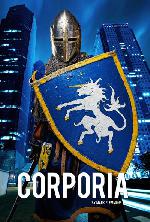
Corporia is a game where Arthurian knights return to save a dystopian corporate world from Chaos and capitalism. Mark Plemmons sets out to create a mechanically simple yet deep system and setting for 'cyberpunk' gaming. Corporia was successfully funded on Kickstarter in 2013; Corporia and its supplements are available through drivethrurpg.com
Corporia is available in a variety of e-book formats and in print. I will be discussing the PDF version. Corporia is a 211-page PDF with six chapters. Later supplements add on to the chapter numbers, making it easy if you pick up more Corporia to find the rules.
In chapter 1, the basic mechanic for Corporia, a 2d6+stat+skill system, is introduced. Fitting the theme, knights and other powerful characters roll 2d6, the Flux dice. The higher of the two dice is used, and if you roll a 6, that's a critical and you get to roll again and keep adding the total. Double 6s on the initial roll are a double critical and grant a 'Flux' point. Double 1s are crashes, so it's simply your stat plus the skill for your total on that roll. Raises make the system more refined and give skilled characters some benefits—either more information or they can choose a hit location without a penalty in combat. Normal characters get only 1d6, so the PCs will win against minor foes where they are skilled. Except for initiative and movement, all character conflict can be settled mechanically by rolling 2d6+stat (core value)+skill. In combat, a character can move and attack, take two move actions, or aim plus perform free actions. So, get two different-colored dice or use a program which shows the dice on a virtual tabletop and you can be seeing if your knight wins in a matter of minutes.
Chapter 2, Human assets is the character creation chapter. Corporia uses archetypes, which are similar to classes, along with a few points for customization. There are 13 archetypes, from the knight-errant who is a reborn knight, to those who use sorcery magic to witchers to celebrities and zeroes. Choose an archetype, each of which has special Assets or discounts on Assets. You then choose how touched by Chaos, the Flux, your knight is. The more Supernatural assets you have, the fewer points you get for skills and ability scores (Core values). There are three levels of Supernatural assets, so if you play the magic-using characters, you would choose between a medium and a high level of magical abilities. The six ability scores are Strength, Deftness, Mettle, Knowledge, Wits and Magic and everyone has some of those traits. Magic is used to resist magic and use magic. Mettle is like Constitution, but also reflects Valor, which is rolled when a character encounters a scary situation to see if they freeze up. Skills are broad, with a few specialties for things such as Science, so you need not worry so much about which skill to take unless you seek hypercompetence.
Chapter 3, Assets, contains many special benefits you can buy. Each character has 10 points for general Assets, and those who have Supernatural Assets get to buy them here. Assets give boosts to rolls, rerolls more money or a safehouse, or powerful magic ability. Hackers can use 'NT3RF4C3' to bring the party into the 'Matrix' as they hack. Assets are clearly explained and well balanced in cost. Magic is also discussed here, with technobabble fiction and clear charts helping you get into the world of magic. Spells have target numbers and are either sorcery or witchcraft disciplines, so your choice of casting should tell you which archetype is going to be more fun to play.
Chapter 4 is the gear chapter. The standard gear a character gets from Knightwatch is listed here in a nice sidebar and there are plenty of guns, wands for wizards and cybernetics to buy. Many are illustrated like in a catalog, so while the chapter is short, it should get you wanting gear.
Chapter 5, The City, is the setting. 22 areas are detailed with a page or so each. The goal is to have a big, evocative city without a specific location. Neighborhoods such as Romero Park and Helfeld nicely evoke zombies and punk rock. A GM can tweak this to fit their group with ease.
Chapter 6 is for GMs. It's a good guide, with the GRAIL system showing you how to make an adventure. Knights should always have options besides a straight-up fight, so investigation is part of GRAIL. Sample foes and 6 mini-adventures help you get started. I really like the random tables and the threat level table; they make it easy to figure out businesses, NPCs and how tough to make the adventure once you get started.
Art is one of the strengths of Corporia. Mark Plemmons has some images of medieval weapons and knightly iconography here, but the focus is on near-future cyberpunk elements. Here his use of stock photos shows a wide variety of characters and scenes. Each archetype has a photo, as does each section of the city. The use of 'magazines,' corporate imagery and advertising brochures further cements the reality.
While Corporia is an a unusual product, bringing Arthurian knights into a cyberpunk setting, the work was ultimately worth doing. Camelot 3000, a comic did this and Babylon 5 played with Arthurian themes in several episodes. The GRAIL system and adventure suggestions, when combined with the artwork, give you an opportunity to become a knight and save the world against the darkness of chaos and the darkness of a corporate dystopia. You get to play heroes and heroines and save the world, but still have to deal with a world that's not as ethical as the Round Table.
Overall, I give Corporia 5 out of 5 on style and 4 out of 5 on substance.

